
Technical publication
Back to publications
Industrial applications
Sonochemical Effect Induced by Hydrodynamic Cavitation
okozyuk.com
Published
Read complete publication for whole-document Find and printing. Browser Find and native printing on this reader include only loaded content.
5 Chemical Mechanisms Generated by Bubble Collapse
The chemical output of cavitation is generated by a sequence of ultrafast reactions inside and around the bubble. The initial step in water is thermal dissociation of water vapor. The products are not released into an inert environment: they immediately react with water, oxygen, nitrogen, other radicals, volatile solutes, and the bubble wall. Consequently, measured hydrogen peroxide or iodide oxidation represents the surviving integrated product of a reaction network, not the instantaneous number of hydroxyl radicals created at minimum radius [3,24,26-27,30-32,38].
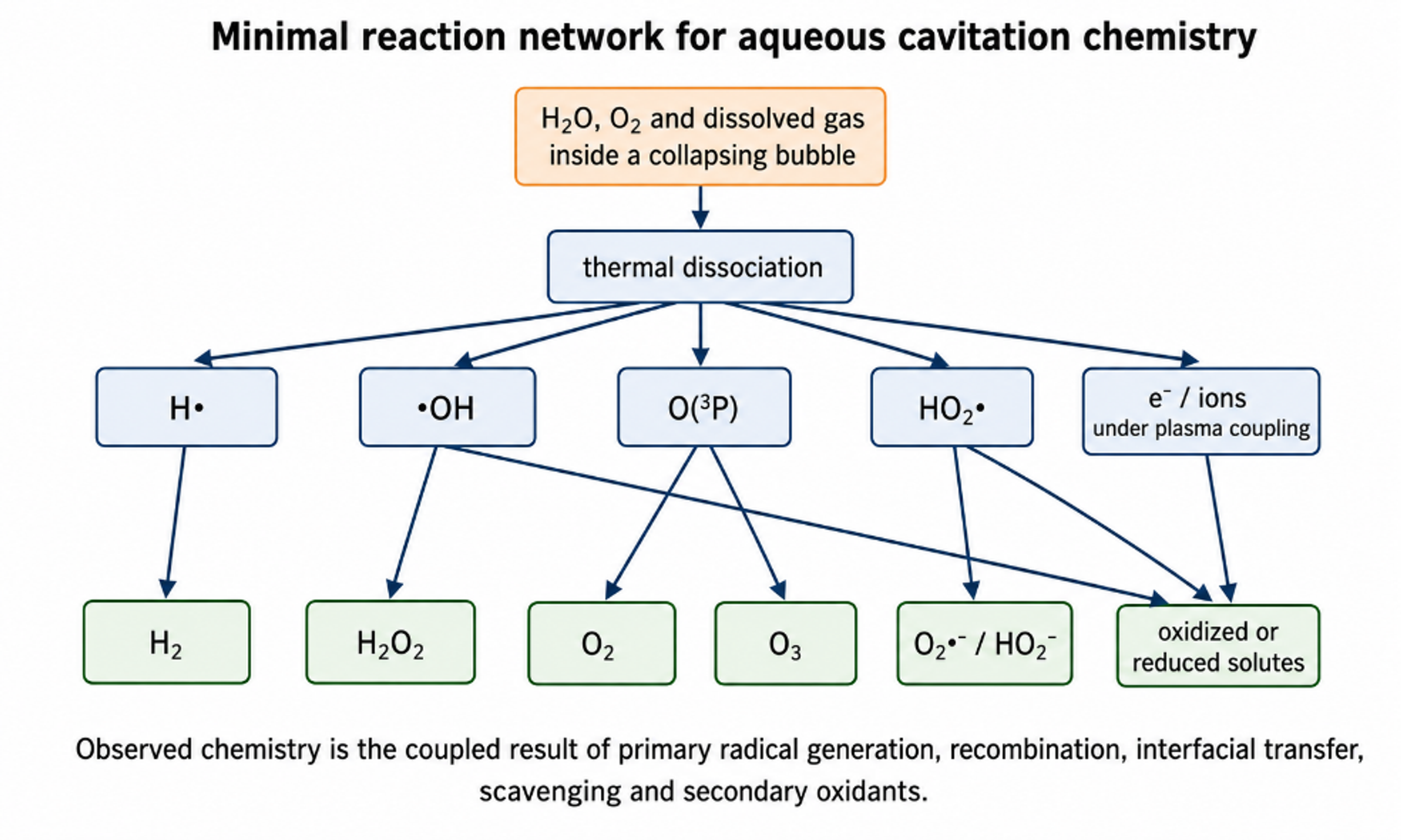
Figure 5.1. Minimal reaction network for aqueous cavitation chemistry. Water and dissolved gas enter a collapsing bubble, radicals form during the hot stage, and longer lived products escape into the liquid [81].
The simplest initiation reaction is:
The energy source is compressional heating and, in extreme cases, electronically excited or plasma like states in the gas vapor core.
Hydroxyl radicals can recombine to form hydrogen peroxide:
Hydrogen atoms can recombine:
In oxygen containing systems, hydrogen atoms form hydroperoxyl radicals:
Hydroperoxyl radicals can produce hydrogen peroxide and oxygen:
At sufficiently high temperature, oxygen atoms and ozone can participate:
where M is a third body that removes excess energy.
The network is strongly temperature dependent. Yasui and coworkers predicted an optimum bubble temperature near 5500 K for oxidant formation in an air bubble because still higher temperatures accelerate nitrogen oxidation and consume useful oxidants [27]. This result is conceptually important: the strongest collapse is not automatically the most productive chemical collapse. A reactor should maximize the net flux of useful species to the liquid, not the unobservable peak temperature.
Table 5.1. Representative aqueous cavitation reactions and engineering significance
| Reaction family | Representative species | Role in process performance | Important sensitivities |
|---|---|---|---|
| Primary thermolysis | H•, •OH | Creates highly reactive reducing and oxidizing radicals | Peak temperature, water vapor fraction, collapse duration |
| Radical recombination | H₂, H₂O₂ | Converts short lived radicals into stable products; can preserve or waste reactivity | Local radical concentration, cluster density, quench rate |
| Oxygen chemistry | HO₂•, O₂•-, O•, O₃ | Extends oxidation beyond the bubble and changes selectivity | Dissolved oxygen, pH, gas composition |
| Nitrogen chemistry | NO, NO₂-, NO₃- | Consumes oxidants but can provide measurable products and alter acidity | Air or N₂ atmosphere, high temperature, oxygen availability |
| Organic radical chemistry | R•, RO•, ROO• | Leads to fragmentation, oxygenation, polymerization, or reduction | Volatility, interfacial adsorption, oxygen level |
| Halide chemistry | Cl•, Cl₂•-, Br•, Br₂•- | Shifts oxidation selectivity and can create halogenated byproducts | Chloride/bromide concentration, pH, radical scavengers |
| Sulfate chemistry | SO₄•- | Provides a longer lived, selective oxidant in activated persulfate systems | Persulfate dose, temperature, catalysts, pH |
A compact rate expression for a dissolved target A separates the three reaction zones:
where each term is an effective volumetric rate associated with gas core pyrolysis, interfacial reaction, or bulk liquid chemistry.
The temperature dependence of an elementary rate constant is commonly represented by the Arrhenius equation:
where A is the pre exponential factor, is activation energy, is the universal gas constant, and T is local temperature.
Equation (5.8) explains the extraordinary reaction acceleration at a hot spot, but it must be applied locally and transiently. The bulk liquid does not attain the bubble core temperature. A process scale rate constant therefore combines a distribution of bubble temperatures, reaction times, active bubble populations, radical escape fractions, and mixing. Assigning the entire reactor a temperature of several thousand kelvin is physically incorrect.
5.1 Volatility, interfacial enrichment, and radical survival
Volatility controls whether an organic molecule can enter the bubble. Highly volatile solutes partition into the gas vapor core and can undergo pyrolysis. Nonvolatile ions and large molecules remain in the liquid and depend on radical transport to the interface or bulk. Surface active molecules can concentrate at the interface, where they may be transformed more rapidly than their bulk concentration predicts. A mechanistic study should therefore report vapor pressure or Henry coefficient, acid base state, octanol water partition tendency where relevant, and surface activity rather than relying only on nominal concentration [3,30,39-41].
Radical survival is controlled by competition. Hydroxyl radicals react close to their formation site because their rate constants with many solutes and scavengers approach diffusion control. At high bubble density, radicals created by neighboring collapses can recombine before contacting the target. At high target concentration, the target itself may intercept more radicals, but it can also reduce vapor pressure, change interfacial properties, or attenuate cavitation. The resulting conversion versus concentration curve can be nonlinear and may show an optimum.
| Critical distinction: Hydrogen peroxide yield is a useful integrated indicator of cavitation chemistry, but it is not identical to hydroxyl radical production. High H₂O₂ can indicate efficient radical escape and recombination, while rapid reaction with a target or catalyst can produce low measured H₂O₂ even when radical generation is high. |
|---|