
Technical publication
Back to publications
Industrial applications
Sonochemical Effect Induced by Hydrodynamic Cavitation
okozyuk.com
Published
Read complete publication for whole-document Find and printing. Browser Find and native printing on this reader include only loaded content.
4 Effect of Gas Type on Adiabatic Bubble Collapse
Dissolved gas determines more than the initial number of nuclei. Gas identity changes the heat capacity ratio, thermal conductivity, diffusivity, solubility, ionization energy, chemical reactivity, and the rate at which the bubble exchanges mass with the liquid. These properties jointly control collapse temperature, luminescence, radical production, and product selectivity. The strongest ideal compression is associated with a large γ, but the highest chemical yield does not necessarily occur for the gas with the largest γ because thermal transport, vapor content, gas chemistry, and bubble stability can dominate [4,25,27-29].
For an ideal mixture with mole fractions and molar heat capacities and , an effective heat capacity ratio can be estimated by:
where is the gas phase mole fraction of species i.
The effective exponent during a real collapse is frequency and time scale dependent. Slow oscillation permits heat exchange and drives the behavior toward isothermal compression. Rapid terminal compression moves the gas core toward adiabatic behavior while retaining a thermal boundary layer. A gas phase Peclet number expresses the competition:
where is gas thermal diffusivity. Large indicates interface motion faster than thermal diffusion across the bubble radius.
A second useful descriptor is the initial noncondensable gas fraction relative to total bubble contents:
where is moles of noncondensable gas and is moles of vapor.
A large increases the gas spring and can prevent complete collapse, while a very small allows intense compression but may produce an unstable cavity with limited chemical feedstock and weak rebound. In practical reactors, gas concentration also affects nucleation density. Degassing may intensify the collapse of the few remaining bubbles but reduce the number of active events. Gas sparging may create more nuclei and improve oxygen supply, yet excessive gas loading can cushion collapse and produce persistent gas holdup. Optimization therefore requires both per bubble intensity and active bubble population.
Table 4.1. Qualitative influence of common gases on cavitation chemistry
| Gas | Key physical properties | Likely collapse effect | Chemical implications |
|---|---|---|---|
| Argon | Monatomic, high γ, relatively low thermal conductivity, chemically inert | Strong compressional heating and stable spectroscopic emitter | Often favors high hot spot temperature and radical yield; widely used reference gas |
| Xenon | Monatomic, high polarizability, low ionization energy, high molar mass | Can enhance light emission and alter plasma chemistry | Potentially strong excitation but high solubility and cost limit process use |
| Helium | Monatomic but very high thermal conductivity and diffusivity | Rapid heat loss can offset the high γ | Can reduce hot spot temperature compared with argon under otherwise similar conditions |
| Nitrogen | Diatomic, γ near 1.4, chemically reactive at high temperature | Lower ideal heating than monatomic gas | Can form NO, NO2-, and NO3-; competes for oxidants at high temperature |
| Oxygen | Diatomic and reactive | Supports oxygen radical pathways | Promotes HO2•, O2•-, peroxide, and oxidation; may also quench excited states |
| Air | N2/O2 mixture with water vapor | Practical compromise between nuclei, oxygen supply, and thermal softness | Produces mixed oxygen- and nitrogen derived chemistry |
| Carbon dioxide | High solubility, polyatomic, lower effective γ, acidifies water | Strong thermal and chemical damping | Often suppresses hot spot temperature; generates carbonate/bicarbonate chemistry |
| Hydrogen | High diffusivity and thermal conductivity; combustible | Rapid transport and heat loss | Strong reducing radical chemistry but major safety constraints |
| Steam rich bubble | High polyatomic vapor fraction | Substantial cushioning and endothermic dissociation | Provides H• and •OH precursor but can lower temperature and oxidant survival |
Rare gas experiments in acoustic cavitation are especially valuable because they isolate the effect of heat capacity and thermal transport. McNamara and coworkers measured emission temperatures between approximately 2300 and 5100 K as gas vapor composition was varied [25]. Okitsu and coworkers showed that the relationship between rare gas atmosphere and chemical yield is not governed by temperature alone [28]. The transferable lesson for hydrodynamic cavitation is that gas composition must be treated as a process variable, not merely as an uncontrolled liquid property.
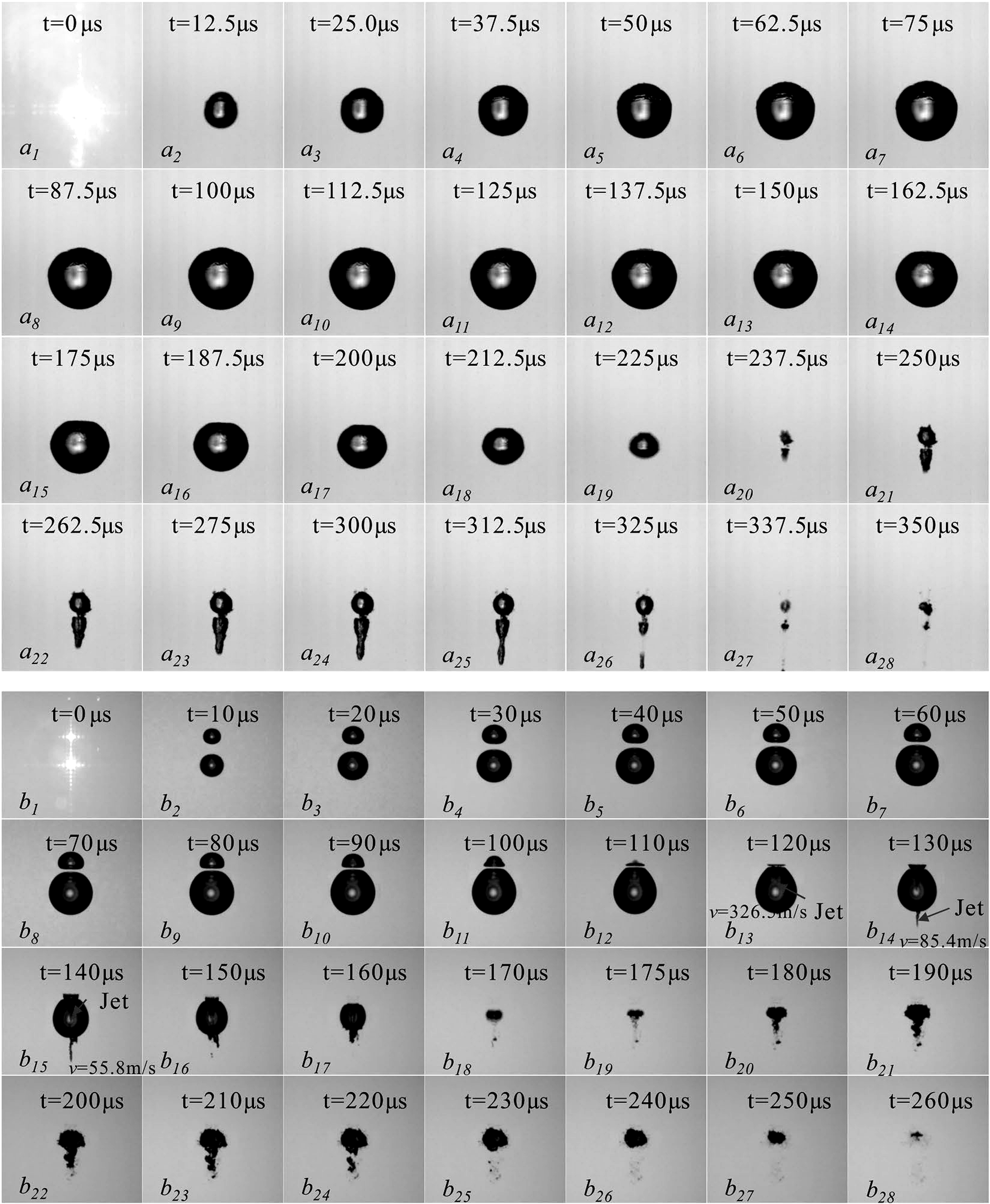
Figure 4.1. High speed image sequences showing interaction, deformation, jetting, and collapse of two cavitation bubbles. [36]. The sequence illustrates why neighboring bubbles change collapse symmetry and energy focusing.
Bubble interaction can overwhelm the single bubble gas effect. Neighboring cavities modify the pressure field, exchange shock waves, coalesce, and collapse asymmetrically. The high speed sequences in Figure 4.1 show that spacing and relative size can redirect jets and distribute shock emission over multiple events [36]. In a dense hydrodynamic cloud, increasing inlet pressure may increase vapor volume while decreasing the chemical yield per unit energy because shielding, coalescence, and radical recombination become stronger [11].

Figure 4.2. Representative high speed images of cavitation bubble clusters generated by focused shock waves at different operating conditions. [37].
Fattahi and coworkers quantified chemistry in controlled bubble clusters and found a maximum conversion of focused shock wave energy to chemical energy at an intermediate cluster energy density, rather than at the largest cluster [37]. Their result was obtained with acoustically or laser mediated cluster generation, but it directly informs hydrodynamic cloud design: more bubbles are useful only while each bubble retains sufficient collapse intensity and products can escape the cluster without immediate recombination.
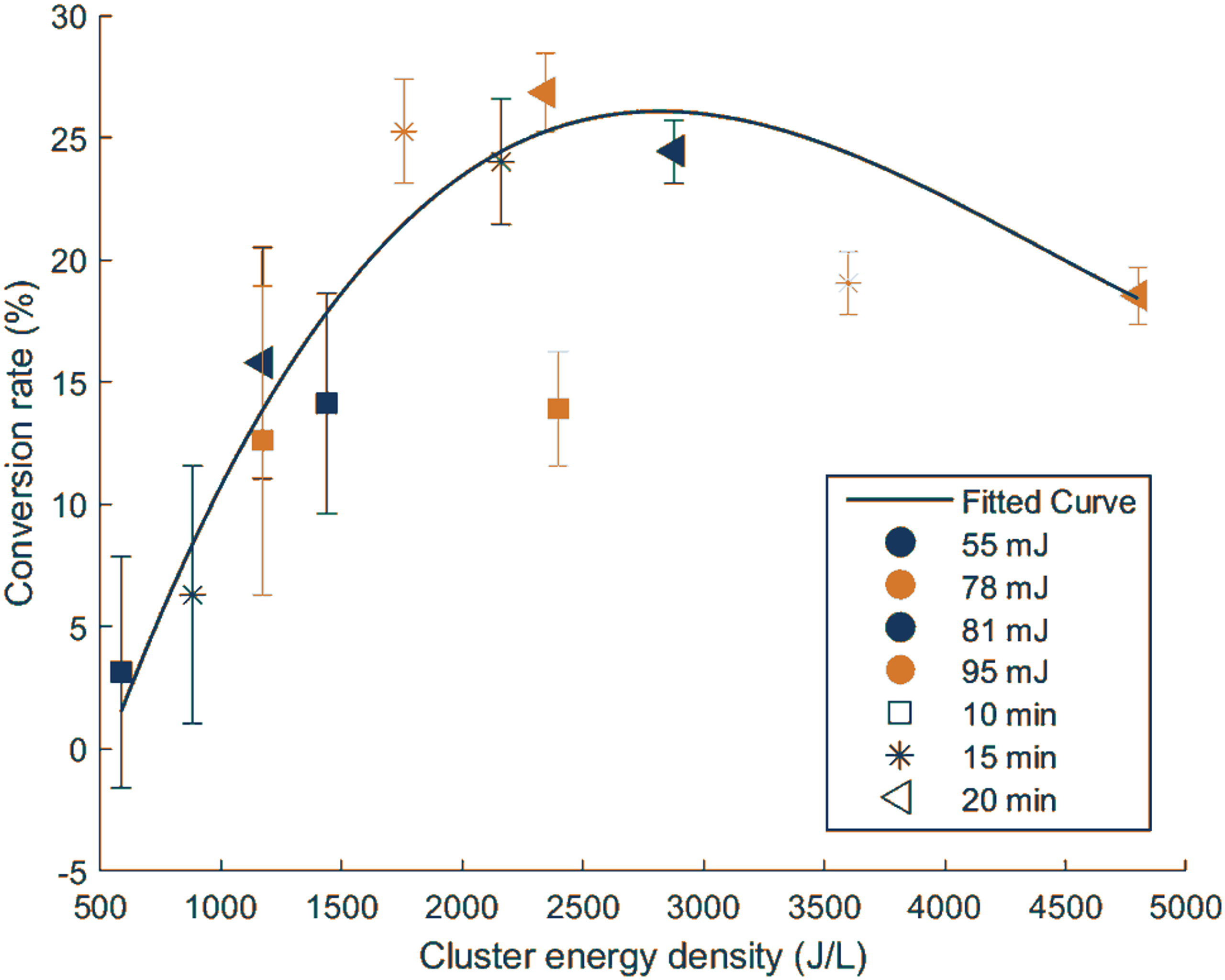
Figure 4.3. Measured conversion of focused shock wave energy to chemical energy as a function of cluster energy density. [37].
Table 4.2. Gas management strategies for hydrodynamic cavitation reactors
| Strategy | Potential benefit | Potential penalty | Recommended verification |
|---|---|---|---|
| Operate air saturated | Simple and reproducible in open systems | Gas content changes with temperature and pressure history | Measure dissolved oxygen and temperature before each run |
| Argon saturation | Can increase per bubble hot spot intensity | Cost, gas consumption, and possible reduction in oxygen chemistry | Compare radical yield per joule and not conversion alone |
| Oxygen sparging | Raises dissolved oxygen and can support secondary oxidation | Excess gas holdup cushions collapse and changes pump behavior | Measure void fraction, pressure drop, off gas, and oxidant yield |
| Partial degassing | May reduce cloud shielding and intensify remaining collapses | Reduces nucleation population and can delay inception | Measure inception pressure, bubble count, and chemical yield |
| CO2 addition | Controls pH and may assist carbonate chemistry | Thermally damps collapse and scavenges •OH through bicarbonate/carbonate | Track inorganic carbon, pH, and product selectivity |
| Closed loop gas control | Enables repeatable composition and mass balance | Requires gas liquid equilibrium control and safety instrumentation | Use gas analysis, pressure control, and leak testing |