
Technical publication
Back to publications
Industrial applications
Sonochemical Effect Induced by Hydrodynamic Cavitation
okozyuk.com
Published
Read complete publication for whole-document Find and printing. Browser Find and native printing on this reader include only loaded content.
3 Adiabatic Bubble Collapse and Temperature
Adiabatic compression is the simplest upper bound model for collapse heating. It assumes that the noncondensable gas behaves ideally, compression is sufficiently rapid that no heat leaves the gas, the amount and composition of gas remain constant, and chemical reactions do not consume energy. For a gas with heat capacity ratio γ, pressure and volume satisfy:
where is noncondensable gas pressure, V is bubble volume, and γ = /.
The corresponding temperature volume relation is:
where T is the gas temperature.
For a spherical bubble with V proportional to R³, the ideal temperature amplification from an initial radius to a minimum radius is:
where is the initial gas temperature. In a growth collapse cycle, is often replaced by for an illustrative compression ratio.
The ideal pressure amplification is even steeper:
where is the corresponding initial gas pressure.
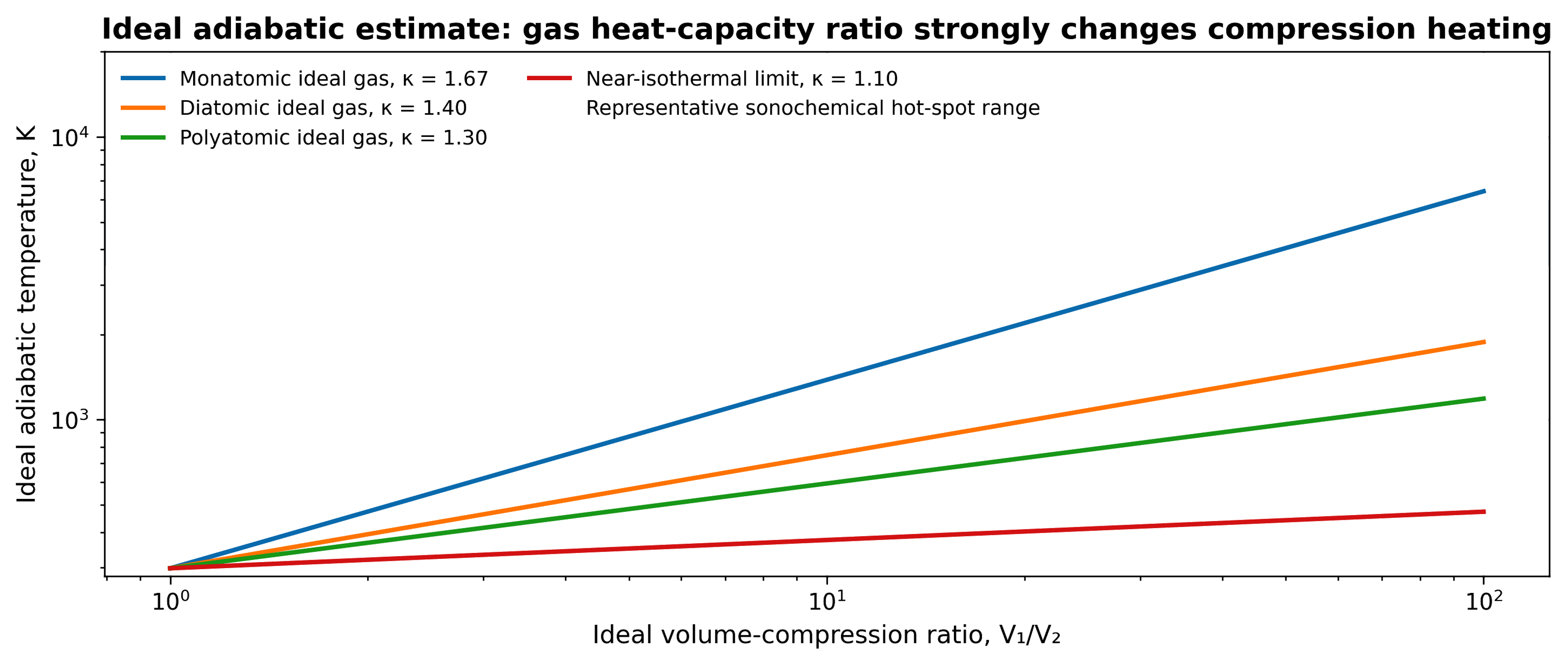
Figure 3.1. Ideal adiabatic temperature amplification as a function of volume compression ratio for representative heat capacity ratios. Calculation from Equation (3.2) [81].
Figure 3.1 demonstrates why small differences in γ matter. Monatomic gases with γ near 5/3 produce a stronger ideal temperature increase than diatomic gases with γ near 1.4 or polyatomic vapors with lower effective γ. However, the graph intentionally omits the most important real bubble losses. Water vapor condenses, dissociates, and absorbs energy; heat flows into the liquid; the gas may not remain spatially uniform; internal shocks can form; and the bubble can become nonspherical. Thus, a large ideal value is evidence of the strength of geometric focusing, not a literal uniform temperature [24-29].
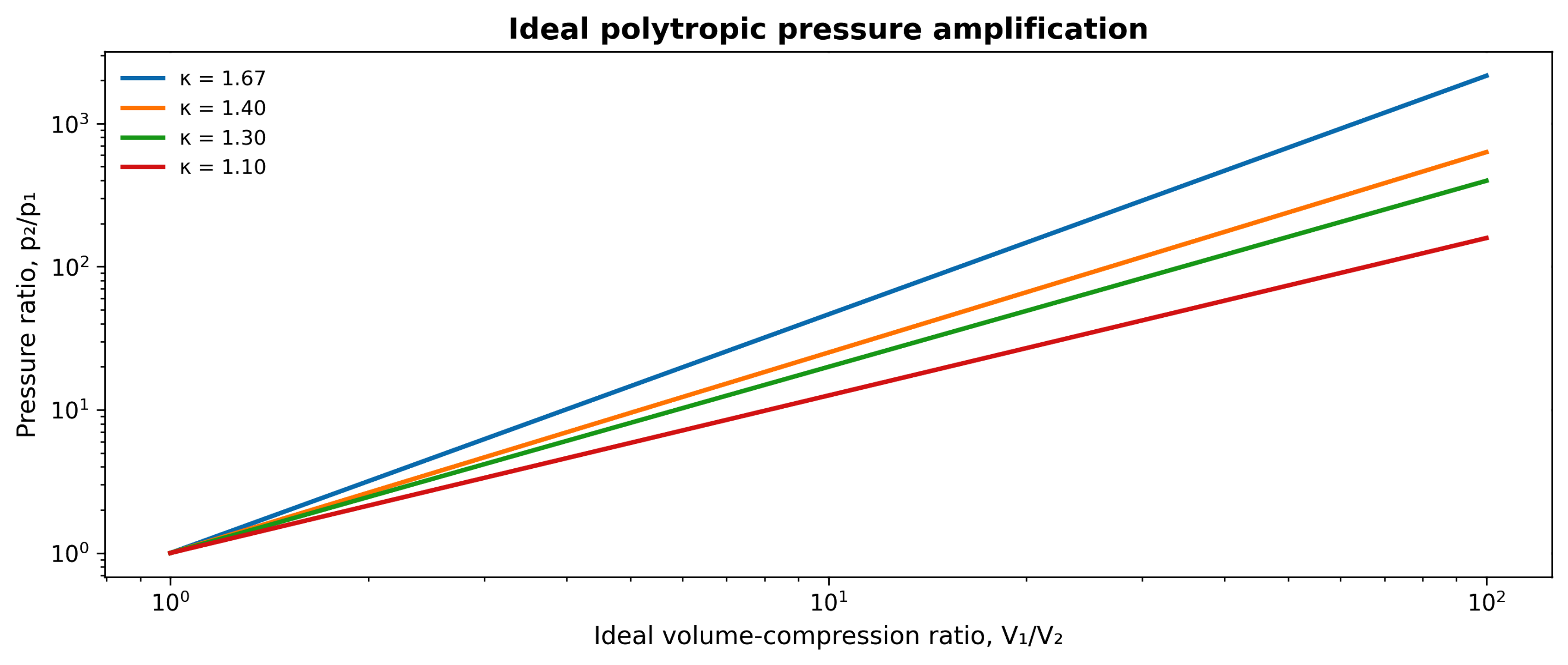
Figure 3.2. Ideal polytropic pressure amplification for several compression exponents. Calculation from Equation (3.4). Real collapse pressure is limited by liquid compressibility, phase change, gas chemistry, and geometry [81].
At extreme compression, finite molecular size can be represented by a hard core radius h. A commonly used van der Waals type correction replaces R³ by R³, h³:
where h is an effective hard core radius below which the gas volume cannot contract in the idealized model.
The reversible work of polytropic compression between states 1 and 2 is:
where n is the polytropic exponent; n = γ for ideal adiabatic compression and n approaches 1 for isothermal compression.
The work in Equation (3.6) is partitioned among gas internal energy, chemical dissociation, heat transfer, acoustic radiation, shock waves, liquid kinetic energy, rebound, and deformation. A model that reproduces radius time data can still predict the wrong chemistry if it uses an oversimplified energy balance. For sonochemical calculations, the bubble pressure equation must be coupled to vapor transport and a reaction mechanism; for engineering design, it is usually more reliable to calibrate the model against both physical and chemical observables [12,24,26-27,35].
Table 3.1. Assumptions in the ideal adiabatic estimate and their real bubble consequences
| Ideal assumption | Real behavior | Expected influence on peak state |
|---|---|---|
| No heat transfer | Gas and vapor conduct heat to a cold liquid boundary layer | Reduces core temperature and increases thermal damping |
| Fixed gas mass | Gas diffusion and vapor evaporation/condensation occur | Changes pressure support, heat capacity, and composition |
| No phase change | Water vapor can condense during compression | Removes vapor mass but releases latent heat near the wall |
| No chemistry | Dissociation and ionization consume energy | Caps temperature and changes radical inventory |
| Uniform core | Temperature and composition gradients and internal shocks develop | Creates local hot regions rather than one uniform state |
| Spherical collapse | Neighboring bubbles, walls, vortices, and pressure gradients deform the cavity | Redirects energy into jets and lowers thermal focusing |
| Ideal gas | High density and finite molecular volume become important | Limits compression and modifies pressure temperature relation |
3.1 Water vapor as a thermochemical moderator
The total pressure inside an aqueous cavitation bubble is commonly represented as the sum of noncondensable gas and vapor contributions:
where is total internal pressure, is noncondensable gas partial pressure, and is water vapor partial pressure.
Water vapor is necessary for hydroxyl radical formation, but excessive vapor lowers collapse temperature. It increases the heat capacity of the bubble contents, undergoes endothermic dissociation, and may not condense rapidly enough to leave the core before the strongest compression. Storey and Szeri showed that nonequilibrium vapor transport strongly constrains the peak state [24]. The resulting design problem is nonmonotonic: a bubble must contain enough water vapor to provide reactive feedstock, but not so much that the collapse is cushioned and the gas mixture becomes thermally soft.
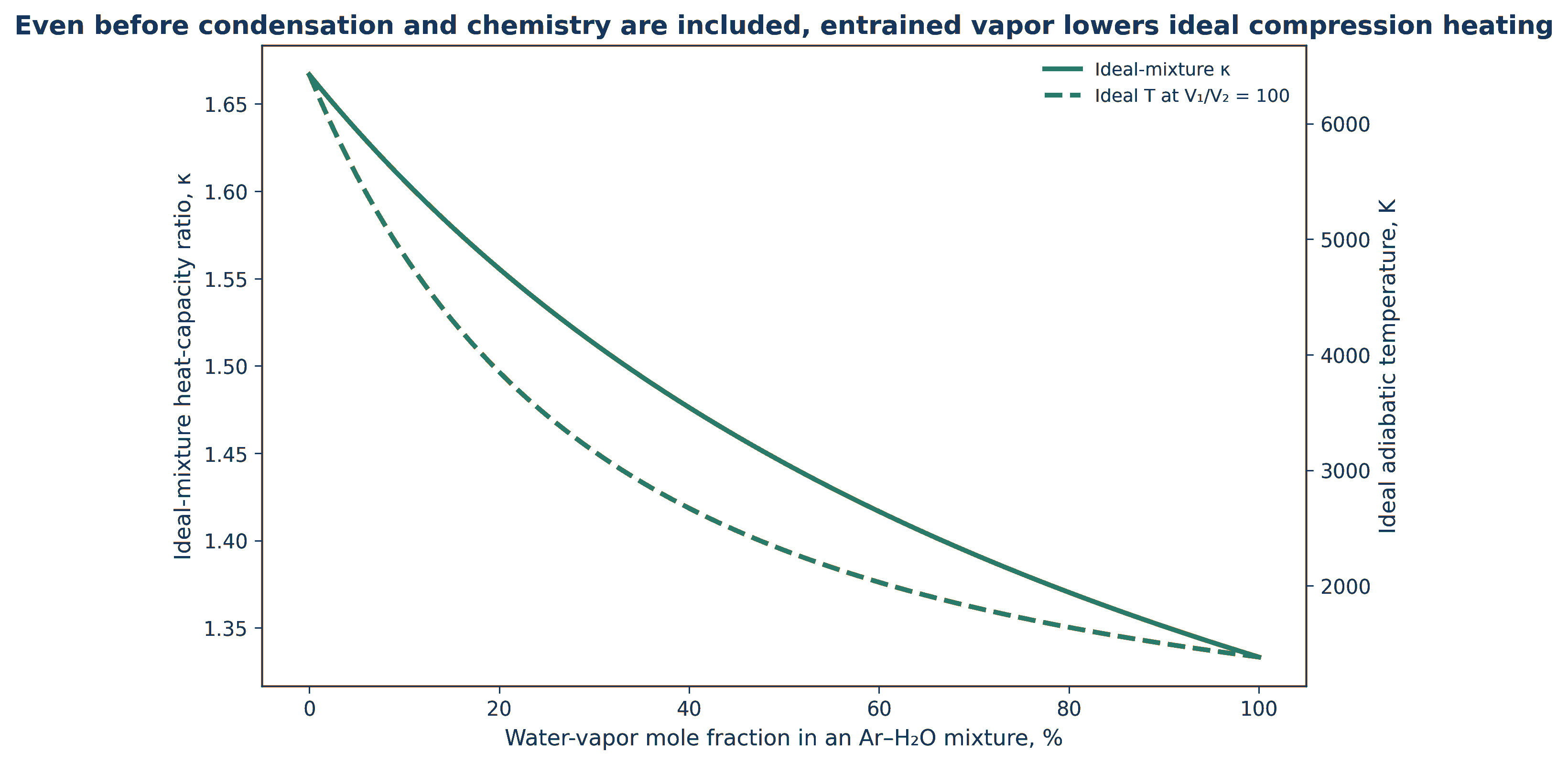
Figure 3.3. Illustrative sensitivity of ideal compression heating to entrained water vapor and associated thermochemical damping. Calculation based on [24-29]. The curve is intended to show direction and nonlinearity rather than a universal quantitative law.
A compact statement of the bubble energy balance is:
where U is internal energy, is heat transfer into gas, represents enthalpy carried by species crossing the interface, and V represents energy consumed or released by reaction r.
Equation (3.8) shows why an adiabatic relation is an upper bound. During collapse, - dV/dt is positive and compressive, but heat loss, condensation, dissociation, and radical chemistry can absorb a substantial fraction. During rebound, energy returns to the liquid or remains as a smaller gas vapor cavity. The chemical products that survive are therefore only one branch of the total collapse energy partition [26].
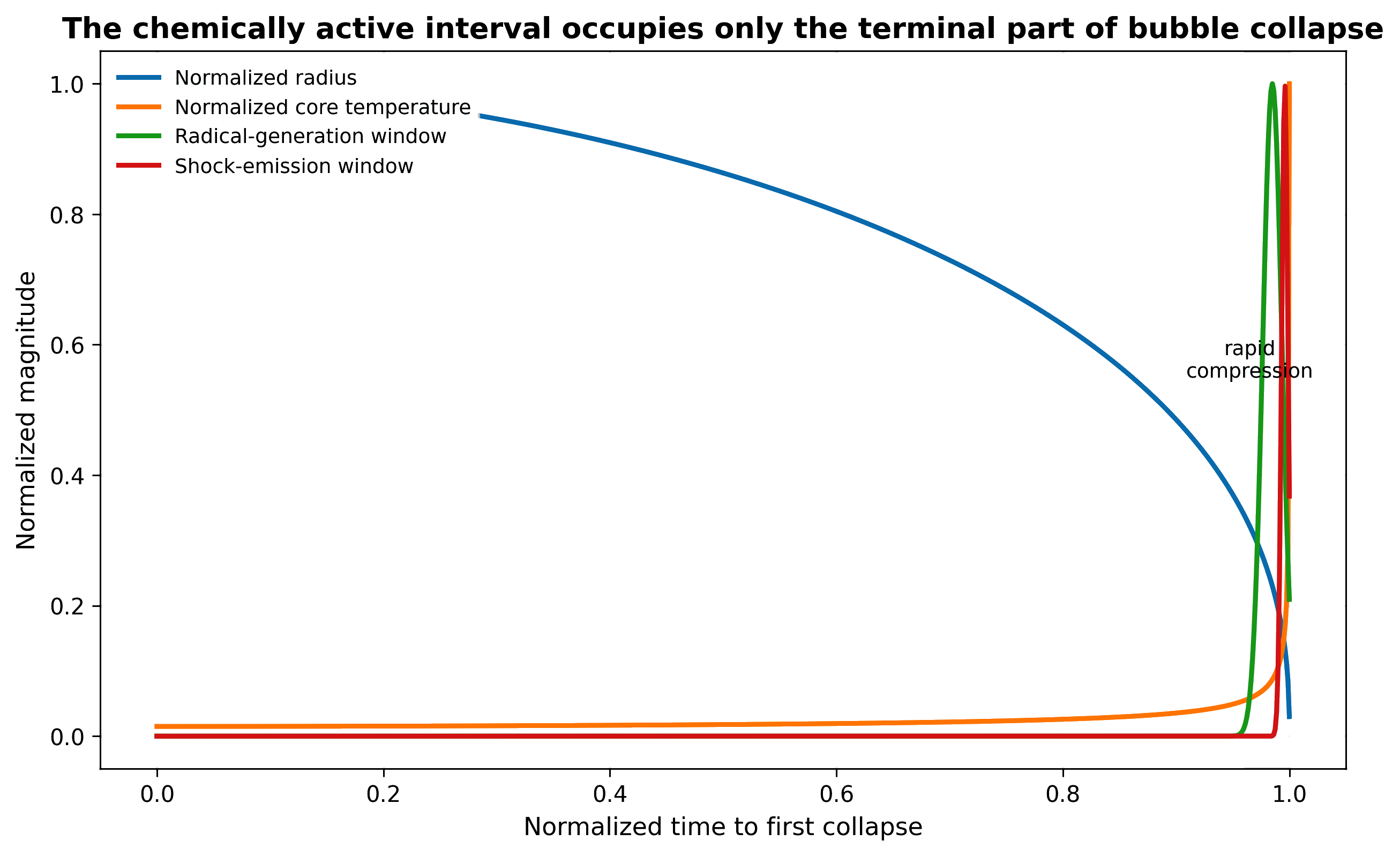
Figure 3.4. The chemically active interval occupies only the terminal portion of a bubble collapse. Radius changes over the full collapse time, while temperature and radical production rise sharply near minimum volume [81].