
Technical publication
Back to publications
Industrial applications
Sonochemical Effect Induced by Hydrodynamic Cavitation
okozyuk.com
Published
Read complete publication for whole-document Find and printing. Browser Find and native printing on this reader include only loaded content.
2 Bubble Dynamics and the Three Zone Model of Cavitation Chemistry
The chemical microreactor is created during the final fraction of the collapse. A bubble first grows because the external pressure falls and vapor or gas enters the cavity. When the external pressure recovers, the surrounding liquid accelerates inward. The inertia of this liquid can carry the interface far beyond quasistatic equilibrium, compressing noncondensable gas and residual vapor into a very small volume. Liquid compressibility, shock formation, heat conduction, condensation, evaporation, diffusion, chemical reactions, and nonspherical deformation become increasingly important as the radius approaches its minimum [1-2,24,33-35].
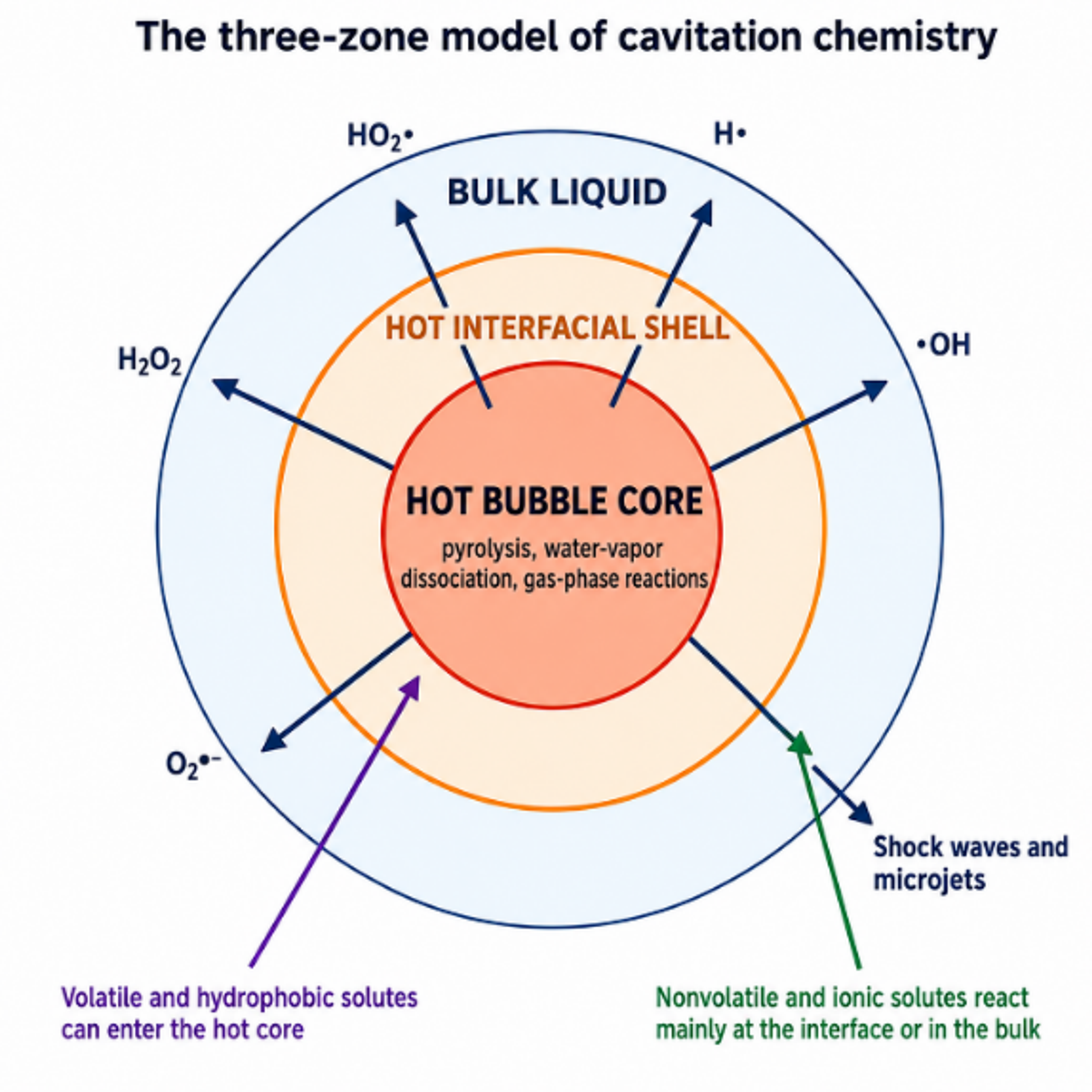
Figure 2.1. Three zone model of cavitation chemistry: gas vapor core, hot interfacial shell, and surrounding bulk liquid [81].
The three zone model in Figure 2.1 is a practical framework for predicting where a reactant will be transformed. Volatile molecules can enter the bubble during growth and undergo pyrolysis or radical attack in the gas vapor core. Nonvolatile ionic species remain in the liquid and react mainly in the interfacial shell or bulk. Moderately volatile amphiphilic molecules can accumulate at the interface, where they experience high radical flux and strong thermal gradients. The interface is not a geometrically sharp reaction surface; it is a transient region with steep temperature, density, and composition gradients.
For a spherical bubble in an incompressible liquid, the classical Rayleigh Plesset equation provides the baseline dynamic balance. It is not adequate for the last instants of a strongly compressible collapse, but it organizes the effects of pressure, gas compression, viscosity, and surface tension:
where R is bubble radius, is pressure inside the bubble, is far field liquid pressure, S is surface tension, μ is dynamic viscosity, and overdots denote time derivatives.
When vapor and gas pressure are neglected, the classical Rayleigh collapse time of an empty spherical cavity of maximum radius under constant driving pressure Δp
where is the first collapse time and Δp is the pressure difference driving collapse.
Equation (2.2) shows why the event is short. A 100 µm cavity collapsing under a 100 kPa pressure difference has a Rayleigh time of approximately 9 µs. The chemically active compression stage occupies only a small fraction of that interval. Consequently, high peak temperature alone is not enough: reaction rates must be fast on nanosecond to microsecond scales, and products must escape recombination during the subsequent quench.
Table 2.1. Chemical characteristics of the bubble core, interfacial shell, and bulk liquid
| Region | Approximate condition | Species favored | Typical reactions | Controlling transport |
|---|---|---|---|---|
| Gas vapor core | Highest transient temperature; low total mass; strong composition change | H•, •OH, O, excited atoms, volatile organic radicals, NOx intermediates | Thermolysis, pyrolysis, gas phase recombination | Evaporation, condensation, gas diffusion, internal shocks |
| Interfacial shell | High temperature gradient and high radical concentration | •OH, H•, organic radicals, solvated products | Hydrogen abstraction, addition to double bonds, electron transfer | Radical diffusion, adsorption, interfacial accumulation |
| Bulk liquid | Near ambient mean temperature with turbulent mixing | H2O2, O3 where formed, HO2•/O2•-, secondary radicals | Advanced oxidation, reduction, hydrolysis, catalyst reactions | Convection, molecular diffusion, scavenging, phase transfer |
| Solid or droplet boundary | Microjet, shock, shear, freshly exposed surface | Surface radicals, lattice defects, active catalytic sites | Heterogeneous oxidation, nucleation, fragmentation | Impact, erosion, wetting, boundary layer renewal |