
Technical publication
Back to publications
Industrial applications
Sonochemical Effect Induced by Hydrodynamic Cavitation
okozyuk.com
Published
Read complete publication for whole-document Find and printing. Browser Find and native printing on this reader include only loaded content.
1 Introduction
This article applies standard hydraulic definitions, energy boundaries, residence time expressions, uncertainty requirements, and scale translation principles to the sonochemical effects induced by hydrodynamic cavitation. The discussion develops the relevant mechanisms, models, measurement methods, reactor design principles, and acceptance criteria.
Cavitation is the formation, growth, and collapse of vapor filled or gas vapor cavities when the local liquid pressure is reduced sufficiently below the pressure required to sustain the continuous liquid phase. In a hydrodynamic cavitation reactor, the pressure reduction is generated by fluid acceleration, streamline curvature, vortex formation, rotor motion, or a combination of these mechanisms. A restriction, Venturi throat, orifice, vortex core, valve trim, rotor stator gap, or specially profiled passage produces a low pressure interval in which preexisting nuclei grow. Downstream pressure recovery then drives collapse. This sequence is mechanically different from acoustic cavitation, where an oscillating sound field repeatedly supplies tensile and compressive half cycles, but the terminal collapse of a sufficiently inertial bubble can create closely related physical and chemical microenvironments [1-10].
The term sonochemical effect is retained because the relevant chemistry was first established and most extensively characterized in ultrasonic fields. It should not be interpreted to mean that sound waves are required. Hydrodynamic cavitation can induce the same primary radical generating reactions, including water vapor dissociation and secondary peroxide formation. Suslick, Mdleleni, and Ries demonstrated that hydrodynamically induced chemistry responds to dissolved gas and liquid temperature in ways analogous to acoustic sonochemistry [4]. Subsequent hydrodynamic studies quantified iodide oxidation, hydroxyl radical production, and pollutant degradation in orifice, Venturi, vortex, and microscale devices [5-6,11-15]. The reaction mechanism may therefore be chemically analogous while reactor yield, selectivity, and energy efficiency remain device specific.
For engineering analysis, cavitation inception and severity are commonly summarized by the cavitation number. Because definitions vary among device classes, the pressure and velocity locations used in the ratio must always be stated. A practical form based on a selected downstream reference pressure and throat velocity is:
where σ is the cavitation number, is the selected downstream or recovered pressure, is liquid vapor pressure, ρ is liquid density, and is the characteristic throat or minimum passage velocity. A lower value generally increases the probability and extent of cavitation, but σ alone does not specify the duration of the low pressure interval, the pressure recovery gradient, bubble cloud density, or collapse location.
The pressure reduction itself follows the mechanical energy balance. Between two stations of a flowing liquid, including irreversible head loss , the balance may be written as:
where p is static pressure, u is mean velocity, z is elevation, g is gravitational acceleration, and is irreversible head loss expressed as liquid head. Equation (1.2) emphasizes that a cavitation device does not create energy. It converts pump work and pressure head into acceleration, turbulence, phase change, and pressure recovery. Only a fraction of that energy reaches chemically productive bubble collapses.
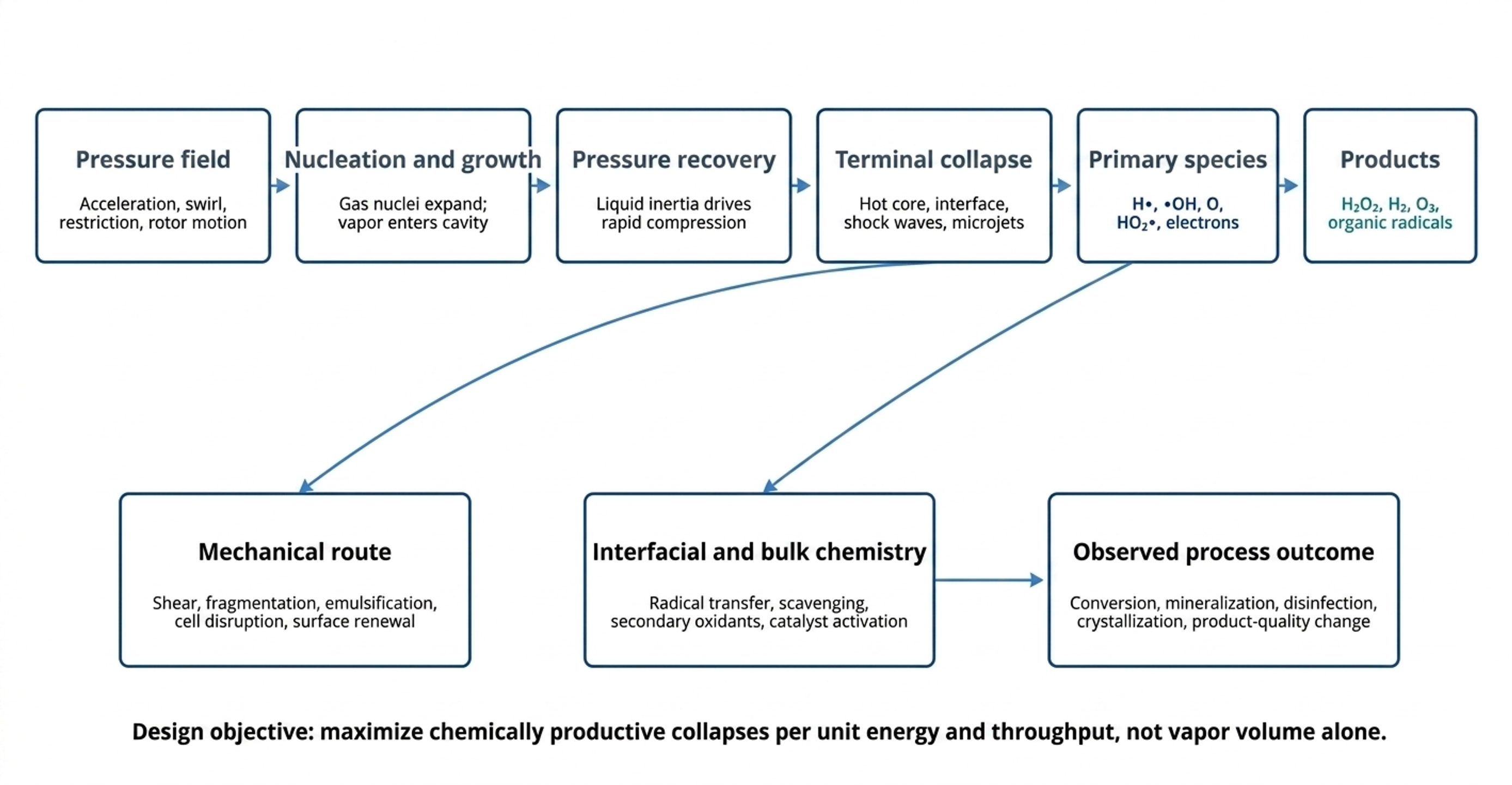
Figure 1.1. Integrated mechanism map for the sonochemical effect induced by hydrodynamic cavitation [81].
Figure 1.1 separates the pressure field mechanism from the observed process result. This distinction is necessary because a large conversion increase may arise from direct radical chemistry, mechanical interfacial renewal, or a combination of both. The same device can therefore be highly effective for emulsification or cell disruption while producing a modest stable oxidant yield.
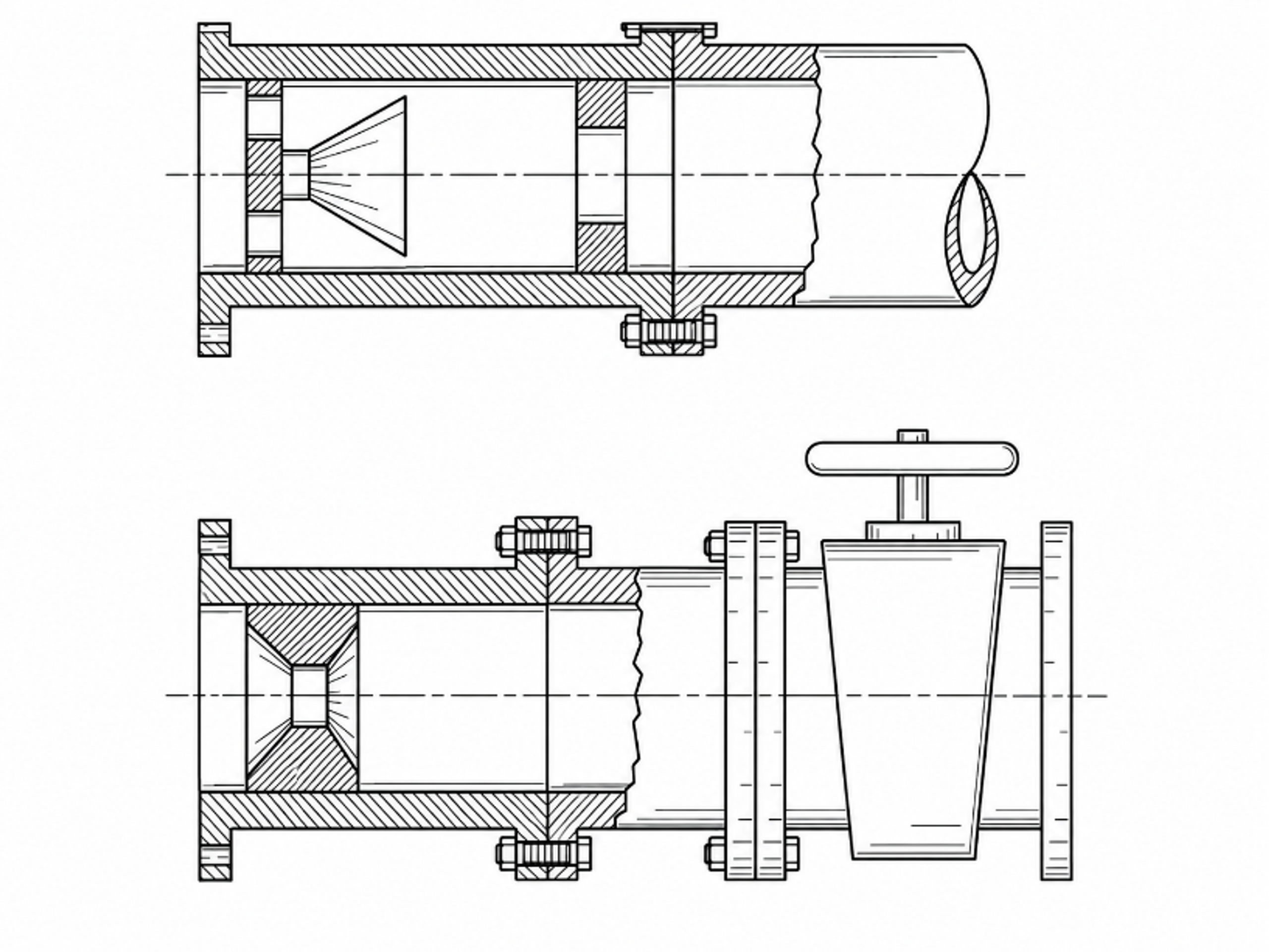
Figure 1.2. Controlled flow apparatus for generating cavities in a local constriction and collapsing them in a downstream elevated pressure region. [16].
The apparatus concept in Figure 1.2 makes the sequence explicit: a local restriction generates a cavitation cavern, the cavities are convected downstream, and a separate hydraulic resistance or recovery zone raises static pressure to initiate collapse. This separation of inception and collapse zones is a recurring design principle in later multistage, vortex, and microfluidic devices [15-17].
Table 1.1. Evidence chain for identifying a genuine hydrodynamic sonochemical effect
| Stage | Required evidence | Chemical significance | Recommended measurement |
|---|---|---|---|
| Hydrodynamic forcing | Defined pressure drop, throat velocity, pressure time history | Establishes whether nuclei experience a low pressure growth interval | Calibrated pressure sensors, flow rate, temperature |
| Cavity formation | Vapor or gas vapor population in the predicted low pressure zone | Confirms phase change or gas release rather than turbulence alone | High speed imaging, acoustic emission, void fraction |
| Collapse and energy focusing | Pressure recovery, shock emission, microjets, rebound or luminescence | Provides a physical route to local heating and bond cleavage | Hydrophone or pressure transducer, high speed imaging, erosion witness |
| Primary chemistry | Radical specific or radical sensitive chemical signal | Demonstrates reactive species formation | Coumarin, salicylic acid, iodide, luminol, EPR where available |
| Process outcome | Mass balance, intermediates, mineralization, selectivity or biological response | Connects cavitation chemistry to the target process | HPLC, LC MS, TOC, spectroscopy, microbiology |
| Energy performance | Yield normalized to a declared hydraulic and electrical boundary | Prevents high conversion at high energy from being misidentified as efficient | mol J⁻¹, g J⁻¹, kWh m⁻³, throughput per reactor volume |
1.1 Terminology and scope
The phrase chemical effect of cavitation includes several mechanisms that should be separated. Thermal chemistry occurs in the compressed gas vapor core. Interfacial chemistry occurs in the hot, high gradient liquid shell surrounding the bubble. Bulk liquid chemistry is driven by radicals and longer lived products transported away from the collapse. Mechanical chemistry includes reactions accelerated indirectly by emulsification, particle fracture, oxide removal, catalyst activation, cell disruption, and renewal of phase boundaries. A process may show a large conversion increase even when the direct radical yield is modest, because cavitation simultaneously changes mass transfer, local composition, and available surface area [3,18-23].
For aqueous advanced oxidation, hydroxyl radicals are often treated as the principal species. This is useful but incomplete. Hydrogen atoms, hydroperoxyl and superoxide radicals, oxygen atoms, ozone under some gas compositions, hydrogen peroxide, nitrogen derived species, chlorine radicals in saline water, sulfate radicals when persulfate is present, and organic radicals formed from volatile solutes can all contribute. The observed pathway is therefore a network whose dominant branch depends on bubble temperature, gas atmosphere, solute location, pH, ionic strength, and the time between radical creation and reaction [24-32].