
Technical publication
Back to publications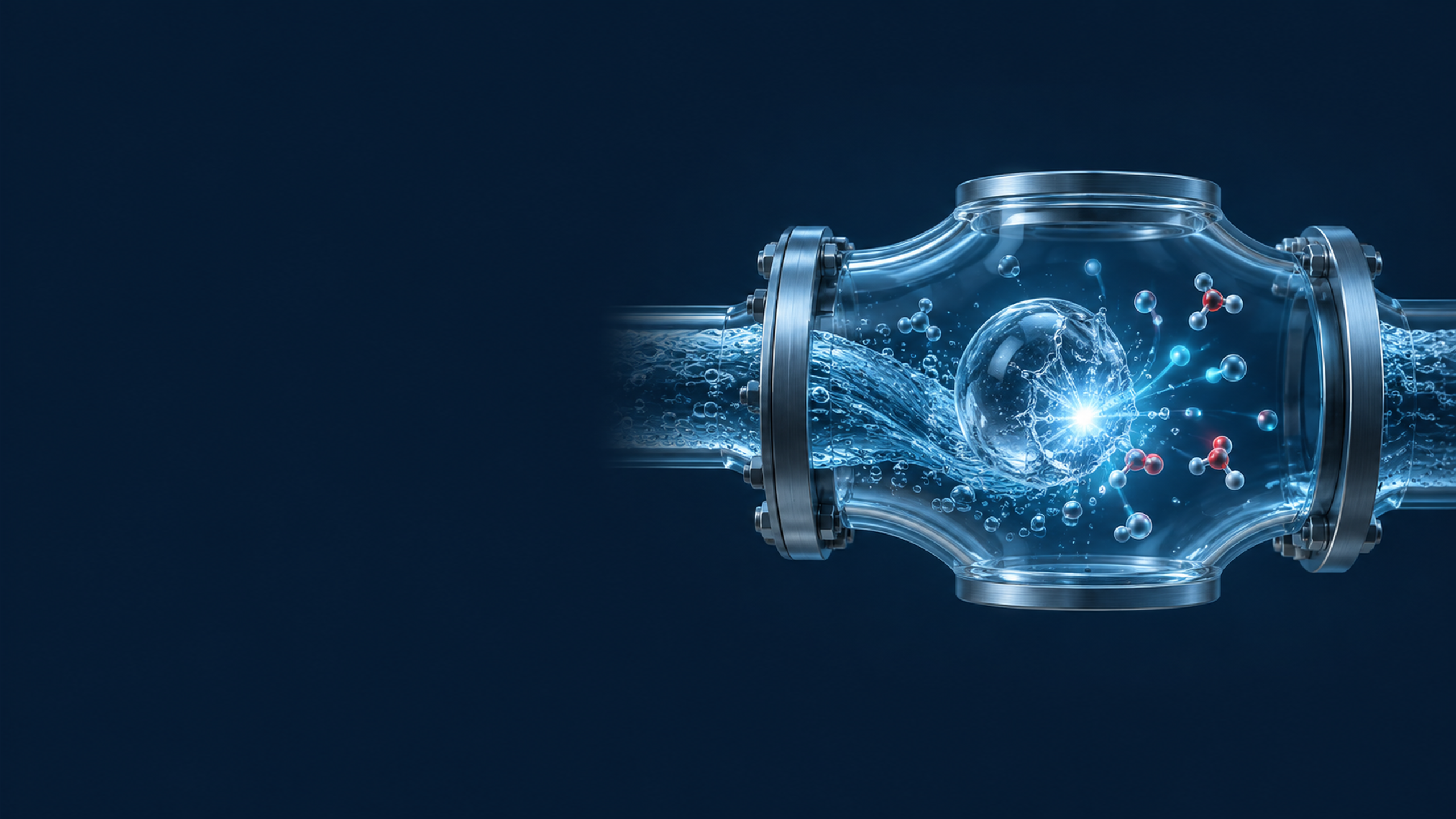
Industrial applications
Sonochemical Effect Induced by Hydrodynamic Cavitation
okozyuk.com
Published
Read complete publication for whole-document Find and printing. Browser Find and native printing on this reader include only loaded content.
Sonochemical Effect Induced by Hydrodynamic Cavitation
Abstract
Hydrodynamic cavitation can generate chemical effects analogous to those associated with acoustic sonochemistry while operating through spatial pressure reduction and recovery in a flowing liquid rather than through an imposed acoustic field. This article examines the physical and chemical basis of these effects, including bubble growth and inertial collapse, adiabatic compression, gas and vapor composition, radical generation, interfacial chemistry, and transport into the bulk liquid. The analysis distinguishes thermal, interfacial, bulk, and mechanically assisted reaction pathways and evaluates the influence of device geometry, pressure recovery, temperature, dissolved gas, bubble cloud structure, and repeated exposure. Chemical dosimetry, energy normalization, high speed imaging, luminescence, and thermal diagnostics are considered as complementary methods for establishing a defensible evidence chain from hydraulic forcing to chemical output. Representative applications include advanced oxidation, disinfection, inorganic synthesis, crystallization, organic and multiphase processing, biomass treatment, and food and beverage processing. Experimental evidence demonstrates that maximum visible vapor volume does not necessarily correspond to maximum chemical yield because bubble interaction, shielding, recombination, and collapse location affect productive energy focusing. The principal scale up objective is therefore to preserve the pressure history, active bubble population, chemically productive collapse exposure, gas condition, residence time distribution, and energy boundary required for the target reaction while controlling erosion, contamination, and safety.