
Technical publication
Back to publications
Industrial applications
Sonochemical Effect Induced by Hydrodynamic Cavitation
okozyuk.com
Published
Read complete publication for whole-document Find and printing. Browser Find and native printing on this reader include only loaded content.
6 Measurement and Quantification of Sonochemical Activity
A credible hydrodynamic cavitation study should combine at least one hydraulic measurement, one physical cavitation measurement where possible, and one chemical dosimeter. Pressure drop alone cannot establish chemical activity. Conversely, pollutant removal alone cannot distinguish radical chemistry from volatilization, adsorption, thermal hydrolysis, emulsification, or sampling artifacts. Recommended measurements include inlet and outlet pressure, flow, temperature, pump power, dissolved gas, cavitation images or acoustic emission, and a chemically defined probe [6,11,15,30-32,35,38].
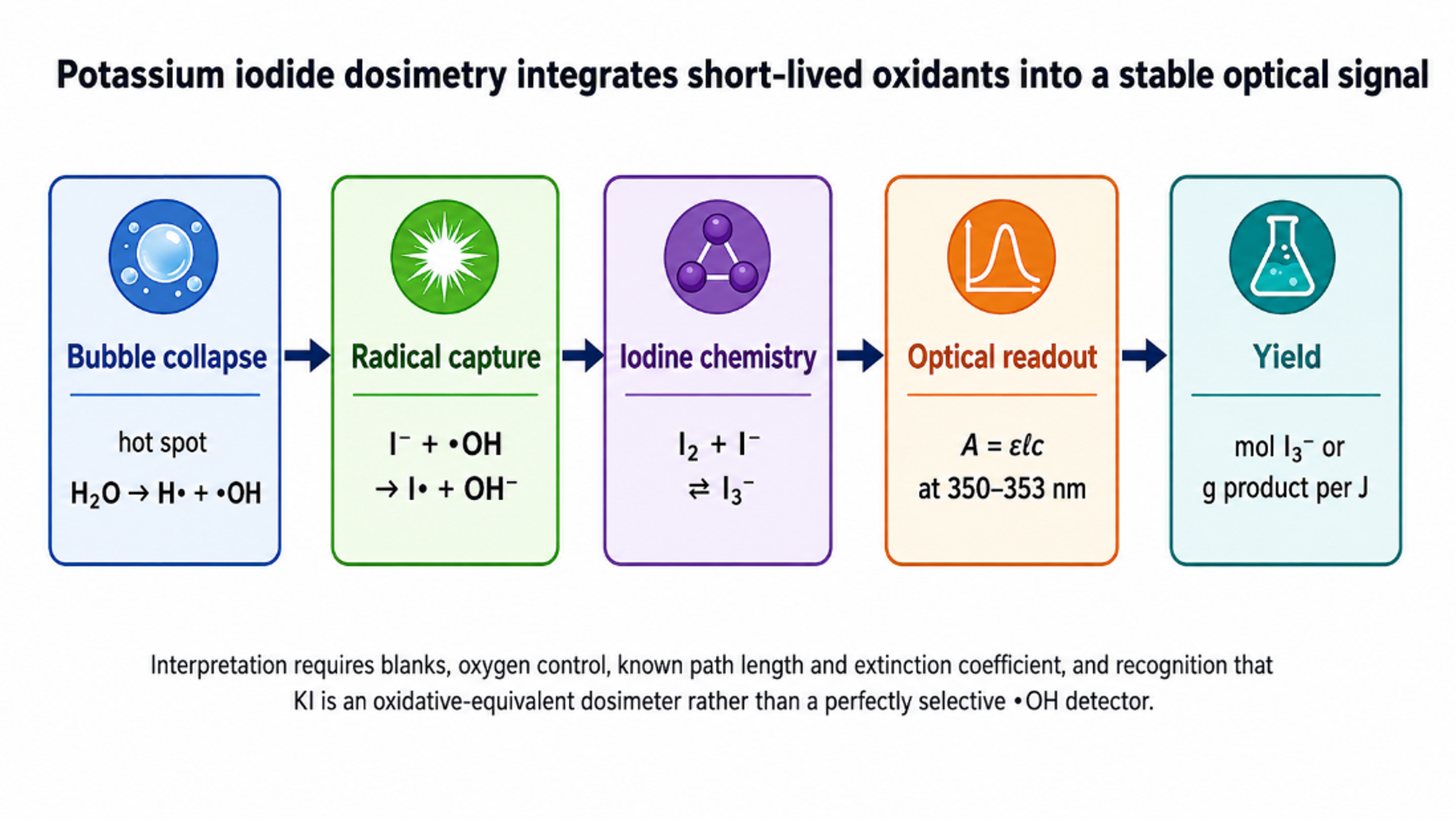
Figure 6.1. Potassium iodide dosimetry converts short lived oxidants into a stable optical signal through iodine and triiodide formation [81].
Potassium iodide oxidation is widely used because it is inexpensive, sensitive, and compatible with flow loops. In an acidic medium, hydrogen peroxide, or related oxidizing species generated during cavitation, oxidizes iodide ions according to:
In the presence of excess iodide, the liberated iodine rapidly complexes to form triiodide ():
The triiodide concentration is obtained from Beer Lambert absorption:
where is absorbance at wavelength λ, is molar absorptivity, b is optical path length, and is triiodide concentration.
The energy normalized cavitational yield can be defined as:
where is moles of a specified product and is the hydraulic or electrical energy basis stated by the author.
For continuous operation over a sampling interval Δt, an oxidant production rate is:
where Q is volumetric flow, and are outlet and inlet concentrations, and is the selected reactor or loop volume used for normalization.
A target degradation is often approximated as pseudo first order over a restricted concentration range:
The electrical energy used in water treatment is:
where EEO is commonly expressed in kWh m⁻³ order⁻¹, is electrical power, V is treated volume, and one order is a tenfold concentration reduction.
Table 6.1. Methods for measuring cavitation induced chemical activity
| Method | Measured response | Strength | Limitation and control |
|---|---|---|---|
| KI dosimetry | I₂/I₃⁻ formation by integrated oxidizing equivalents | Simple, sensitive, established for comparing reactors | Not specific to •OH; depends on pH, oxygen, iodine chemistry, and mass transfer |
| Terephthalate fluorescence | 2-hydroxyterephthalate formed by •OH addition | Sensitive proxy for hydroxyl radicals | Product yield is less than unity and probe chemistry must be calibrated |
| Salicylic acid dosimetry | Hydroxylated aromatic products | Provides product fingerprints | Multiple products and chromatographic analysis required |
| H₂O₂ assay | Stable peroxide accumulated in liquid | Useful for mass balance and hybrid AOP design | Can be consumed by catalysts, solutes, walls, light, or further cavitation |
| EPR spin trapping | Radical adduct spectra | Direct species identification | Specialized, time sensitive, and affected by spin trap transport |
| Fricke dosimetry | Fe²⁺ oxidation to Fe³⁺ | Long established oxidant dosimeter | Strongly dependent on acidity and dissolved oxygen |
| Chemical target degradation | Loss of a selected compound and product formation | Application relevant | Mechanism may include non-radical effects; requires blanks and carbon balance |
| Calorimetry | Rate of bulk temperature rise | Defines dissipated power for normalization | Does not identify how much energy enters productive collapses |
| High speed imaging and acoustic emission | Bubble cloud, collapse, shock/noise signatures | Links chemistry to physical cavitation state | Optical access and calibration can be difficult in opaque industrial fluids |
Koda and coworkers proposed standardized KI oxidation normalized by calorimetric power for acoustic systems [38]. Hydrodynamic studies should adopt the same principle of explicit energy accounting, but the appropriate input basis must be stated. Hydraulic power QΔp describes energy delivered across the cavitating device. Pump electrical power includes motor and pump inefficiency. Whole plant power may include cooling, gas compression, ozone generation, and separation. All three metrics can be useful, but they answer different questions.
Controls are essential. A noncavitating pressure drop control distinguishes cavitation from ordinary pumping and shear. A thermal control follows the same bulk temperature history without cavitation. Gas and pH controls identify oxygen or acid base effects. For hybrid systems, each component must be tested alone at the same energy and reagent dose. Samples should be quenched when necessary to prevent post reactor reaction from being mistaken for in reactor chemistry.