
Technical publication
Back to publications
Industrial applications
Sonochemical Effect Induced by Hydrodynamic Cavitation
okozyuk.com
Published
Read complete publication for whole-document Find and printing. Browser Find and native printing on this reader include only loaded content.
9 Chemistry in Organic Liquids and Organic Containing Systems
Organic systems fall into two distinct classes: organic compounds dissolved or dispersed in water, and predominantly organic liquids such as fuels, oils, alcohols, solvents, and monomer mixtures. In aqueous systems, the central question is where the organic molecule resides relative to the bubble. In neat or high organic fraction liquids, solvent vapor becomes a major component of the bubble and can dominate the hot spot chemistry. Organic vapors may pyrolyze to carbon centered radicals, unsaturated fragments, hydrogen, carbon monoxide, carbon dioxide, soot like products, or polymer precursors depending on structure and oxygen availability [3,39-41].
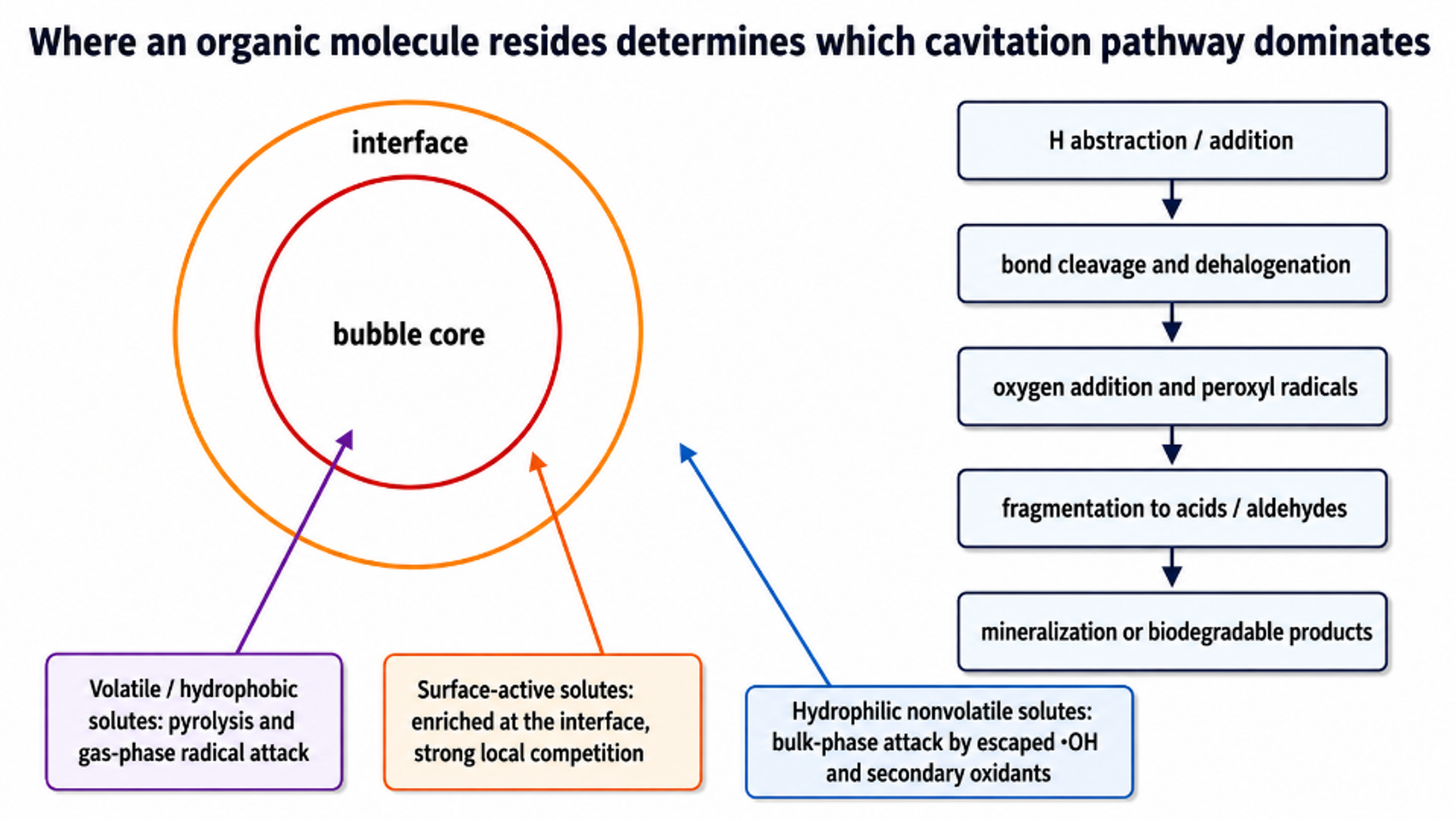
Figure 9.1. Organic molecule location determines the dominant cavitation pathway: gas core pyrolysis, interfacial radical attack, or bulk liquid oxidation [81].
For a dilute volatile solute, Henry's law provides a first estimate of gas liquid partitioning:
where is solute partial pressure, is Henry's law constant under the selected convention, and is liquid mole fraction.
A convenient distribution factor between a cavitation bubble and liquid is:
For a nonvolatile target reacting mainly with a steady radical flux, the observed kinetics may be approximated by:
where contains radical generation, transport, scavenging, and intrinsic reaction contributions.
For a multiphase organic process, the overall rate can be decomposed as:
where the terms represent direct chemistry, enhanced interphase transport, and conversion caused by particle or droplet disruption and surface renewal.
Hybrid process synergy is frequently reported as:
where is the observed rate constant for the combined process and and are rate constants for hydrodynamic cavitation and the auxiliary process alone under matched conditions. greater than 1 indicates positive kinetic synergy on this basis.
Table 9.1. Organic compound classes and likely cavitation pathways
| Compound class | Dominant location | Likely transformations | Analytical concerns |
|---|---|---|---|
| Volatile chlorinated solvents | Bubble core and interface | Pyrolysis, dehalogenation, radical oxidation | Volatilization and off gas must be separated from destruction |
| Phenols and aromatic pollutants | Interface and bulk | •OH addition, ring opening, oxygenation, mineralization | Intermediate toxicity and total organic carbon balance |
| Dyes | Mostly bulk/interface | Chromophore cleavage and oxidation | Color loss can precede mineralization |
| Pharmaceuticals | Bulk/interface; speciation dependent | Hydroxylation, dealkylation, ring cleavage | Transformation products and biological activity |
| Alcohols | Often volatile and interfacially active | H abstraction, aldehyde/ketone formation, radical scavenging | Can suppress aqueous •OH yield while forming organic radicals |
| Hydrocarbons and fuels | Organic phase and bubble vapor | Oxidation, desulfurization, cracking, emulsification | Flammability, off gas, peroxide formation, phase separation |
| Vegetable oils and fatty esters | Dispersed organic phase | Interesterification/transesterification support, oxidation if air is present | Distinguish chemical conversion from emulsification and soap formation |
| Polymers and monomers | Bulk/interface | Chain scission, radical initiation, crosslinking or polymerization | Molecular weight distribution and oxygen inhibition |
| Biomass slurries | Solid liquid interface | Limited direct radical oxidation plus hydrolysis and surface activation | Physical size reduction often dominates observed benefit |
The early hot spot experiments in nonaqueous liquids established that solvent vapor composition controls cavitation temperature and emission [39-41]. High vapor pressure solvents can fill the bubble with polyatomic vapor and lower the collapse temperature. Low vapor pressure liquids may permit stronger heating but can be viscous, difficult to nucleate, or unsafe at elevated pressure. The organic liquid must therefore be selected and conditioned with attention to vapor pressure, viscosity, surface tension, heat capacity, thermal conductivity, gas solubility, flash point, and chemical stability.
Table 9.2. Influence of organic liquid properties on hydrodynamic sonochemistry
| Property | Bubble dynamic effect | Chemical consequence | Design response |
|---|---|---|---|
| Vapor pressure | Controls vapor loading during growth | High vapor pressure supplies reactant but cushions collapse | Lower bulk temperature or raise recovery pressure when appropriate |
| Viscosity | Damps growth and collapse; raises pumping loss | Can reduce active bubble population and radical yield | Use heating cautiously, larger passages, or rotor/vortex designs |
| Surface tension | Changes nucleation and minimum stable radius | Affects interfacial area and emulsion formation | Control surfactants and contamination |
| Thermal conductivity | Controls heat loss from the gas liquid interface | Changes hot spot temperature and quench rate | Consider gas selection and residence time |
| Gas solubility | Sets nuclei and noncondensable gas content | Controls collapse cushioning and oxygen chemistry | Use closed gas conditioning when reproducibility is critical |
| Polarity and hydrogen bonding | Influence vapor composition and radical stabilization | Shift pyrolysis, H abstraction, and electron transfer pathways | Use product analysis rather than assuming aqueous pathways |
| Flash point and autoignition | Do not directly set cavitation, but define hazard envelope | Hot spots do not heat the whole liquid, yet off gas and static ignition remain hazards | Inerting, bonding, ventilation, pressure relief, gas monitoring |
| Phase ratio in emulsions | Changes bubble location and energy dissipation | Controls mass transfer and contact with oxidants | Optimize droplet size, coalescence, and downstream separation |
Hydrodynamic cavitation often benefits organic processing through coupled mechanical and chemical action. In biodiesel synthesis, rapid dispersion and interfacial renewal can dominate over radical chemistry [46]. In deep desulfurization, cavitation disperses aqueous oxidizing species into the organic phase while also generating reactive species [47]. In ethanol and biomass processing, particle disruption and increased enzymatic accessibility are central [21-23,48-49]. These examples reinforce the need to identify the rate limiting mechanism before optimizing for maximum radical yield.