
Technical publication
Back to publications
Industrial applications
Sonochemical Effect Induced by Hydrodynamic Cavitation
okozyuk.com
Published
Read complete publication for whole-document Find and printing. Browser Find and native printing on this reader include only loaded content.
8 Chemistry in Inorganic Liquids and Aqueous Electrolytes
In hydrodynamic cavitation literature, chemistry in inorganic liquids most often means water containing acids, bases, salts, dissolved gases, oxidants, or inorganic precursors. These solutes rarely enter the bubble core because they are nonvolatile. Their transformation occurs at the interface or in the bulk through radicals, longer lived oxidants, extreme local supersaturation, and cavitation generated surfaces. Ionic strength also changes gas solubility, vapor pressure, interfacial tension, and bubble coalescence, so salts affect both bubble physics and chemical kinetics.
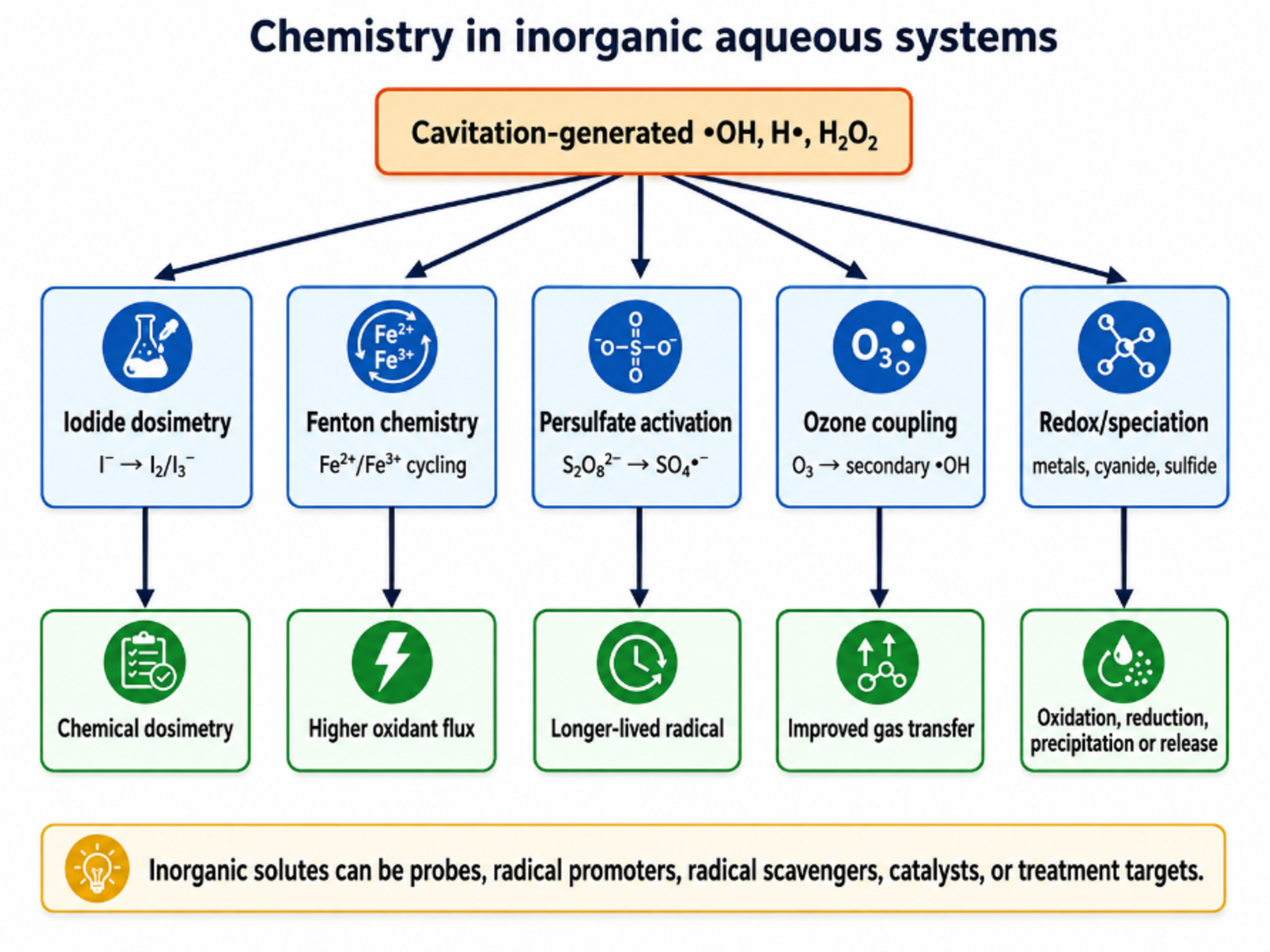
Figure 8.1. Principal chemical pathways in inorganic aqueous systems are exposed to hydrodynamic cavitation [81].
The Fenton reaction is a common route for converting accumulated hydrogen peroxide into hydroxyl radicals:
Persulfate can be activated thermally, mechanically, photochemically, or catalytically to form sulfate radicals. A simplified activation step is:
Bicarbonate scavenges hydroxyl radicals and forms the less reactive but more selective carbonate radical:
Cavitation generated reducing species can reduce metal ions or metal complexes:
where denotes an effective reducing equivalent supplied by H•, organic radicals, or solvated electron like chemistry depending on the system.
For cavitation assisted crystallization, classical nucleation theory provides a useful baseline:
where J is nucleation rate, is solid liquid interfacial energy, is molecular volume, is Boltzmann's constant, and is supersaturation ratio.
Supersaturation is defined as:
where C is actual solute concentration and C* is equilibrium solubility at the local temperature and pressure.
Cavitation can increase nucleation by several coupled routes: transient cooling or heating, rapid pressure change, formation of clean surfaces, fragmentation of early crystals, removal of adsorbed gas, and intense micromixing. It can also increase secondary nucleation by crystal collision and attrition. Equations (8.5) and (8.6) therefore describe only the thermodynamic contribution; practical controlled flow crystallization also depends on hydrodynamic history and crystal population balance [43-44].
Table 8.1. Influence of common inorganic ions and additives
| Species | Primary interaction | Possible benefit | Possible adverse effect |
|---|---|---|---|
| Fe²⁺/Fe³⁺ | Fenton and redox cycling | Converts H₂O₂ to •OH and intensifies oxidation | Sludge generation, pH sensitivity, catalyst loss |
| HCO₃⁻/CO₃²⁻ | •OH scavenging and CO₃•⁻ formation | May increase selectivity toward electron rich compounds | Usually lowers nonselective oxidation rate |
| Cl⁻ | Formation of chlorine radicals under strong oxidation | Can assist disinfection in selected conditions | Chlorinated byproducts and radical scavenging |
| Br⁻ | Bromine radical chemistry | Fast electron transfer reactions | Bromate or brominated byproduct risk |
| SO₄²⁻ | Changes ionic strength and interfacial behavior | Can influence coalescence and conductivity | May alter dosimetry and scaling tendency |
| S₂O₈²⁻/HSO₅⁻ | Precursor to sulfate radicals | Extends oxidation and can improve selectivity | Reagent cost, residual sulfate, quenching requirement |
| I⁻ | Sensitive oxidant dosimeter | Quantifies integrated chemical activity | Probe chemistry can perturb the radical field at high concentration |
| NO₂⁻/NO₃⁻ | Products and reactants of nitrogen chemistry | Can indicate high temperature gas reactions | Compete for radicals and affect water quality |
| Metal salts | Reduction, hydrolysis, precipitation, nucleation | Nanoparticle and catalyst synthesis | Agglomeration, contamination, and uncontrolled redox chemistry |
Table 8.2. Inorganic and materials applications of cavitation induced chemistry
| Application | Primary chemical role | Important physical role | Key controls |
|---|---|---|---|
| Advanced oxidation | Generate •OH, H₂O₂, SO₄•⁻, or secondary oxidants | Mix reagents and renew interfaces | pH, oxidant dose, ion matrix, energy per order |
| Fenton and Fenton like treatment | Accelerate Fe redox cycle and peroxide activation | Disperse catalyst and reduce mass transfer resistance | Iron dose, pH, peroxide staging, sludge management |
| Nanometal synthesis | Reduce metal ions and create unusual phases | Rapid quench, fragmentation, and deagglomeration | Gas atmosphere, precursor concentration, stabilizer, contamination |
| Metal oxide synthesis | Hydrolysis, oxidation, defect generation | Micromixing and nucleation | Temperature, pH, precursor feed, residence distribution |
| Crystallization | Local supersaturation and possible radical chemistry | Nucleation, attrition, surface cleaning | Supersaturation, pass number, crystal breakage, scale up |
| Disinfection | Oxidative damage to cell components | Membrane disruption and microjet action | Water matrix, organism, contact time, residual oxidant |
| Electrochemical intensification | Remove passivating films and improve redox transport | Boundary layer thinning and gas removal | Electrode spacing, erosion, conductivity, gas evolution |
The classic sonochemical synthesis of amorphous iron demonstrates how cavitation can create phases that are difficult to produce under ordinary bulk conditions [45]. Although that work used acoustic cavitation, the mechanism, rapid localized heating followed by quench and radical reduction, is relevant to hydrodynamic reactors when sufficient collapse intensity and precursor access are achieved. Hydrodynamic devices add continuous throughput and potentially larger production rates, but they require careful control of erosion derived metal contamination and residence time distribution.