
Technical publication
Back to publications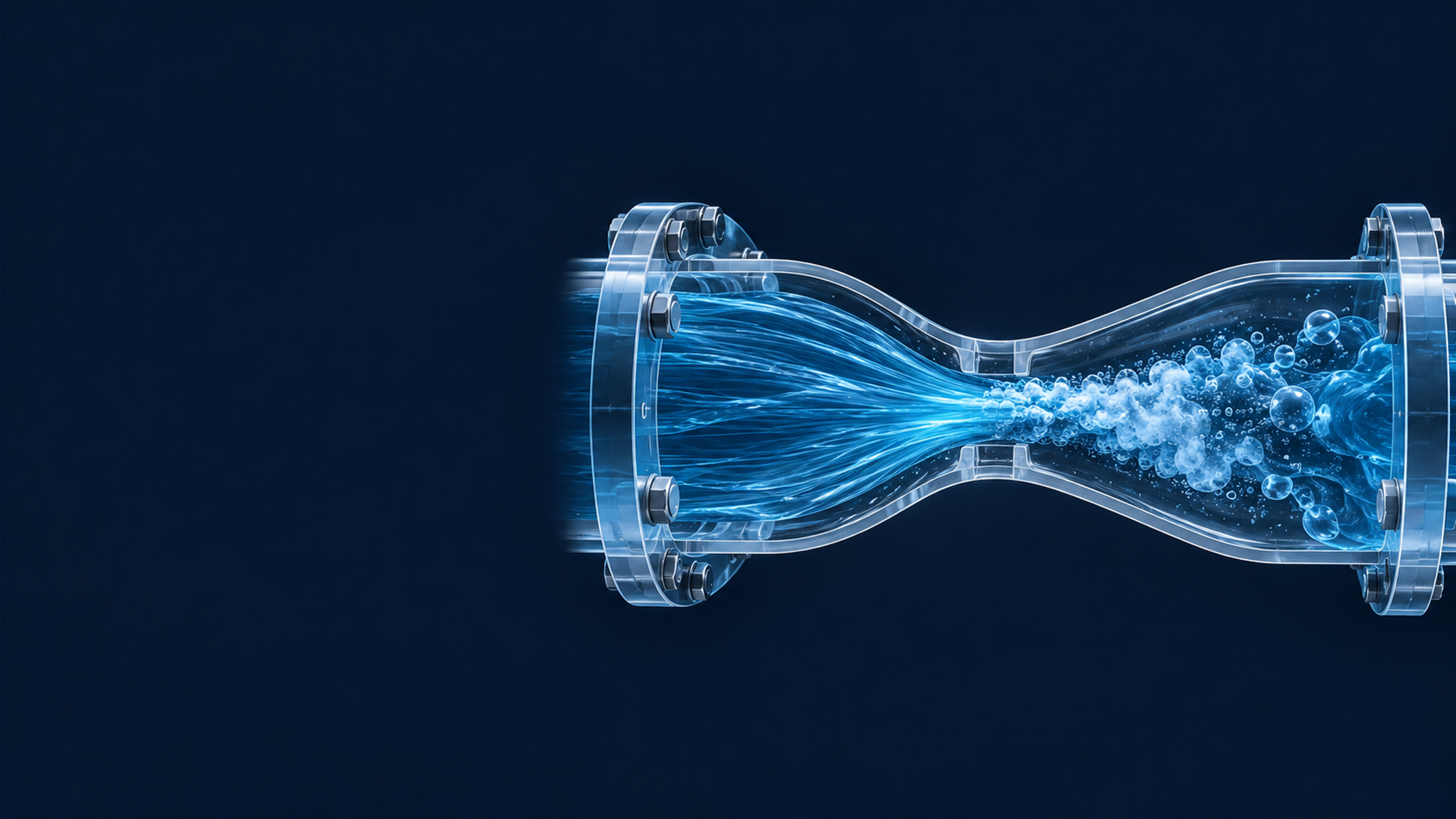
Fundamentals
Physical Basis of Hydrodynamic Cavitation Generation
okozyuk.com
Published
Read complete publication for whole-document Find and printing. Browser Find and native printing on this reader include only loaded content.
2.6 Collective Effects and the Limits of Single Index Descriptions
Cavitation fields range from isolated bubbles to attached sheets, detached clouds, vortex cores, and extended supercavities. The prevailing regime is determined by geometry, nuclei availability, pressure level, residence time, and pressure recovery. Isolated cavities can often be analyzed using single bubble models, whereas dense clouds exhibit collective behavior. Neighboring cavities modify the local pressure field, shield one another from the imposed disturbance, and may collapse as coordinated structures that generate pressure pulses stronger than those of an isolated event [8,9].
A lower minimum pressure does not necessarily produce a more effective cavitation process. When vapor occupies a large fraction of the flow passage, pressure recovery can shift beyond the intended active zone or be cushioned by a persistent vapor cloud. Effective hydrodynamic generation therefore requires simultaneous control of inception, growth time, void fraction, cloud transport, and collapse location. The same considerations apply to acoustically generated bubble clouds and hydrodynamic cavity structures [2,10].