
Technical publication
Back to publications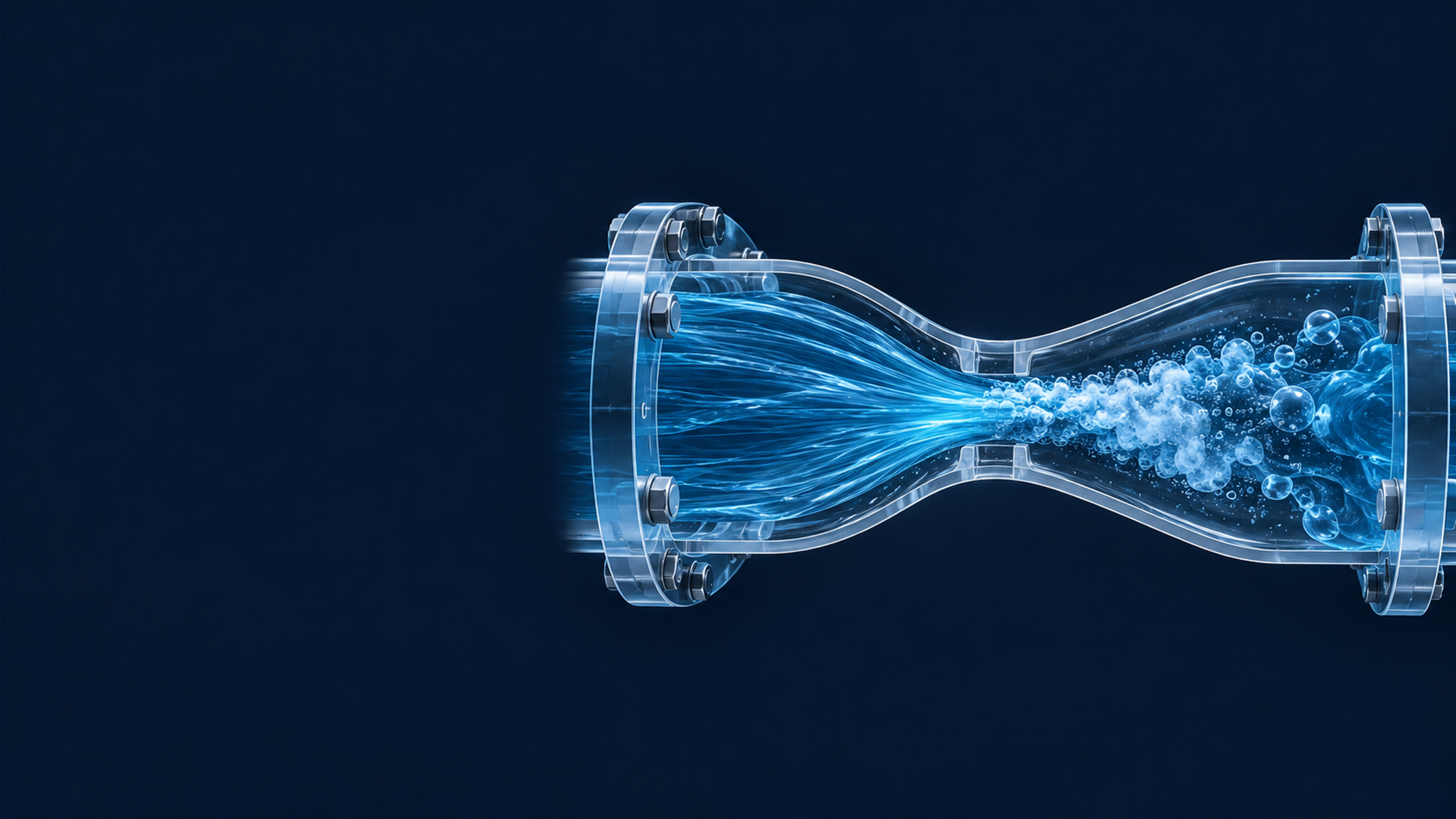
Fundamentals
Physical Basis of Hydrodynamic Cavitation Generation
okozyuk.com
Published
Read complete publication for whole-document Find and printing. Browser Find and native printing on this reader include only loaded content.
2.7 Conclusions
Hydrodynamic cavitation generation is governed by the coupled conversion of static pressure to local kinetic energy, the availability of nuclei, and the subsequent recovery of pressure that drives cavity collapse. No single cavitation number fully characterizes the process because equivalent nominal pressure drops can produce different cavity morphologies and collapse locations when geometry, liquid properties, gas content, and pressure recovery differ.
Reliable design and scale up therefore require a multivariable description that combines cavitation number, Reynolds and Weber scaling, pressure recovery, energy consumption, and process outcome. Device selection should account for where cavities form and collapse, whether the desired regime is discrete or collective, and whether erosion, clogging, or mechanical complexity constrains operation. These principles provide a physical basis for selecting and comparing hydrodynamic cavitation devices without treating cavitation intensity as a function of pressure drop alone.