
Technical publication
Back to publications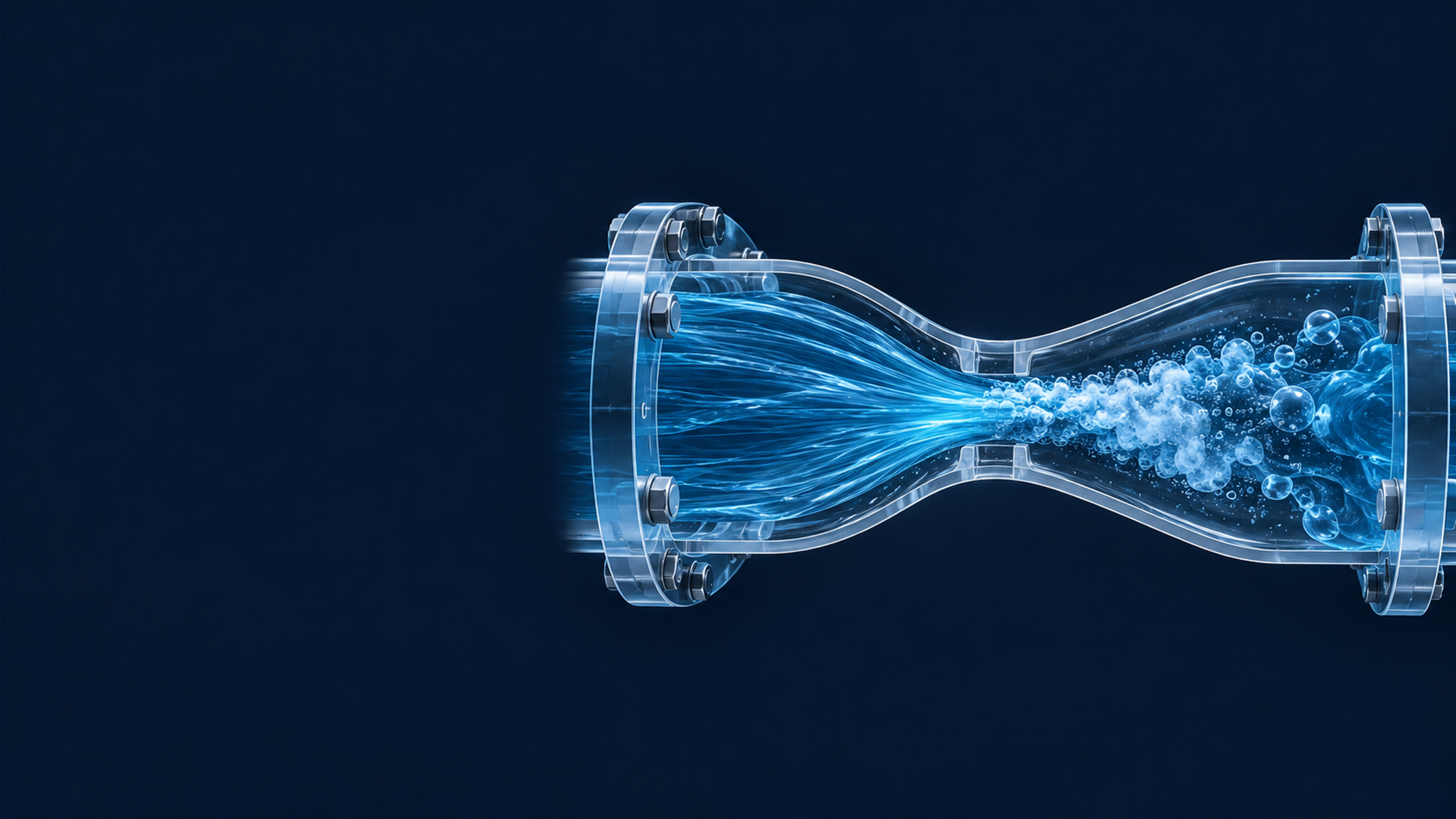
Fundamentals
Physical Basis of Hydrodynamic Cavitation Generation
okozyuk.com
Published
Read complete publication for whole-document Find and printing. Browser Find and native printing on this reader include only loaded content.
2.5 Forms and Regimes
Hydrodynamic cavitation occurs in distinct spatial and temporal forms that differ in stability, collapse behavior, and engineering consequence. Table 2.3 summarizes the principal regimes relevant to cavitation processing and hydraulic systems.
Table 2.3. Common cavitation forms and regimes. [7]
| Form or regime | Typical geometry or behavior | Primary concern |
|---|---|---|
| Bubble cavitation | Discrete cavities grow in a low pressure region and collapse after convection. | Noise, local pitting, and inception diagnostics. |
| Sheet cavitation | An attached vapor layer forms on a blade or hydrofoil suction surface. | Performance change, reentrant jet instability, and cloud shedding. |
| Cloud cavitation | A group of cavities is periodically shed and collapses collectively. | Strong pressure pulses, vibration, and high erosion potential. |
| Vortex cavitation | A vapor core forms in a concentrated vortex such as a propeller tip or leakage vortex. | Noise, long range interaction, and remote collapse damage. |
| Traveling cavitation | Cavities nucleate in the free stream and pass through a pressure field. | Test tunnel nuclei sensitivity and isolated impact events. |
| Partial cavitation | Vapor occupies only part of a passage or surface. | Often controllable but may be unstable or erosive. |
| Supercavitation | A cavity extends over most of the body or blade. | Drag and load control, cavity closure, ventilation, and stability. |
| Choked two phase flow | Vapor volume limits mass flow or pressure recovery. | Severe performance loss and inability to gain flow with added pressure drop. |