
Technical publication
Back to publications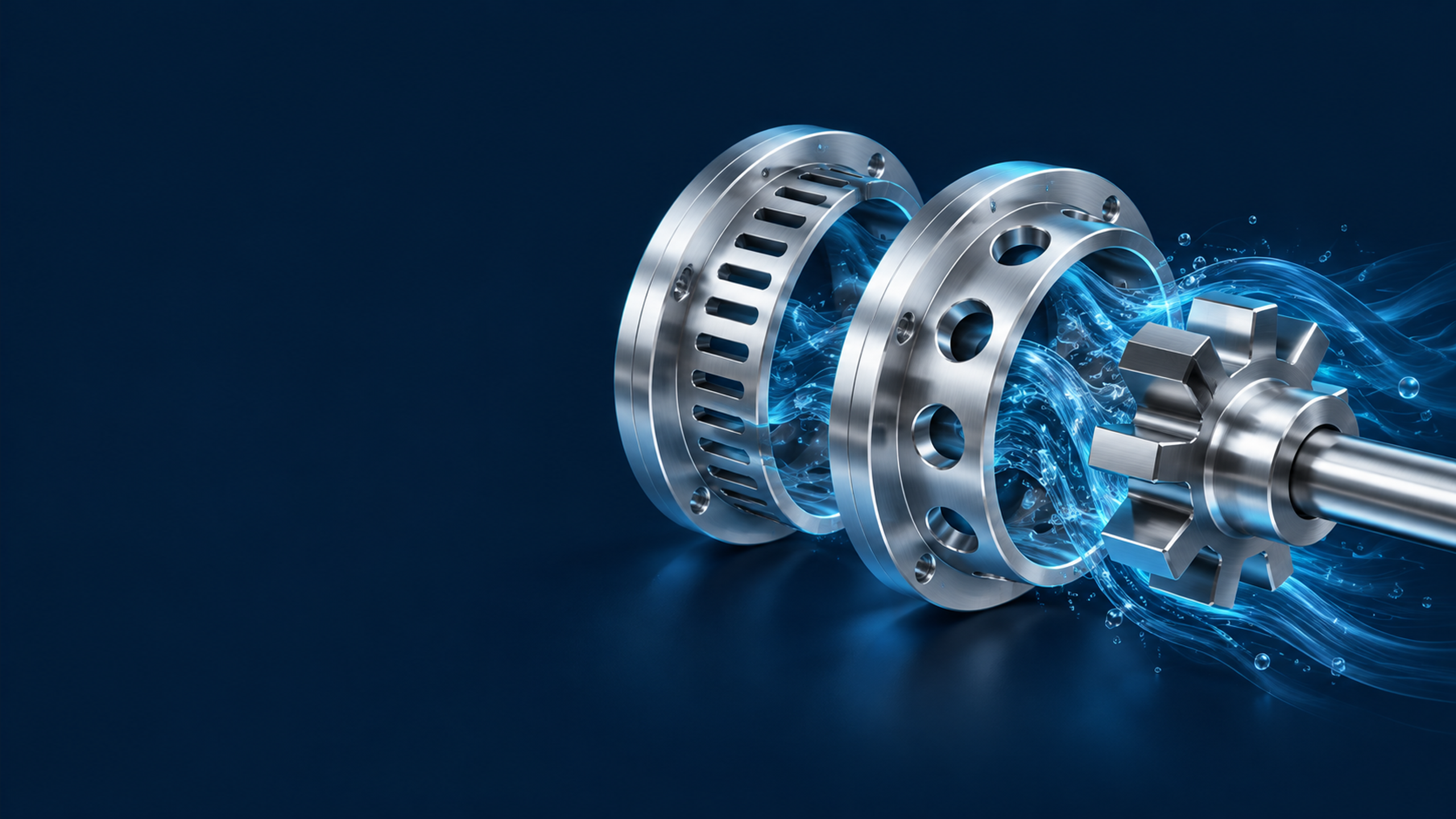
Other
Performance considerations in stator selection for high shear rotor-stator mixers
okozyuk.com
Published
Read complete publication for whole-document Find and printing. Browser Find and native printing on this reader include only loaded content.
1. Introduction
In high shear rotor-stator mixers, stator aperture geometry is one of the primary design variables governing hydrodynamic performance and process outcome. The stator does far more than contain the rotor. Its opening pattern determines the hydraulic restriction surrounding the rotating element, the effective discharge area, the magnitude and distribution of local velocity gradients, and the frequency with which fluid elements are subjected to intense shear and extensional deformation. As a result, stator design directly influences several coupled performance variables: volumetric pumping rate, pressure drop across the head, local energy dissipation rate, recirculation intensity, solids passage capability, and susceptibility to fouling or blinding. Commercial systems commonly use four baseline stator geometries: coarse disintegrating heads, square hole screens, slotted heads, and fine emulsor or fine screen heads. More aggressive configurations may incorporate toothed stators or multistage slotted ring assemblies to increase the number of shear zones and breakup events experienced during a single pass through the work head. From an engineering standpoint, the stator pattern changes the balance between pumping and comminution. Coarse disintegrating heads typically provide lower hydraulic resistance, higher bulk circulation, and better tolerance for large particles or fibrous solids, but they generate fewer high intensity shear events per pass. Square hole and slotted heads impose greater restriction, increase local discharge velocity through the apertures, and promote stronger shear driven dispersion. Fine emulsor heads push this effect further by maximizing repeated fluid acceleration, deceleration, and reorientation across small openings, which improves droplet and particle size reduction at the expense of throughput, solids tolerance, and ease of cleaning.
In practical process terms, moving from a coarse disintegrating head to a square hole, slotted, or fine screen geometry shifts machine behavior along four key axes: throughput capacity, local shear intensity, solids handling robustness, and cleanability. For that reason, stator selection should be treated as a first order process design decision rather than a secondary mechanical detail.