
Technical publication
Back to publications
Other
Performance considerations in stator selection for high shear rotor-stator mixers
okozyuk.com
Published
Read complete publication for whole-document Find and printing. Browser Find and native printing on this reader include only loaded content.
2. Effect of stator geometry on process behavior
2.1 Coarse disintegrating heads
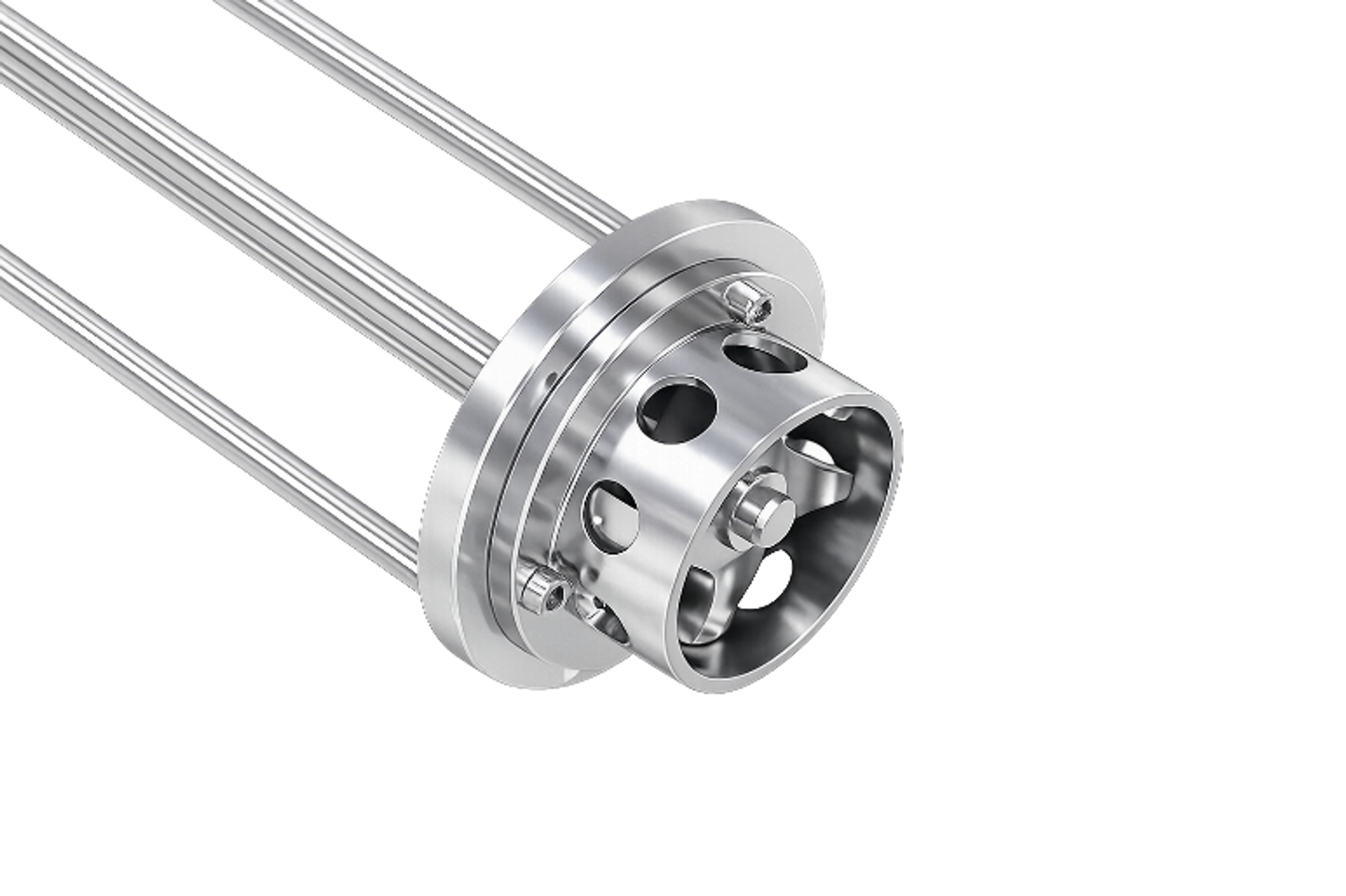
A coarse disintegrating head is a high flow rotor-stator geometry intended for primary size reduction, rapid phase turnover, and first pass incorporation of solids, semi solids, and difficult powders. The stator is typically drilled or slotted with relatively large openings, often circular or square, which increases open area and reduces hydraulic restriction through the head. In practical terms, this geometry shifts performance toward bulk pumping capacity, strong recirculatory exchange, and mechanical breakup of larger agglomerates rather than maximum shear intensity at a very small gap. From an engineering standpoint, this head sits at the throughput dominant end of the rotor-stator spectrum. The larger stator apertures reduce pressure drop and allow higher volumetric flow through the work head at a given rotor tip speed. That makes it effective where the process objective is to move a large mass of product through the shear zone quickly, repeatedly expose fresh material to the rotor-stator interface, and prevent localized overprocessing. It is commonly selected for early stage duty such as powder induction, wet out of low density solids, hydration of gums or thickeners, dispersion of soft solids, and breakdown of semi solid feed materials before finer processing. Its value is strongest in processes with large initial particle size, strong phase viscosity mismatch, or a requirement for rapid tank turnover. The coarse head handles demanding premix conditions well because it tolerates higher solids loading, is less prone to immediate blinding than fine screens, and can sustain circulation even when the system is still nonuniform. In liquid-liquid service, it is useful for pre-emulsification where the immediate need is gross droplet breakup and phase incorporation rather than final droplet size minimization. The main limitation is shearing density. Because the fluid passes through larger openings, the head generates lower local energy dissipation rates and fewer high intensity shear events per unit volume than a fine disintegrating or emulsor screen. As a result, it is generally not the optimum final stage head when the process target is fine emulsion, narrow particle size distribution, smooth finished texture, or maximum interfacial area development. In most engineered mixing trains, the coarse disintegrating head is best viewed as a front end conditioning tool: it prepares the material for subsequent refinement by a finer rotor-stator head or by a downstream homogenizing step.
2.2 Square hole screens
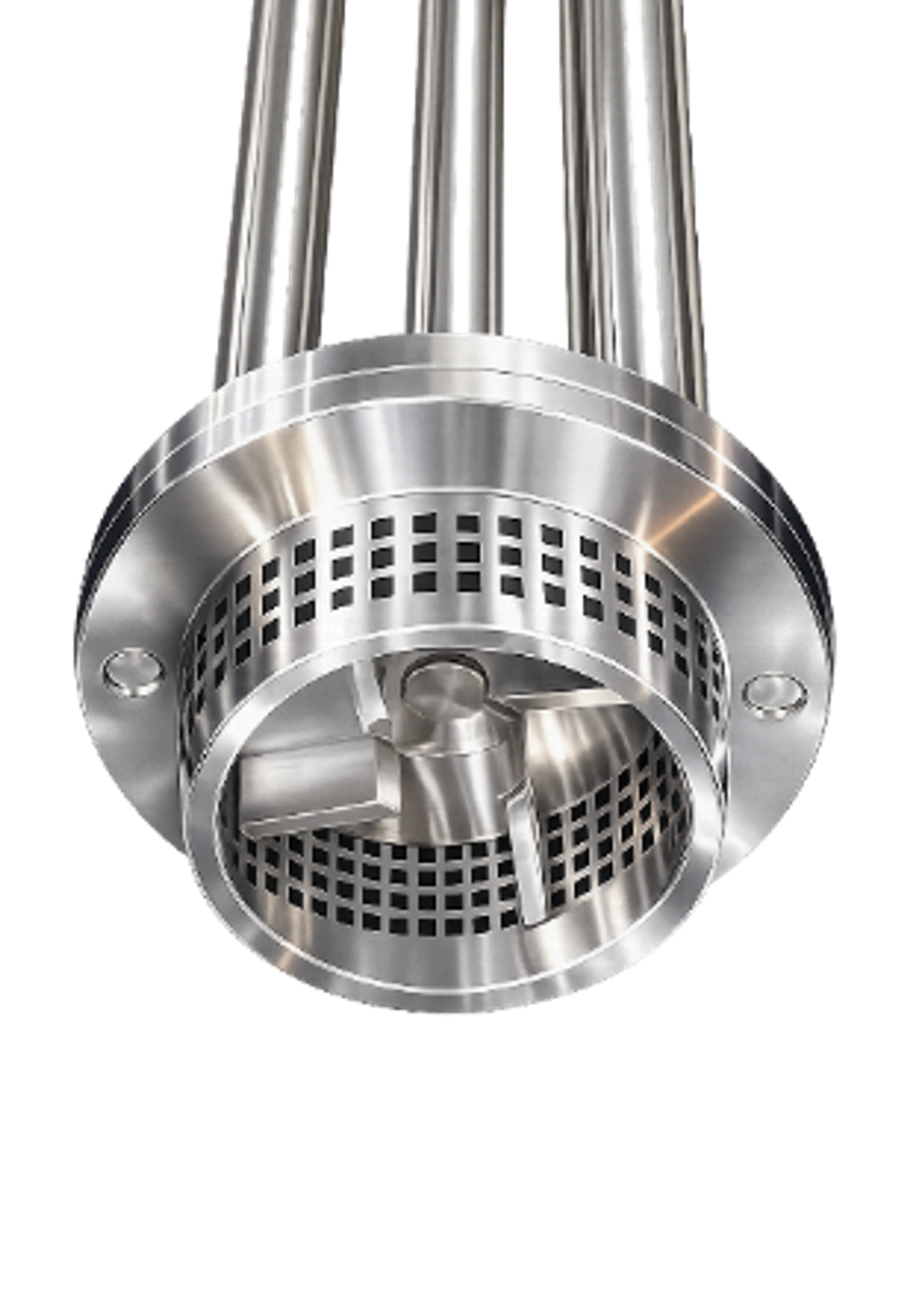
A square hole high shear screen is a stator geometry used in rotor-stator mixing systems when the duty requires high local energy dissipation, repeated extensional and shear deformation, and aggressive recirculation through the work head. In operation, the rotor generates strong suction into the head, accelerates the fluid solid mixture to high tip speed driven velocities, and forces it through a dense array of square apertures. Each passage through the rotor-stator clearance and each discharge through the stator openings creates a new shear event, so the product experiences multiple high intensity deformation cycles in rapid succession. From a process engineering standpoint, this screen is typically the general purpose high shear stator for demanding dispersion and homogenization service. It is well suited for rapid deagglomeration of powders, dissolution of soluble granular materials, size reduction of insoluble particles, and formation of fine emulsions, gels, and colloidal suspensions. The dense perforation pattern increases the frequency of particle rupture, agglomerate breakdown, and droplet disruption events compared with a coarser stator. That usually translates into narrower particle or droplet size distribution, faster solids incorporation, and improved uniformity of the final product. The tradeoff is hydraulic. A finer, denser square hole screen imposes greater flow resistance, increases pressure drop across the head, and typically reduces throughput at a given rotor speed and power input relative to a coarse screen. It also raises the risk of localized plugging or blinding when the feed contains long fibrous material, tough elastic fragments, or poorly wetted powders that can form paste like accumulations at the apertures. For that reason, square hole heads are most effective when the feed is reasonably flowable, solids are introduced in a controlled manner, and the formulation does not contain components likely to bridge or smear across the openings. In practical selection terms, the square hole screen is usually chosen when the primary objective is shearing intensity and dispersion quality rather than maximum pumping rate. It is a strong choice for emulsification duty, powder liquid incorporation, and general particle size reduction where the process benefits from repeated high energy forcing events and where the system can tolerate the associated increase in hydraulic load.
2.3 Slotted heads
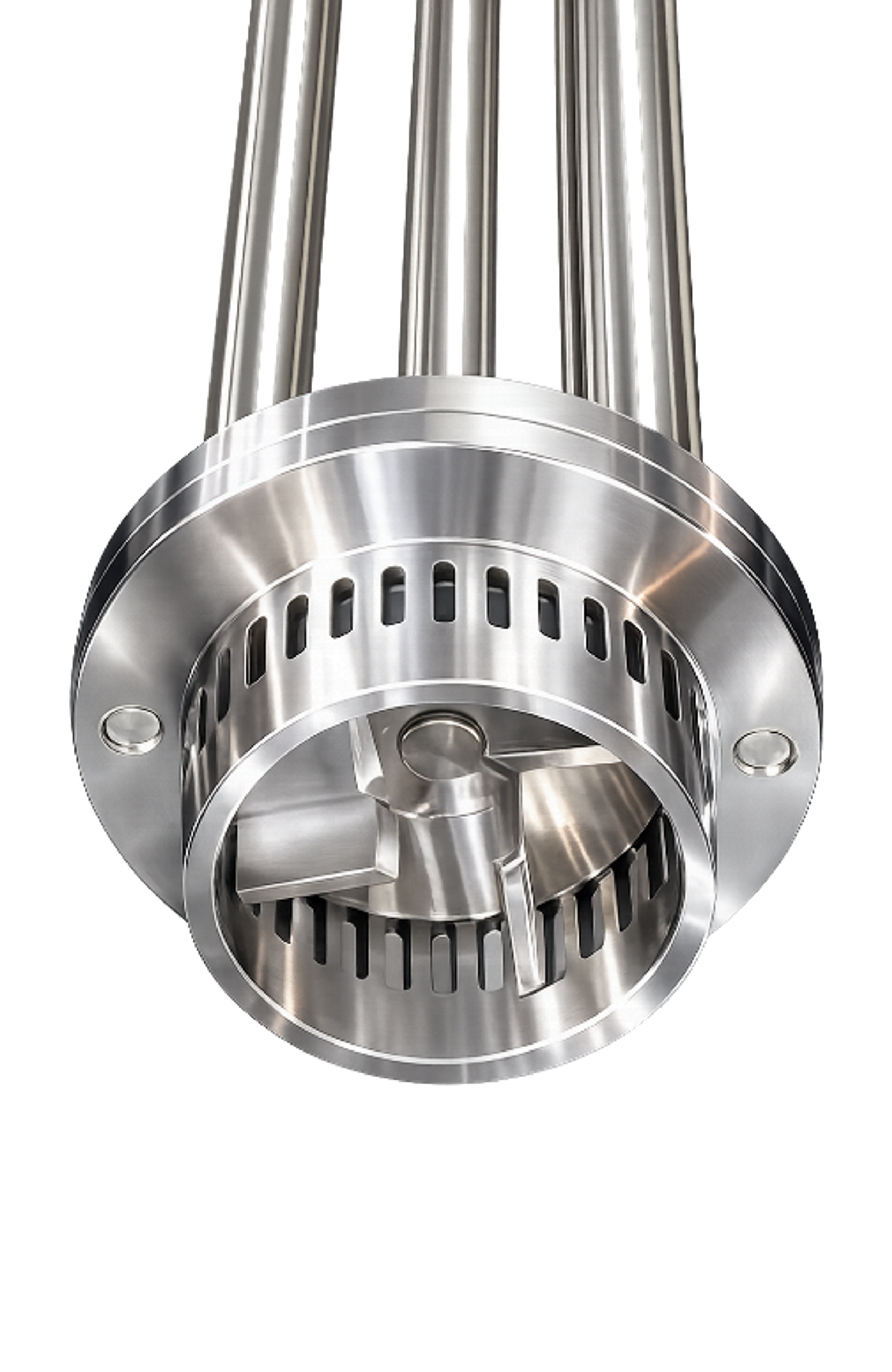
A slotted disintegrating head is a rotor-stator high shear mixing element engineered for aggressive size reduction, dispersion, and homogenization of difficult feedstocks, especially those that are fibrous, deformable, viscoelastic, or tissue like. Typical duty includes the breakdown of animal and vegetable tissue, the comminution of stringy or cellular solids, and the progressive disintegration of elastic materials such as rubbers and some polymers. The working principle combines high tip speed rotor action with close clearance passage through a stator fitted with elongated vertical slots. This geometry generates strong local velocity gradients, repeated acceleration deceleration cycles, hydraulic shear in the rotor-stator gap, and direct mechanical shearing as particles, fibers, or soft solids are drawn into the shear zone and forced across the slot edges. From a process engineering standpoint, the slotted stator is often the preferred geometry when the formulation contains materials that would tend to blind, bridge, or wrap on fine perforations. The elongated slot profile presents a lower plugging risk than small round holes while still maintaining a high energy shear field at the slot entrance, within the gap, and at the slot discharge. This makes the design more tolerant of long fibers, connective tissue, peel, skins, pulp, and other non-free flowing solids. In practical terms, slotted heads usually provide a more favorable pumping to shear balance than fine screen emulsor heads: they recirculate material effectively, sustain throughput under solids loading, and still deliver substantial particle reduction. For that reason, they are widely used in both batch and inline configurations where the objective is rapid disintegration, solubilization, and prehomogenization of challenging materials before finer downstream shear treatment or final polishing.
2.4 Fine screen or emulsor heads
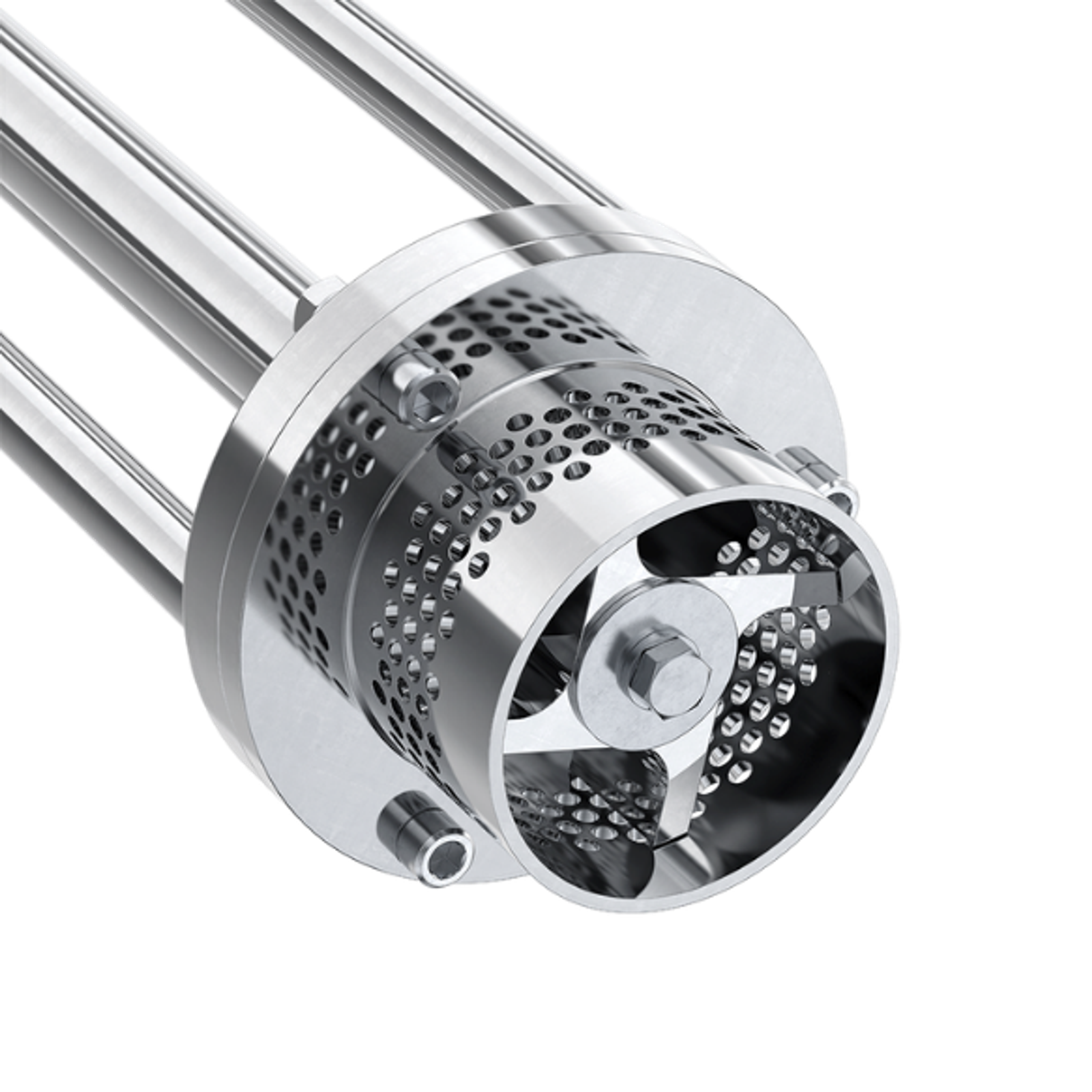
A fine screen rotor-stator homogenizer is a high shear finishing device designed for late stage droplet and agglomerate size reduction, texture refinement, and emulsion polishing. Unlike broader slot or coarse toothed stator geometries that are more forgiving during early dispersion, the fine emulsor uses a stator with very small apertures or a fine perforated screen. This geometry sharply increases local velocity gradients as product is accelerated through the restricted openings, producing intense shear, extensional deformation, and hydraulic impact at the discharge zone. From a process standpoint, this is typically a finishing geometry rather than a front end dispersion tool. The reduced opening size increases discharge velocity and raises the energy density applied to the fluid element during the final pass through the stator. That added shear can drive further droplet breakup, collapse soft agglomerates, and improve final particle size distribution, gloss, mouthfeel, or surface smoothness. In emulsification duty, it is often the stage that determines whether the product reaches the target fineness and visual uniformity. Its effectiveness depends heavily on feed condition. A fine screen performs best when the material has already been premixed, prewetted, and stripped of large solids or poorly dispersed lumps. If coarse particles, stringy solids, or partially hydrated gums are introduced too early, the screen becomes a restriction point rather than a refinement stage. Under those conditions, flow rate drops, shear becomes nonuniform, temperature rise may increase, and the risk of fouling, plugging, or unstable power draw goes up significantly. This geometry is also more viscosity sensitive than more open stator designs. As viscosity rises, the pressure required to force product through small openings increases, and effective circulation can fall off quickly. That makes fine screens better suited to low to moderate viscosity systems, or to process windows where viscosity remains manageable until the finishing step. In practice, fine emulsor are selected when final quality targets justify tighter hydraulic restriction, but they should usually be paired with an upstream dispersing stage that conditions the product before it reaches the screen.
2.5 Multistage and toothed heads
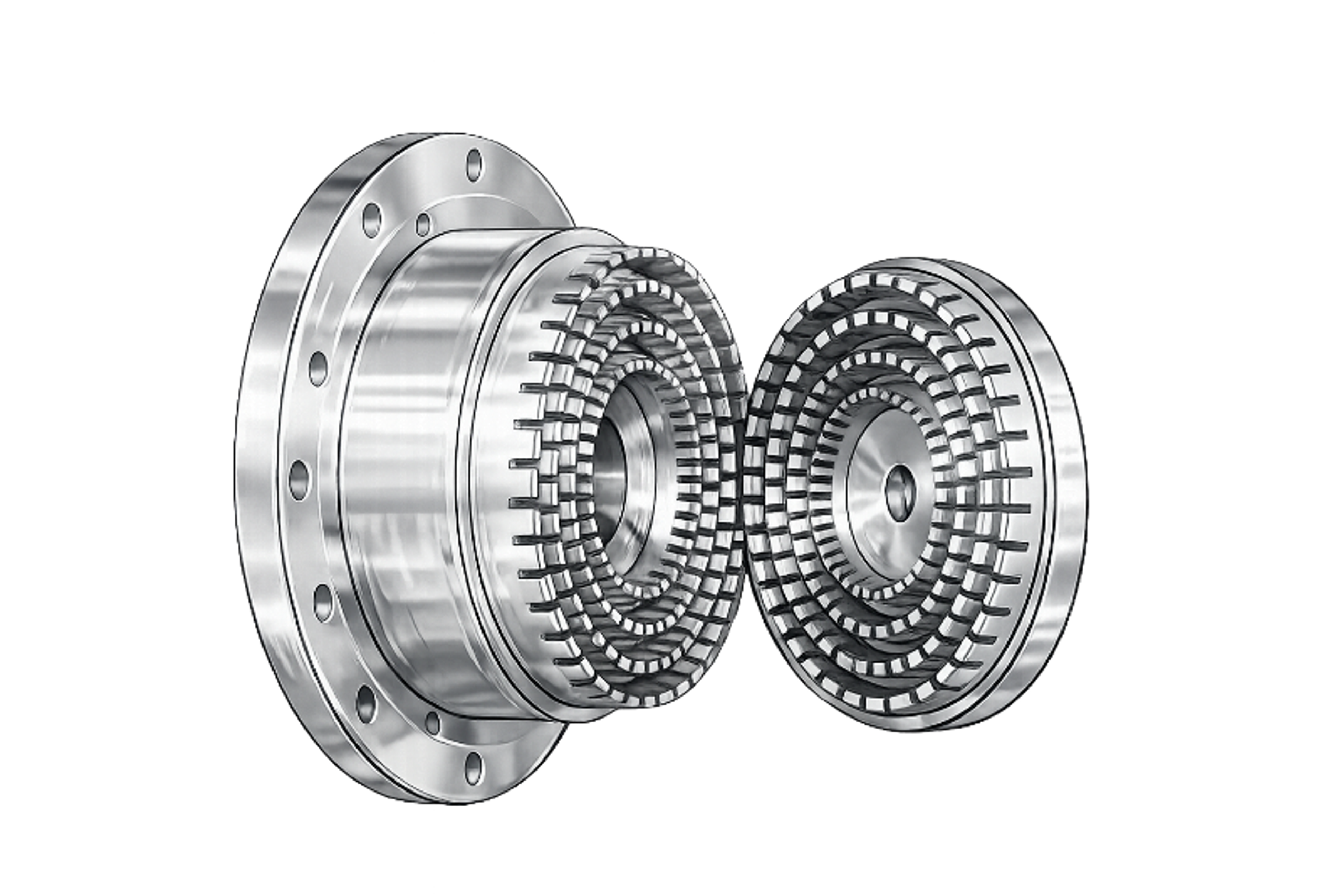
A multistage toothed rotor-stator homogenizer is an intensive mechanical dispersion device used when the process objective is fine droplet size reduction, deagglomeration, or tightly controlled emulsification. In contrast to a single stage rotor-stator head, multistage design forces the product through two or more successive shear zones during one pass through the work head. Each stage imposes another cycle of acceleration, gap shear, pressure fluctuation, turbulence, and discharge, so the material experiences repeatedly controlled breakup before it leaves the head. From an engineering standpoint, the value of a multistage head is not just higher instantaneous shear rate. The more important benefit is staged energy application. Larger droplets, soft agglomerates, or partially wetted solids can be broken down in the first zone, then exposed to finer and more uniform disruptive stresses in downstream zones. This improves droplet size distribution, reduces the number of bulk recirculation passes needed to reach specification, and usually gives better batch to batch repeatability than relying on a single high shear event alone. Toothed and specialized stator geometries extend this principle further. Instead of using only simple slots or holes, these heads use interacting tooth profiles, fine shear gaps, and multiple concentric rotor-stator interfaces to generate localized extensional flow, high velocity gradients, and repeated tooth passing events. The result is stronger mechanical disruption of droplets and particle clusters, especially in systems where interfacial tension is high, solids are difficult to wet, or the formulation tends to recoalesce after initial breakup. These configurations are usually selected for duties where final microstructure matters more than maximum flow rate. Typical drivers include narrow droplet size targets, improved emulsion stability, pigment or powder deagglomeration, and processes where downstream performance depends on consistent particle size distribution. The tradeoff is that multistage and toothed heads generally impose higher power draw, greater hydraulic resistance, and more heat generation than simpler heads, so motor sizing, residence time, temperature control, and CIP cleanability have to be considered during equipment selection.