
Technical publication
Back to publications
Reactors & equipment
Hydrodynamic Cavitation in Emulsification and Homogenization
okozyuk.com
Published
Read complete publication for whole-document Find and printing. Browser Find and native printing on this reader include only loaded content.
3 Mechanisms of Hydrodynamic Cavitation Emulsification
3.1 Cavitation inception, growth, and collapse
Hydrodynamic cavitation begins when local static pressure falls sufficiently close to or below the vapor pressure of the liquid. Nuclei grow into vapor filled or gas and vapor cavities in a low pressure region, then travel into a pressure recovery zone. Condensation and collapse produce pressure waves, liquid microjets near interfaces, and strong local velocity gradients [5,6,15–17]. A bubble collapsing near the interface between two liquids can deform the interface, strip ligaments, and fragment a parent droplet. A collapse far from any droplet may contribute mostly to heat, sound, and bulk mixing. The probability of spatial encounter is therefore a core variable, even when it is not measured directly.
The conventional cavitation number is:
where is a defined recovered downstream pressure, is vapor pressure at the operating temperature, and is the throat or reference velocity. Lower values usually indicate a lower pressure margin and stronger cavitation, but the optimum is device and formulation specific. Values reported by different laboratories cannot be compared unless pressure taps, velocity definitions, dissolved gas content, temperature, and geometry are equivalent. Some historical cone mixer studies used a different cavitation index referenced to cavitation inception. Those values are retained as reported but should not be equated numerically with Equation (9).
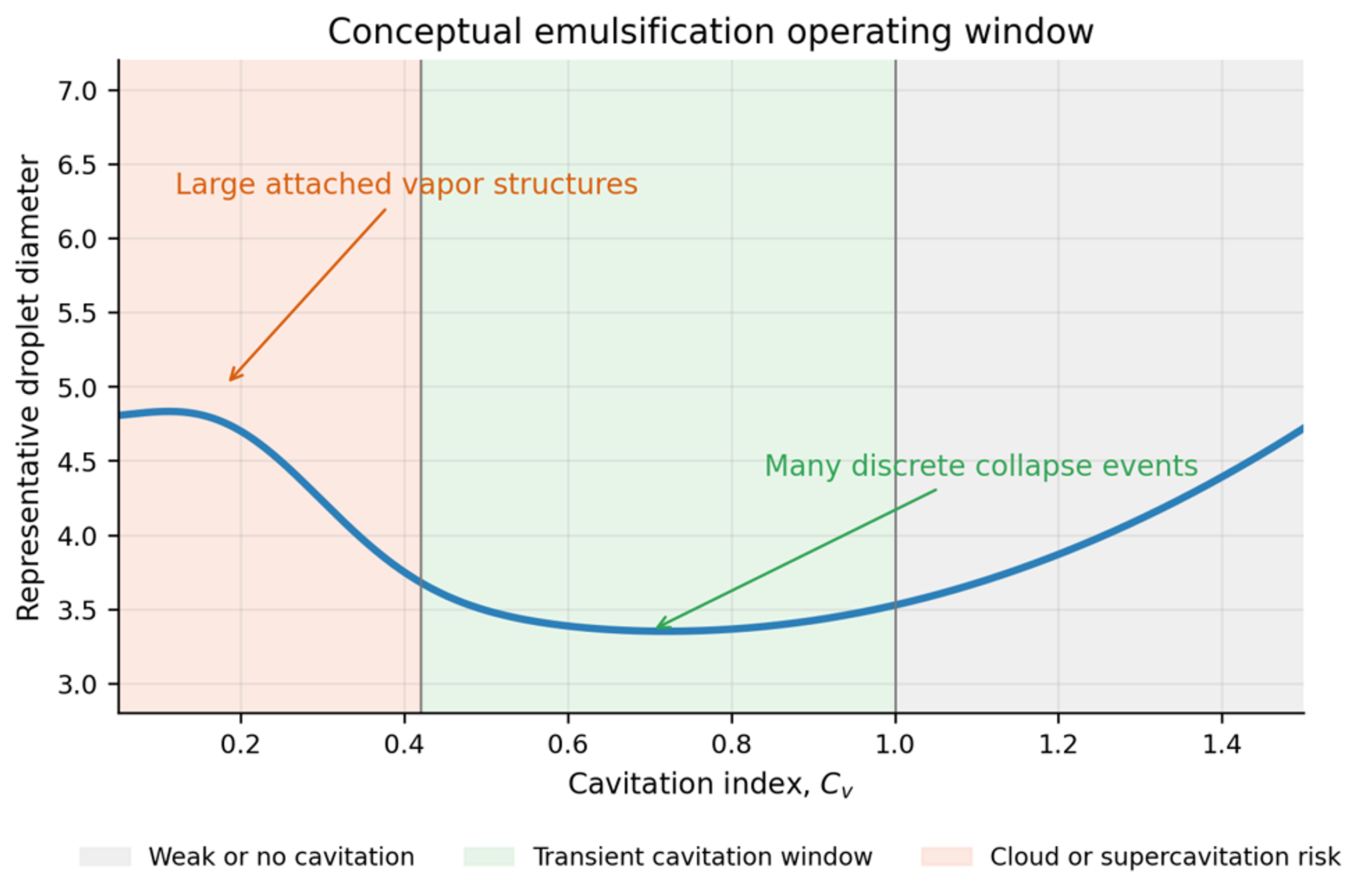
Figure 4. Conceptual operating window. Droplet size may pass through a minimum as cavitation progresses from inception to a field of many transient cavities and then to large, attached vapor structures [9].
The visually largest cavity is not necessarily the most useful emulsification state. In a transient regime, many bubbles can collapse separately in the recovery zone. In a supercavitating or choked state, a large, attached vapor region can reduce the number of discrete collapse events, redistribute pressure recovery, and increase gas or vapor shielding. The optimum is therefore device and formulation specific and should be identified from product response, pressure signals, temperature, and flow behavior rather than from visual intensity alone [3,5–7,18,19].
3.2 Dimensionless breakup criteria
Several dimensionless groups organize the combined effects of inertia, viscosity, interfacial tension, and geometry. The Reynolds number is:
The droplet Weber number is:
The capillary number is:
The Ohnesorge number is:
The viscosity ratio is:
Here is a device length scale, is a characteristic droplet scale velocity difference, and is a shear rate. The capillary restoring pressure of a spherical droplet is:
Breakup becomes probable when a disruptive stress exceeds capillary and viscous resistance. A compact engineering form is:
The critical value is not universal because deformation history, surfactant mobility, internal circulation, and stress type differ among shear, extension, turbulence, and cavity collapse.
Table 3. Dimensionless groups and their use in hydrodynamic cavitation emulsification.
| Group | Expression | Main role | Caution |
|---|---|---|---|
| Cavitation number | Pressure margin for cavity formation | Definition and pressure tap location must be stated | |
| Reynolds number | Ratio of inertia to viscosity | Does not describe local collapse intermittency | |
| Weber number | Inertial stress relative to capillarity | Choice of local velocity is model dependent | |
| Capillary number | Viscous shear relative to capillarity | More useful in viscous or extensional regions | |
| Ohnesorge number | Internal viscous resistance | Changes as droplets become smaller | |
| Viscosity ratio | Internal circulation and deformation | Temperature can change both viscosities strongly | |
| Euler number | Device pressure loss relative to inertia | Not a cavitation intensity measure by itself |
3.3 Turbulent, extensional, and collapse induced stresses
In the inertial subrange of locally isotropic turbulence, the characteristic stress acting across a droplet of diameter may be written:
where is the local turbulent energy dissipation rate per unit mass. Balancing turbulent stress with capillary pressure gives the Kolmogorov and Hinze estimate for the maximum stable diameter [12,20–22]:
where is an empirical constant that depends on the flow and criterion used. The smallest turbulent length scale is:
where is the kinematic viscosity. When droplets approach or fall below , viscous range deformation and local strain become more relevant than inertial subrange scaling. Cavitation adds a second, highly intermittent stress population. For this reason, a model based only on a reactor average can reproduce overall trends yet miss device to device differences created by collapse location and probability.
The active exposure of a fluid element is often summarized by the residence time:
where is the active or nominal reactor volume and is volumetric flow. For recirculation systems, the average hydraulic power is:
and the specific hydraulic energy delivered in one pass is:
The ideal number of passes through a recirculating loop over processing time is:
where is the batch or loop inventory. Actual exposure is distributed because of mixing in the tank, bypassing, and residence time dispersion. These equations are useful for energy accounting, but they do not identify how much energy is deposited in the effective cavitation region.
3.4 Bubble collapse energetics
The radial dynamics of an isolated spherical cavity in an incompressible liquid are commonly represented by the Rayleigh and Plesset equation:
where is bubble radius, is internal bubble pressure, is the far field pressure, and is liquid vapor surface tension. Compressibility, heat and mass transfer, noncondensable gas, nearby walls, neighboring bubbles, and nonspherical collapse require more advanced models. For an empty spherical cavity collapsing under constant pressure difference , the Rayleigh collapse time is approximately:
A simple pressure volume work estimate for collapse from to is:
For complete collapse, , the corresponding average collapse power is:
If the affected liquid mass is approximated by the liquid occupying the initial bubble volume,
then the local specific dissipation estimate is:
Equation (29) is a local idealization, not a reactor average energy balance. It shows why small collapse length scales and high recovery pressure can create very high instantaneous dissipation, while the total energy assigned to useful droplet breakup remains a small fraction of pump power. It also clarifies why a large, attached cavity at low collapse pressure may be less useful than many smaller cavities collapsing under a stronger pressure recovery [3,4,23].