
Technical publication
Back to publications
Reactors & equipment
Hydrodynamic Cavitation in Emulsification and Homogenization
okozyuk.com
Published
Read complete publication for whole-document Find and printing. Browser Find and native printing on this reader include only loaded content.
2 Emulsion Fundamentals and Product Metrics
2.1 Emulsion classes and terminology
Oil in water (O/W) emulsions contain oil droplets in an aqueous continuous phase. Water in oil (W/O) emulsions contain water droplets in an oil phase. Multiple emulsions, such as W/O/W and O/W/O, contain droplets within droplets. Pickering emulsions are stabilized predominantly by solid particles adsorbed at the interface. The terms macroemulsion, miniemulsions, nanoemulsion, and microemulsion are used inconsistently across disciplines, so every technical specification should state the actual measurement method and size statistics rather than rely on a category name alone [1,2,10,11].
Table 1. Practical classification of liquid dispersion systems. Size boundaries are approximate and overlap among fields.
| System | Typical droplet scale | Thermodynamic status | Common preparation route | Design implication |
|---|---|---|---|---|
| Coarse or macroemulsion | 1 to 100 µm, sometimes larger | Unstable at equilibrium; kinetically stabilized | Agitated tank, static mixer, rotor stator | Separation may be rapid unless viscosity or interfacial stabilization is sufficient |
| Miniemulsion or submicron emulsion | 0.1 to 1 µm | Kinetically stabilized | High shear, high pressure homogenization, cavitation | Requires rapid surface coverage and control of the coarse tail |
| Nanoemulsion | Roughly 20 to 500 nm | Kinetically stabilized | High pressure homogenization, microfluidization, ultrasonication, cavitation, phase inversion | Optical appearance, ripening, and surfactant demand become dominant |
| Microemulsion | Commonly 10 to 100 nm | Thermodynamically stable over a composition region | Spontaneous self-assembly with high surfactant and often cosurfactant loading | Formulation, not mechanical energy, is the controlling variable |
| Multiple emulsion | Internal and external droplets may span submicron to tens of micrometres | Kinetically stabilized and structurally complex | Sequential emulsification | Excessive second stage stress can destroy internal droplets |
| Pickering emulsion | Broad range | Kinetically stabilized by particles | High shear plus particle wetting control | Particle wettability and adsorption energy govern stability |
2.2 Droplet size distribution and interfacial area
A single mean diameter cannot fully describe an emulsion. Number weighted measurements emphasize small droplets, while volume weighted and scattering based methods emphasize large droplets. The generalized moment mean diameter for discrete size classes is:
where is the number of droplets in class and is the representative diameter. The Sauter mean diameter, which preserves the volume to area ratio, is:
The volume weighted mean diameter is:
For spherical droplets, the interfacial area per unit emulsion volume is related directly to :
where is the dispersed phase volume fraction. This equation explains why a modest reduction in diameter creates a large increase in surface area and surfactant demand. The breadth of a distribution is often summarized by the span:
where , , and are cumulative percentile diameters. A process may reduce while leaving an undesirable coarse tail. For quality control, the minimum reporting set should therefore include the measurement method, dilution protocol, basis of weighting, or Z average, , span or polydispersity index, temperature, and the time between processing and analysis.
Table 2. Droplet size and distribution metrics used in emulsification studies.
| Metric | Physical meaning | Strength | Main limitation |
|---|---|---|---|
| Diameter with the same volume to area ratio as the distribution | Directly related to interfacial area and many breakup models | Can conceal a coarse tail | |
| Volume weighted mean | Sensitive to large droplets and useful for process failure detection | Strongly affected by a small number of coarse droplets | |
| , , | Cumulative distribution percentiles | Describe distribution location and coarse fraction | Depend on weighting basis and instrument model |
| Span | Relative width from , , | Simple comparison of breadth | Does not show multimodality |
| PDI | Polydispersity index from dynamic light scattering | Useful for submicron systems | Not interchangeable with laser diffraction span |
| Z average | Cumulants mean from dynamic light scattering | Standard for many nanoemulsions | Sensitive to dilution and scattering assumptions |
| Specific interfacial area | Area per unit mass or volume | Connects droplet size to mass transfer and surfactant demand | Requires spherical droplet and composition assumptions |
The reversible work required to create interface is the increase in interfacial free energy:
where γ is the interfacial tension. Mechanical equipment supplies far more energy than the thermodynamic minimum because most input is dissipated as bulk turbulence, heat, vibration, sound, viscous loss, and pump inefficiency. Interfacial area generated per unit energy is therefore a more revealing comparison metric than nominal power alone [2,12,13].
2.3 Stability mechanisms
Small droplets reduce gravitational separation, but they do not make an emulsion thermodynamically stable. In the dilute Stokes regime, the creaming or sedimentation velocity is approximated by
where and are continuous and dispersed phase densities, is gravitational acceleration, and is continuous phase viscosity. The quadratic diameter dependence is a major reason that homogenization slows creaming. The equation becomes inaccurate in concentrated, non Newtonian, flocculated, or hindered settling systems.
Ostwald ripening can be summarized by a cubic radius growth law:
where depends on interfacial tension, solubility of the dispersed phase in the continuous phase, diffusivity, molar volume, temperature, and formulation. Hydrodynamic cavitation does not remove the need to control ripening, coalescence, or flocculation. It can even increase the driving force for instability by creating more interface. The resulting emulsion remains useful only when interfacial coverage, electrostatic or steric repulsion, continuous phase rheology, and storage conditions provide an adequate kinetic barrier [1,2,14].
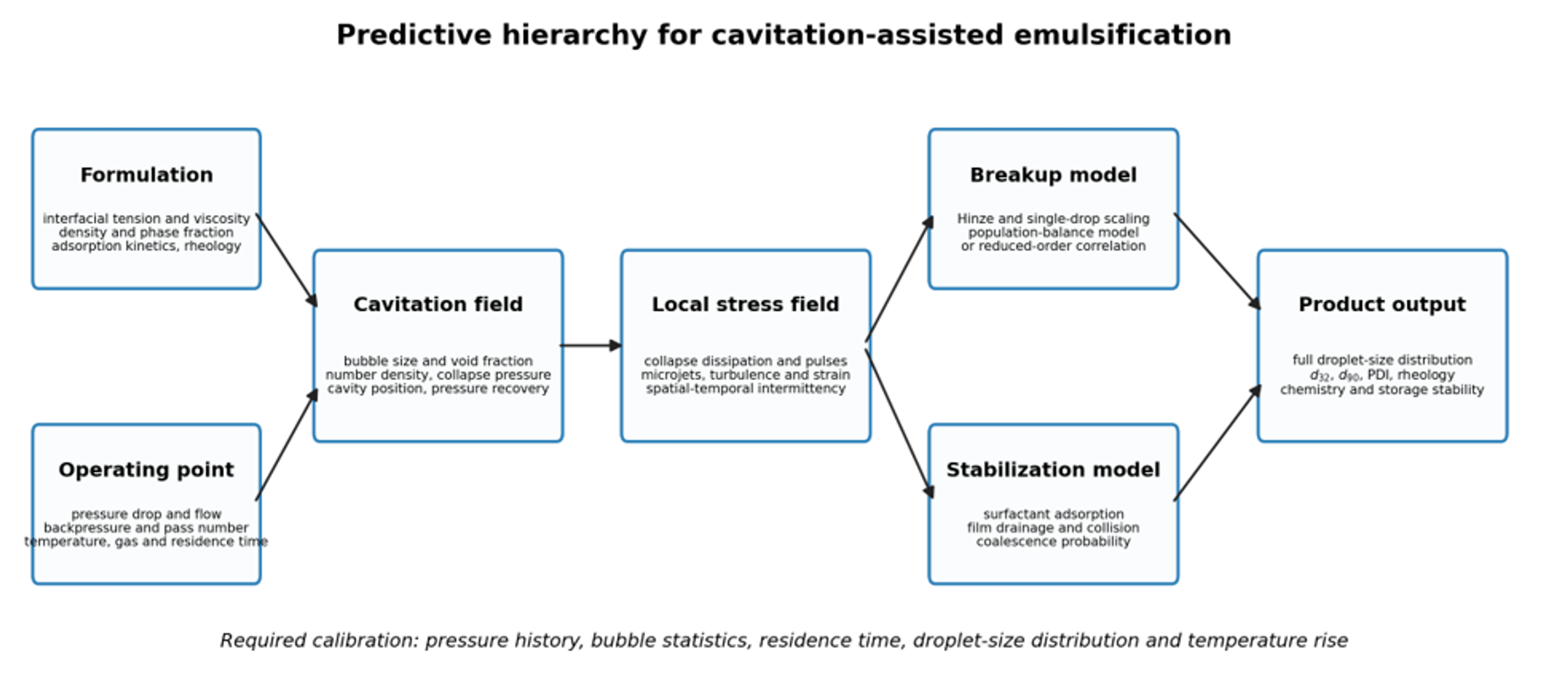
Figure 3. Predictive hierarchy for cavitation assisted emulsification. Formulation and operating inputs determine the cavitation field and local stress distribution; breakup and stabilization models then predict the droplet size distribution and product properties [9].