
Technical publication
Back to publications
Reactors & equipment
Hydrodynamic Cavitation in Emulsification and Homogenization
okozyuk.com
Published
Read complete publication for whole-document Find and printing. Browser Find and native printing on this reader include only loaded content.
1 Introduction
Hydrodynamic cavitation applied to emulsification and homogenization requires a consistent framework for hydraulic definitions, energy boundaries, residence time, uncertainty, and scale translation. This article develops the mechanisms, mathematical models, equipment configurations, operating variables, validation methods, and acceptance criteria specific to cavitation assisted emulsification and homogenization.
Emulsification is the formation of a dispersion in which one liquid is present as droplets within another immiscible or only partly miscible liquid. Homogenization is a broader operation that reduces and equalizes the size of droplets, particles, aggregates, or other inhomogeneities. In industrial practice, a single machine may perform premixing, emulsification, deagglomeration, homogenization, heating, extraction, and reaction intensification in the same pass. The central engineering task is therefore not simply to create small droplets. It is to create the required distribution of sizes, stabilize the newly generated interface, and do so at the necessary throughput without unacceptable heating, oxidation, erosion, contamination, or maintenance burden [1–4].
These operations are important in foods and beverages, dairy products, mayonnaise and dressings, cosmetics, dermatological products, injectable and oral formulations, agrochemical concentrates, fuel water dispersions, polymer latexes, coatings, lubricants, edible oil refining, fermentation media, and specialty chemicals. Droplet size influences opacity, mouthfeel, flavor release, viscosity, creaming, sedimentation, filtration, sprayability, dissolution, drug release, reaction rate, and interphase mass transfer [1,2]. Practical process objectives include dispersing one liquid within another, reducing and narrowing the droplet size distribution, suppressing creaming and coalescence, and improving the required physical, chemical, or biological performance [3].
Conventional high energy equipment includes rotor stator mixers, colloid mills, high pressure homogenizers, microfluidizers, and ultrasonic processors. Low energy routes include phase inversion, spontaneous emulsification, and membrane methods. Each route occupies a different region of throughput, attainable droplet size, formulation dependence, energy input, cleanability, and capital cost. Hydrodynamic cavitation is attractive because cavities are produced by the liquid flow itself, usually through a constriction, vortex chamber, valve, nozzle, cone, rotor stator clearance, or perforated rotating element. This permits continuous processing with conventional pumps and piping, without the limited penetration depth and scale sensitivity of an acoustic field [5–8].
The local nature of cavitation is both its advantage and its main design difficulty. The most severe events occur near collapsing cavities, while the volume averaged power density may be modest. Weak cavitation may add little beyond ordinary turbulence. Excessive vapor formation may produce a large, attached cavity or vapor blanket, reduce the number of discrete collapses, increase heat load and gas entrainment, and expose equipment to erosion. The correct question is therefore: which bubble population, pressure recovery field, residence time, and formulation create the required droplet size distribution at the lowest total process penalty?
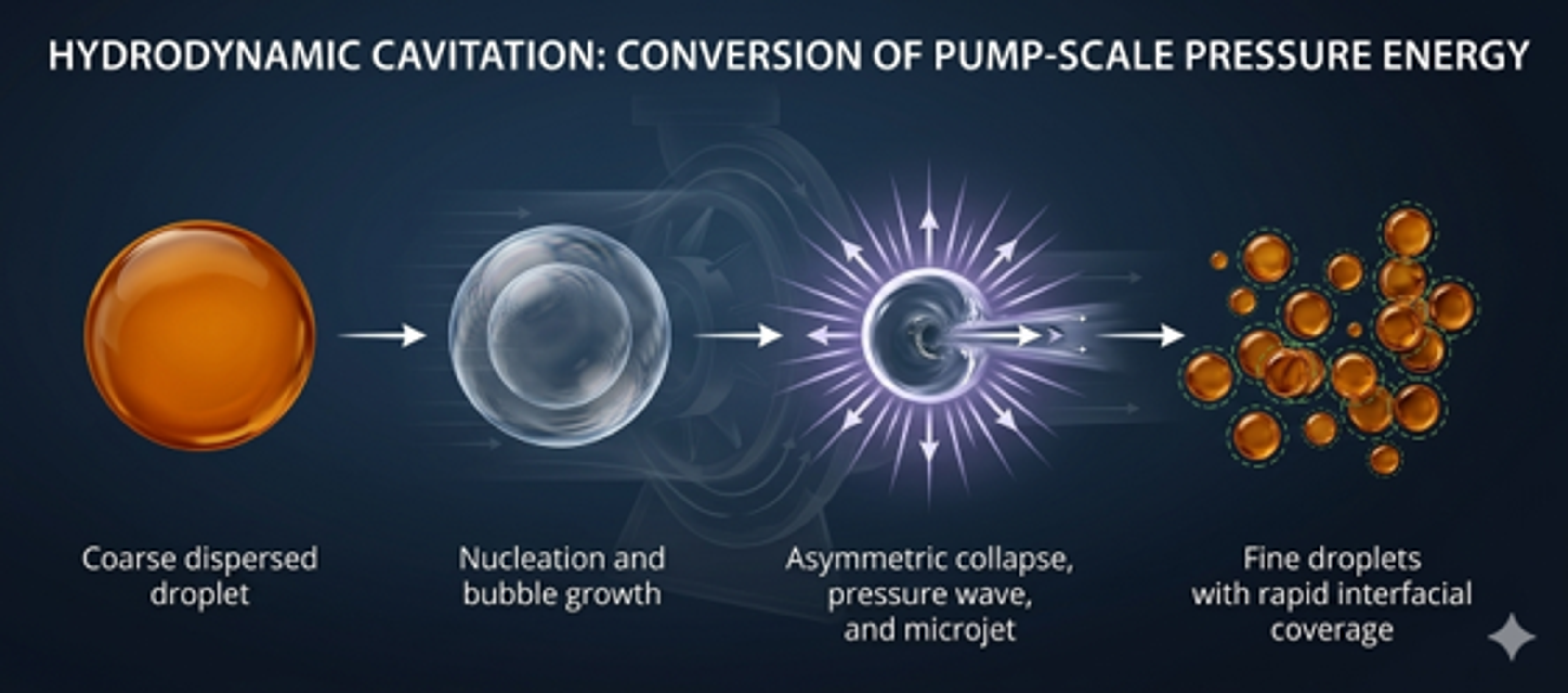
Figure 1. Conceptual sequence for cavitation assisted droplet breakup and stabilization. A coarse droplet is deformed by pressure and velocity fluctuations, fragmented near a collapse event, and then stabilized by rapid interfacial coverage [9].
Cavitation assisted emulsification differs from a purely mechanical shear process in three respects. First, the stress field is highly intermittent. Second, cavity collapse can generate strong gradients over distances comparable to bubble and droplet dimensions. Third, the pressure recovery zone is as important as the low pressure generation zone because collapse, rather than vapor formation alone, supplies much of the disruptive action. These distinctions explain why average inlet pressure, nominal power, or cavitation number alone seldom predicts product quality across different devices.
A central distinction in this article is made between breakup capacity and stabilization capacity. Breakup capacity is the ability of the flow to overcome capillary and viscous resistance. Stabilization capacity is the ability of surfactants, proteins, polymers, or particles to cover newly generated interface and prevent recoalescence. A process may therefore provide sufficient breakup while still producing a coarse or broad distribution when adsorption is too slow or droplet collisions are too frequent.
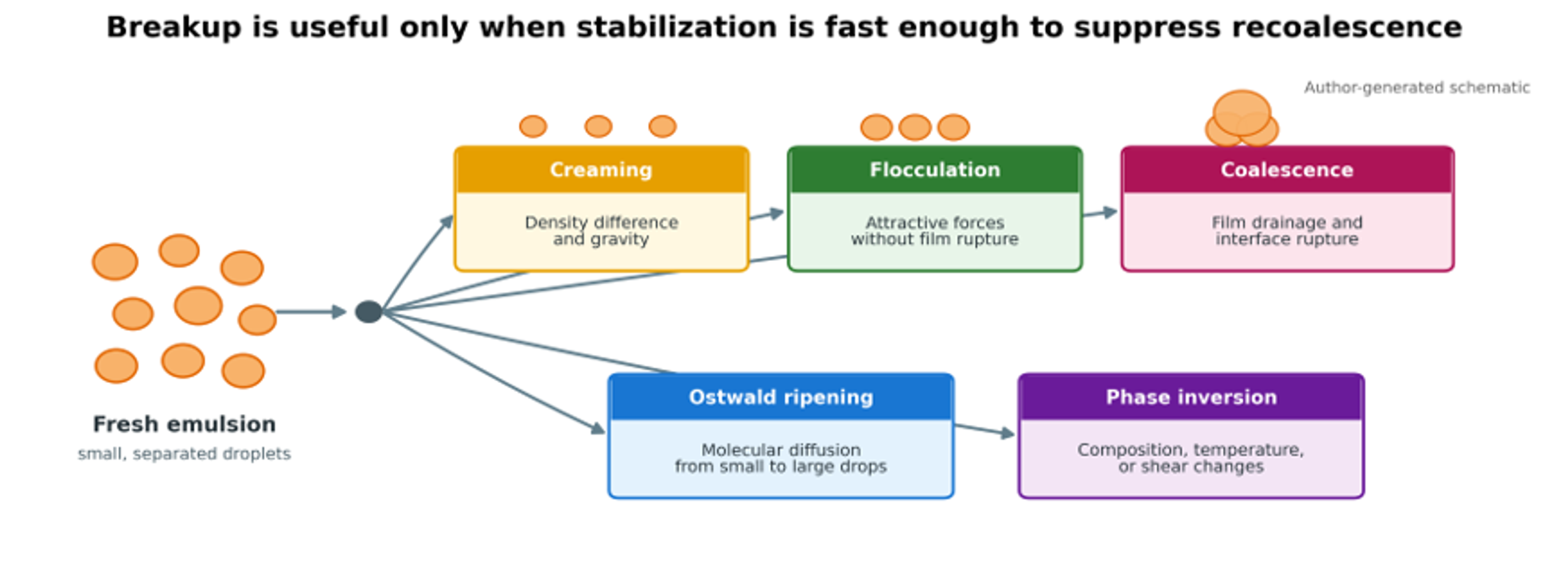
Figure 2. Principal physical destabilization pathways after emulsification. Creaming and sedimentation redistribute droplets, flocculation joins droplets without merging, coalescence merges droplets, Ostwald ripening transfers material through the continuous phase, and phase inversion changes emulsion topology [9].