
Technical publication
Back to publications
Other
Fabrication of High Performance Catalysts by Controlled Flow Cavitation
okozyuk.com
Published
Read complete publication for whole-document Find and printing. Browser Find and native printing on this reader include only loaded content.
5 Structure Forming Mechanisms
5.1 Micromixing and Suppression of Compositional Segregation
In conventional coprecipitation, local pH and supersaturation can differ substantially from bulk measurements. One metal hydroxide may nucleate near the precipitant inlet while another remains soluble. Cavitation can shorten the lifetime and spatial scale of these gradients by exposing the fresh intermediate to high velocity gradients, turbulent eddies, extensional deformation, and repeated pressure fluctuations. The improved phase purity reported for perovskites and cobalt molybdates is consistent with more uniform local composition before substantial aging occurs [1-7,23-27].
Micromixing is not equivalent to molecular equilibrium. Extremely rapid precipitation can occur before complete mixing, and the initial feed contact can determine the first nuclei. The preferred configuration places the principal mixing event at or immediately before the restriction, minimizes stagnant premix volume, and uses feed rates that maintain the required stoichiometry throughout the run. A pH measurement in the recycle tank cannot resolve transient pH at the feed contact point.
5.2 Fragmentation, Deagglomeration, and Surface Renewal
Fresh precipitates are often fractal gels or weak agglomerates rather than dense primary crystallites. Pressure waves, turbulent stress, and microjets can rupture these networks. Fragmentation increases external area, shortens diffusion distances for washing and precursor decomposition, exposes new support surface, and can distribute a secondary phase more uniformly across a support.
Fragmentation of soft agglomerates must be distinguished from comminution of dense crystallites. X-ray diffraction may show unchanged crystallite size while laser diffraction shows a large decrease in agglomerate size. Conversely, nucleation and growth can change crystallite size without a comparable change in measured hydrodynamic diameter. A complete study should therefore include at least one primary structure method and one suspension scale particle size method.
5.3 Local Heating and the In Situ Calcination Hypothesis
The early cavitation program reported three principal observations consistent with localized precursor decomposition. Selected area electron diffraction of selected dried products indexed to oxide phases. Ammonium molybdate processed in an insoluble medium produced X-ray patterns interpreted as indicating greater decomposition than oven treated references exposed for several hours. A kinetic back calculation suggested bulk particle heating above approximately 200 °C and a short inferred event near 675 °C. Calcium fluoride particles recirculated through a CaviMax processor became more rounded and developed necklike contacts [6,23-27].
These observations are important but indirect. They do not measure bubble temperature, heat flux into a suspended particle, or the temperature distribution within a gel agglomerate. Rounded particles may also result from impact, fracture followed by redeposition, dissolution and reprecipitation, or preferential abrasion. The Cu-Zn-Al study in the source materials did not observe the expected in situ calcination under its test conditions. A modern investigation should therefore combine high speed pressure measurements, calorimetry, thermally sensitive probe reactions, rapid product sampling, and thermal controls before assigning a unique local temperature.
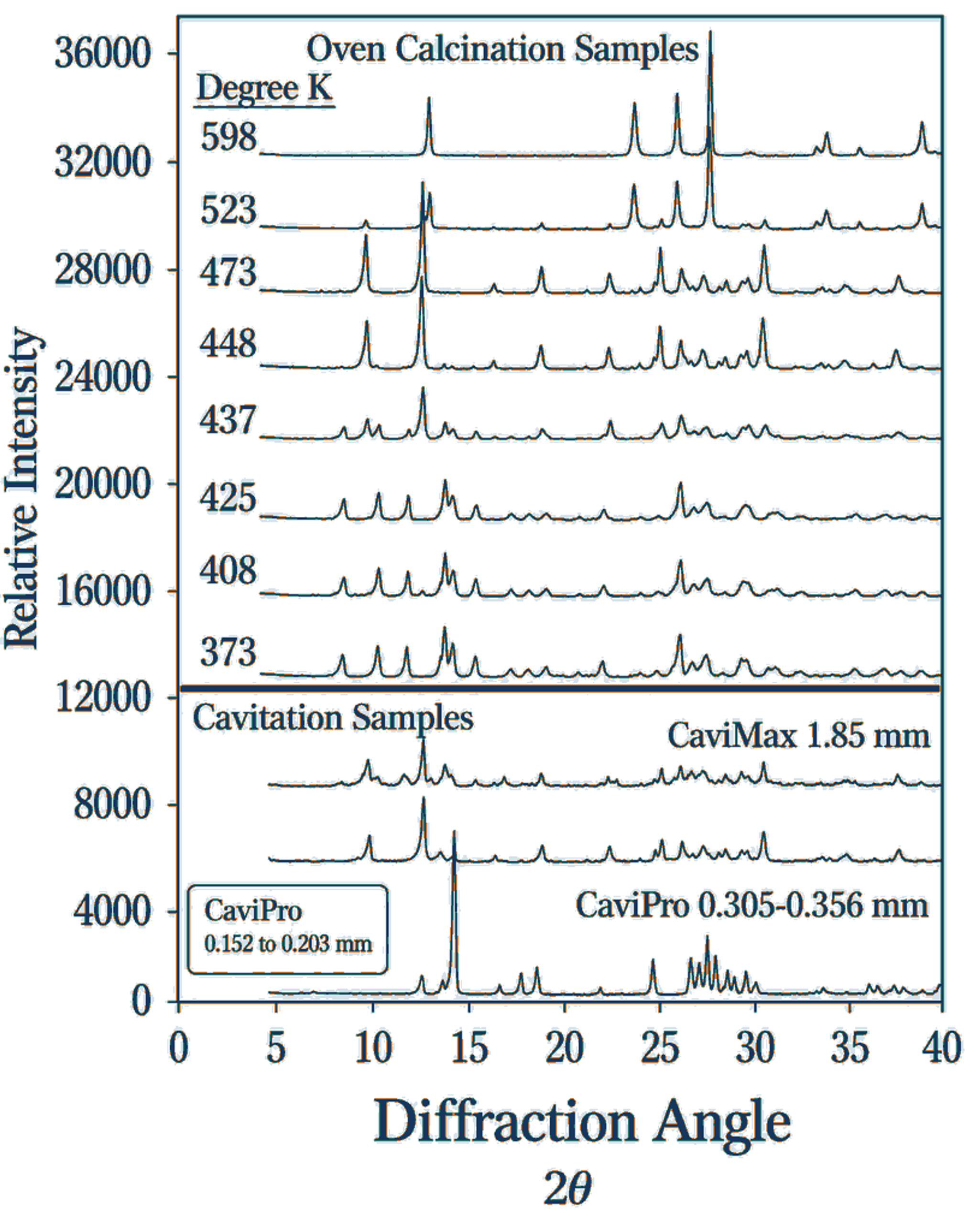
Figure 5.1. X-ray diffraction comparison was used in the early cavitation program to infer ammonium molybdate decomposition during processing. [6] The result is indirect evidence of thermal or mechanically assisted conversion.
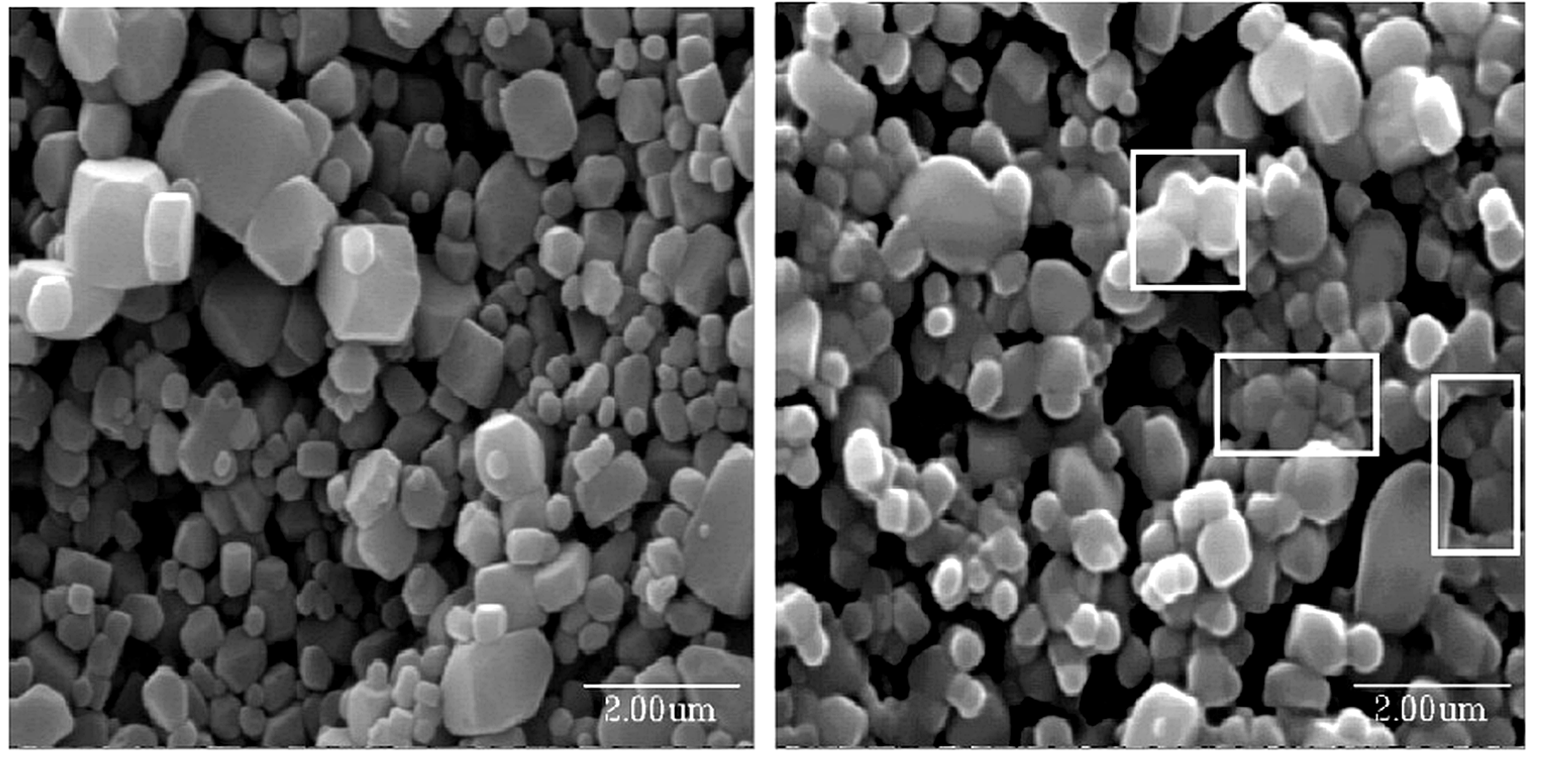
Figure 5.2. Calcium fluoride before and after CaviMax recirculation. The processed material shows rounding and necklike contacts that were interpreted as evidence of local softening. [25].
5.4 Nucleation, Growth Arrest, and Microstrain
CFC can increase nucleation by rapidly establishing a more uniform supersaturation field, dispersing embryos, and providing particle or bubble interfaces for heterogeneous nucleation. Sustained growth can be limited because residence time in the most intense zone is short and the slurry rapidly returns toward bulk temperature. Conversely, recycle and warm holding can promote ripening. Final size is therefore an emergent response to chemistry, hydrodynamics, and downstream thermal history.
Microstrain measured by diffraction line broadening can arise from lattice mismatch, coherent interfaces, compositional gradients, vacancies, dislocations, or residual stress, but it can also reflect analysis artifacts. Early work reported adjustable strain in copper-zinc-aluminum oxides, titania, and lead zirconate titanate, suggesting that mechanical and thermal history may alter defect retention independently of mean crystallite size. The catalytic significance depends on whether those defects survive activation and contribute to a measurable active site population.
Table 5.1. Mechanistic hypotheses and decisive experiments
| Hypothesis | Consistent observations | Decisive experiment | Interpretation risk |
|---|---|---|---|
| Rapid micromixing improves composition uniformity | Higher phase purity in multimetal oxides | Time resolved feed tracer and spatial composition mapping | Phase purity can also result from calcination |
| Collapse fragments soft gels | Smaller agglomerates and improved dispersion | In situ particle size before and after one pass | Drying can create or destroy agglomerates |
| Local heating decomposes precursor | Oxide diffraction and decomposition pattern | Fast product quench with thermal markers and calorimetry | Pressure, abrasion, and dissolution may mimic heating |
| CFC increases nucleation density | Shorter induction and smaller crystallites | Nucleation rate measured at constant supersaturation | Higher mass transfer can also accelerate growth |
| CFC introduces useful defects | Higher microstrain or altered lattice parameter | Operando spectroscopy linked to intrinsic rate | Line broadening can include instrument and size effects |
| Pressure recovery controls collapse location | Back pressure changes structure and erosion | Synchronized pressure field and high speed visualization | A single downstream pressure cannot describe the cloud |