
Technical publication
Back to publications
Other
Engineering Calculations for Rotor-Stator Mixers
okozyuk.com
Published
Updated
Read complete publication for whole-document Find and printing. Browser Find and native printing on this reader include only loaded content.
4 Flow pulsation frequencies
4.1 Local feature passage
At a stationary observation point, passage of identical rotor features produces the kinematic frequency
This frequency commonly appears in a pressure signal measured near one stator opening. Its amplitude depends on the rotor and stator patterns and on the hydraulic response. Harmonics at , and higher multiples arise from departures of the local waveform from a sinusoid. A kinematic event frequency therefore specifies a candidate spectral component, while its measured amplitude requires a flow model or an experiment.
4.2 Integrated overlap and exposure time
The summed overlap around the circumference has additional symmetry. For ideal uniformly spaced rotor and stator patterns with feature counts and , a repeat frequency associated with their common rotational symmetry is
Equation (4.2) gives a symmetry repeat frequency of the integrated opening pattern. It does not guarantee a nonzero fundamental in the measured pressure or even a varying total open area. Particular opening widths can cancel the corresponding Fourier coefficient, and the first surviving component can occur at a higher harmonic. Asymmetry, maldistribution, sensor position, staggered rows and hydraulic coupling can instead emphasize , , shaft frequency or other combinations. The reported frequency must identify whether it refers to a local passage event, a geometric repeat or an observed pressure component.
For characteristic effective width and relative tangential velocity , a nominal exposure time is
The width depends on both opening widths and on whether exposure means any overlap or a selected effective area. The duty ratio is meaningful only when refers to successive equivalent events of that same opening definition. Local exposure time should not be combined automatically with a frequency calculated from the summed circumferential area.
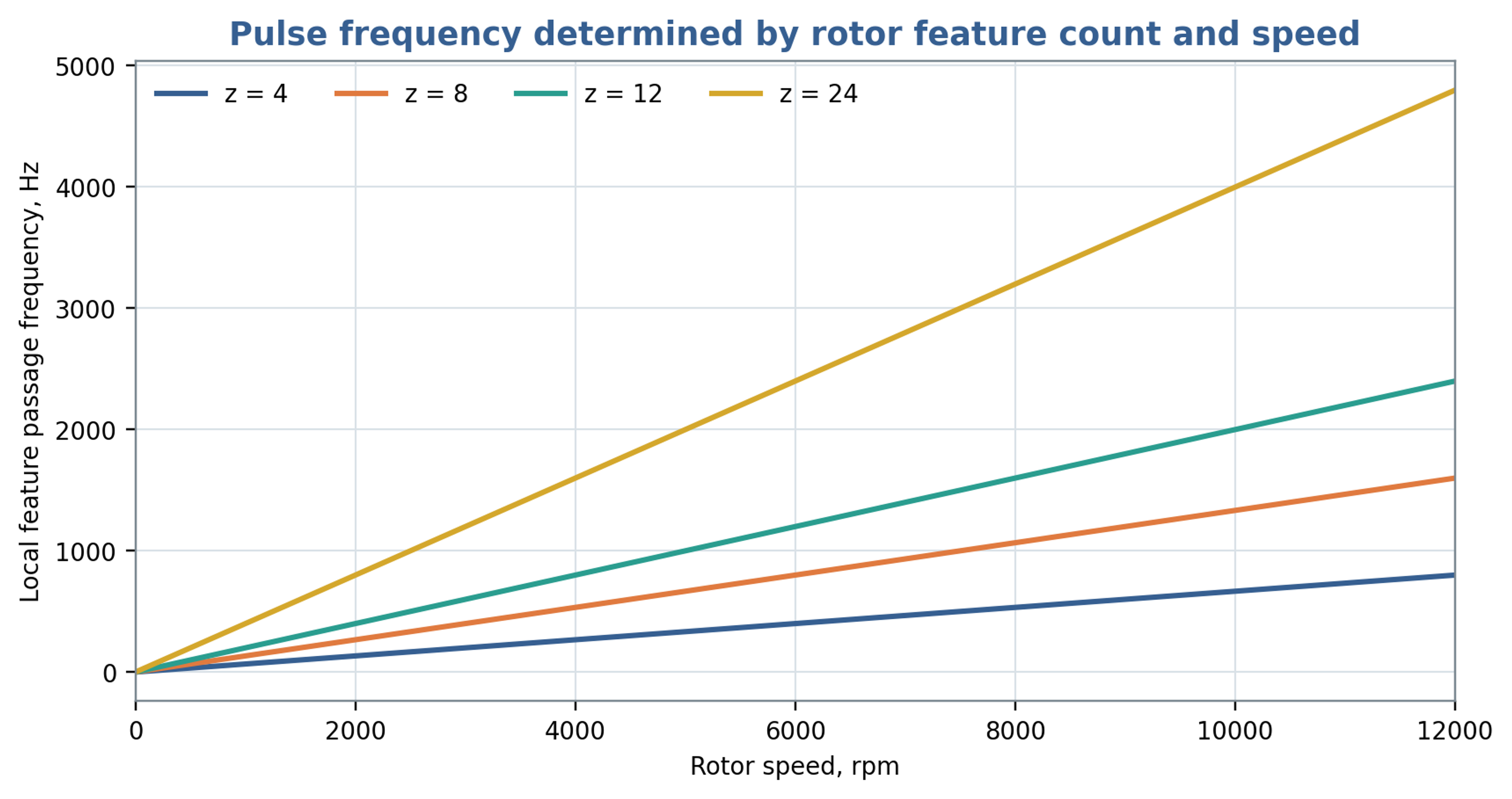
Figure 4.1. Local rotor feature passage frequency as a function of shaft speed and feature count, calculated from Equation (4.1).
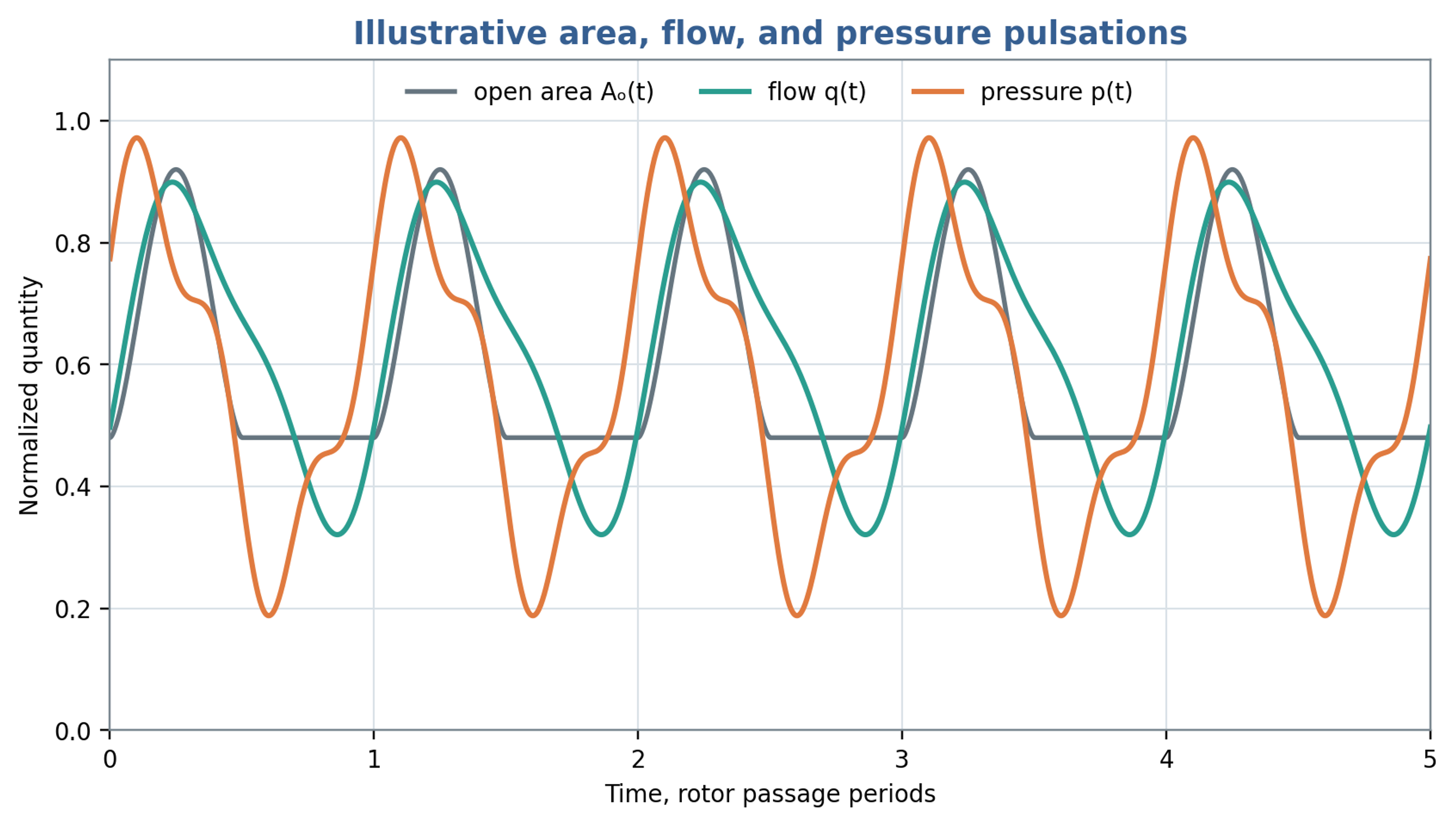
Figure 4.2. Illustrative normalized opening area, flow and pressure waveforms. Hydraulic inertia and resistance introduce phase differences between the signals. The traces are model examples.
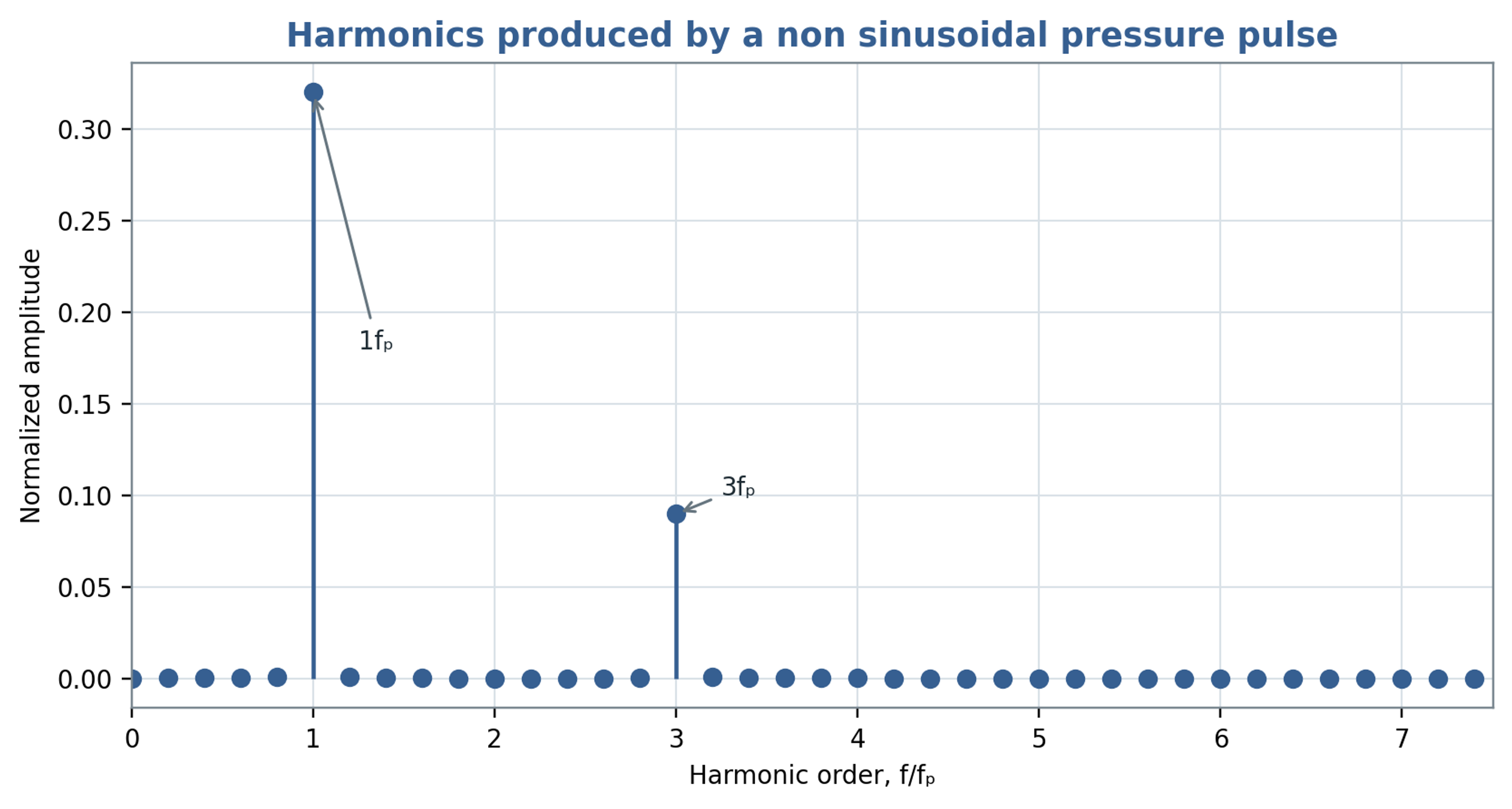
Figure 4.3. Harmonic spectrum of the illustrative pressure waveform. Spectral amplitudes refer to the specified example and are not a universal mixer spectrum.
Table 4.1. Frequency definitions used in rotor stator calculations
| Frequency | Definition | Typical use |
|---|---|---|
| Shaft frequency | Mechanical vibration, imbalance, once per revolution asymmetry | |
| Rotor local passage | Pressure or velocity near a fixed stator location | |
| Stator interaction count | when viewed from a rotor attached sensor or repeated rotor path | Relative pattern interaction |
| Integrated overlap symmetry repeat | for ideal uniform patterns | Symmetry of total opening area; verify nonzero harmonics |
| Harmonics | , | Sharp opening and closing, resonance, noise |
| Structural natural frequency | Determined from housing, shaft, pipe, and supports | Resonance screening |