
Technical publication
Back to publications
Other
Emulsification and Homogenization in Rotor-Stator Mixers
okozyuk.com
Published
Read complete publication for whole-document Find and printing. Browser Find and native printing on this reader include only loaded content.
7 Coalescence and population balance
The droplet distribution measured after processing reflects both fragmentation and the loss of newly formed droplets through coalescence. These mechanisms alter droplet number in opposite directions while conserving the total dispersed volume when phase transfer is negligible. A population balance provides a systematic way to combine these events with transport and residence time. It also identifies which experimental quantities are required to distinguish a mechanically limited process from one controlled by interfacial stabilization.
7.1 Collision and film drainage
Coalescence is the process by which colliding droplets merge after the intervening continuous phase film drains and ruptures. Collision is necessary but does not guarantee merger. Adsorbed surfactants, proteins, polymers, or particles can change film mobility, introduce repulsive forces, and provide interfacial mechanical resistance. Continuous phase viscosity also affects drainage and contact time. The probability of coalescence therefore depends jointly on hydrodynamics and formulation and cannot be inferred from collision frequency alone.
For droplets assigned to classes i and j, a class pair collision rate can be written as
where is the collision kernel and and are number concentrations. The expression applies directly to distinct classes. For the number of unordered collisions within one class, a factor of one half is required to avoid counting each pair twice.
The fraction of collisions that results in merger is represented by the coalescence efficiency:
where is the probability that a collision produces coalescence under the specified conditions. The same pair counting convention used for the collision rate must be retained.
Turbulent relative motion can increase the collision kernel, whereas effective interfacial stabilization reduces coalescence efficiency. Increasing rotor speed may therefore accelerate both fragmentation and encounters between droplets. The observed population evolves according to the balance of these processes and the distribution of exposure times. A final or slowly changing mean diameter does not imply that all microscopic events have ceased.
7.2 Population balance representation
A population balance describes the evolution of droplet number across size classes while accounting for transport, fragmentation, and coalescence. Unlike a correlation for a single mean diameter, it retains information about the distribution and can connect local flow conditions to the product leaving a device. For a number density expressed per unit physical volume and per unit droplet volume, the balance takes the form
where and denote births and deaths caused by breakup, while and denote births and deaths caused by coalescence. Density also depends on position, although that dependence is suppressed in the displayed notation. The balance shown assumes that droplets share the represented transport velocity; separate slip or spatial dispersion terms may be needed when these effects are significant.
For a breakup frequency that is specified for each droplet volume, the corresponding death term is
where g(v) is the frequency at which droplets of volume v undergo breakup.
The birth term sums daughter droplets created by breakup of all larger parents:
Loss of droplets through coalescence with other sizes is described by
Closure requires the coalescence birth term as well as the displayed loss term. For binary merger, this term collects pairs whose volumes sum to the product droplet volume and includes the pair counting factor needed to prevent duplication. Breakup and coalescence kernels must be calibrated or independently validated and must conserve dispersed volume. Coupling the population balance to computational fluid dynamics also requires consistent treatment of local stress, residence time, and stochastic exposure. A model fitted only to one average diameter can reproduce that quantity while predicting an incorrect distribution or coarse fraction [8, 24, 25, 26].
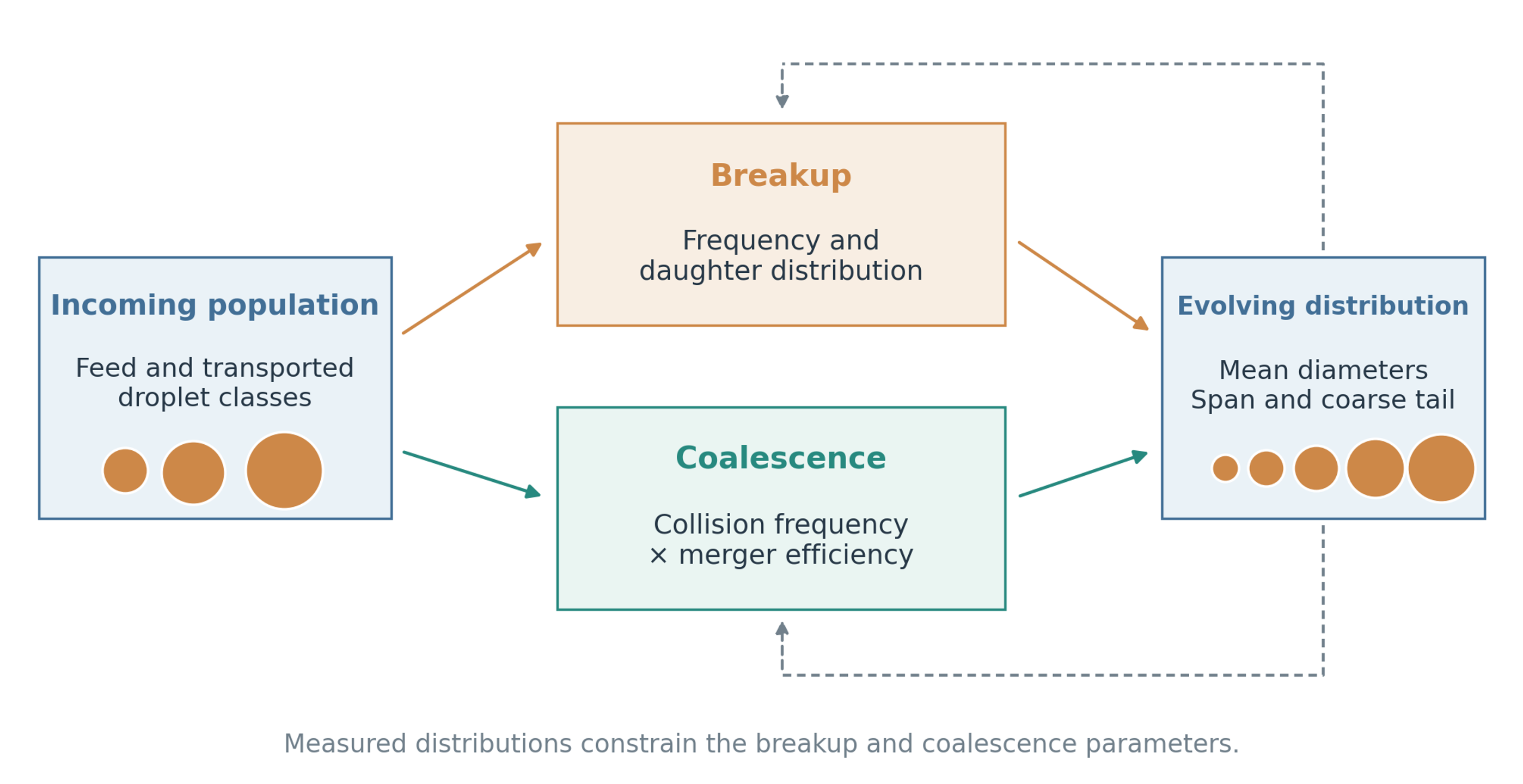
Figure 7.1. Population balance representation of emulsification. Transport, breakup frequency, daughter size distribution, collision frequency, and coalescence efficiency determine the evolving droplet distribution. Measurements are needed to constrain model parameters.
7.3 Approach to an asymptotic distribution
Repeated treatment commonly produces progressively smaller changes in the measured distribution. An empirical approach to an asymptote can describe this behavior over a calibrated range of equivalent pass number. The relation is useful for estimating treatment time and identifying diminishing returns, provided that the formulation and operating conditions remain approximately constant. One such expression is
where is the initial Sauter mean diameter, is the fitted asymptotic value, and is an empirical pass constant. In this equation denotes equivalent pass number, rather than the rotational frequency denoted by in the hydrodynamic expressions.
The fitted asymptote describes the tested process and does not establish a fundamental mechanical limit. Emulsifier availability, adsorption, temperature change, air incorporation, coalescence, or nonuniform circulation can each influence the apparent limiting diameter. Model fitting should therefore use the accompanying temperature, power, and distribution data, and extrapolation beyond the investigated pass range should be treated as a prediction requiring confirmation. A useful endpoint is reached when the product specification is met with acceptable thermal exposure and when additional passes provide insufficient benefit to justify their energy cost.