
Technical publication
Back to publications
Other
Emulsification and Homogenization in Rotor-Stator Mixers
okozyuk.com
Published
Read complete publication for whole-document Find and printing. Browser Find and native printing on this reader include only loaded content.
5 Interfacial thermodynamics and emulsifier dynamics
Newly formed droplets must acquire an interface that resists merger during subsequent collisions. The relevant description includes the equilibrium relation between bulk concentration and surface coverage, the rate at which that coverage develops, and the response of the interfacial layer to deformation. These processes explain why a formulation with a low measured equilibrium tension may behave differently during a short mixing event and why total emulsifier concentration alone is an incomplete measure of stabilization capacity.
5.1 Equilibrium and dynamic interfacial tension
The interfacial tension relevant to breakup depends on how recently the interface was created and how rapidly surface active material reaches it. An equilibrium value describes an interface that has had sufficient time to approach a stable composition. Rotor stator deformation and collision may occur on much shorter timescales, so a newly formed interface can retain a higher tension and incomplete coverage. A low equilibrium tension consequently does not ensure effective emulsification when adsorption is slow. Measurements of dynamic interfacial tension at appropriate temperature and interface age provide a closer connection to the processing event [2, 6].
An empirical relaxation expression is useful for illustrating the distinction between newly formed and equilibrated interfaces:
where is the tension assigned to a newly formed interface, is its equilibrium value, is interface age, and is an effective adsorption timescale.
The exponential form is a convenient approximation and does not replace a diffusion or adsorption model when detailed kinetics are required. For much smaller than , the interface remains close to its initial state; for much larger than , the equilibrium value becomes more representative. A comparison between adsorption time and the time available before a significant droplet collision is expressed by
where is the characteristic interval before a newly formed droplet experiences a collision relevant to coalescence.
A value of much greater than unity indicates that considerable adsorption may occur before collision. A value much smaller than unity indicates that collision can precede the development of a protective layer. This timescale comparison is a screening criterion: adequate surface coverage, interfacial film properties, and the probability of film rupture must also be considered before drawing a conclusion about stability.
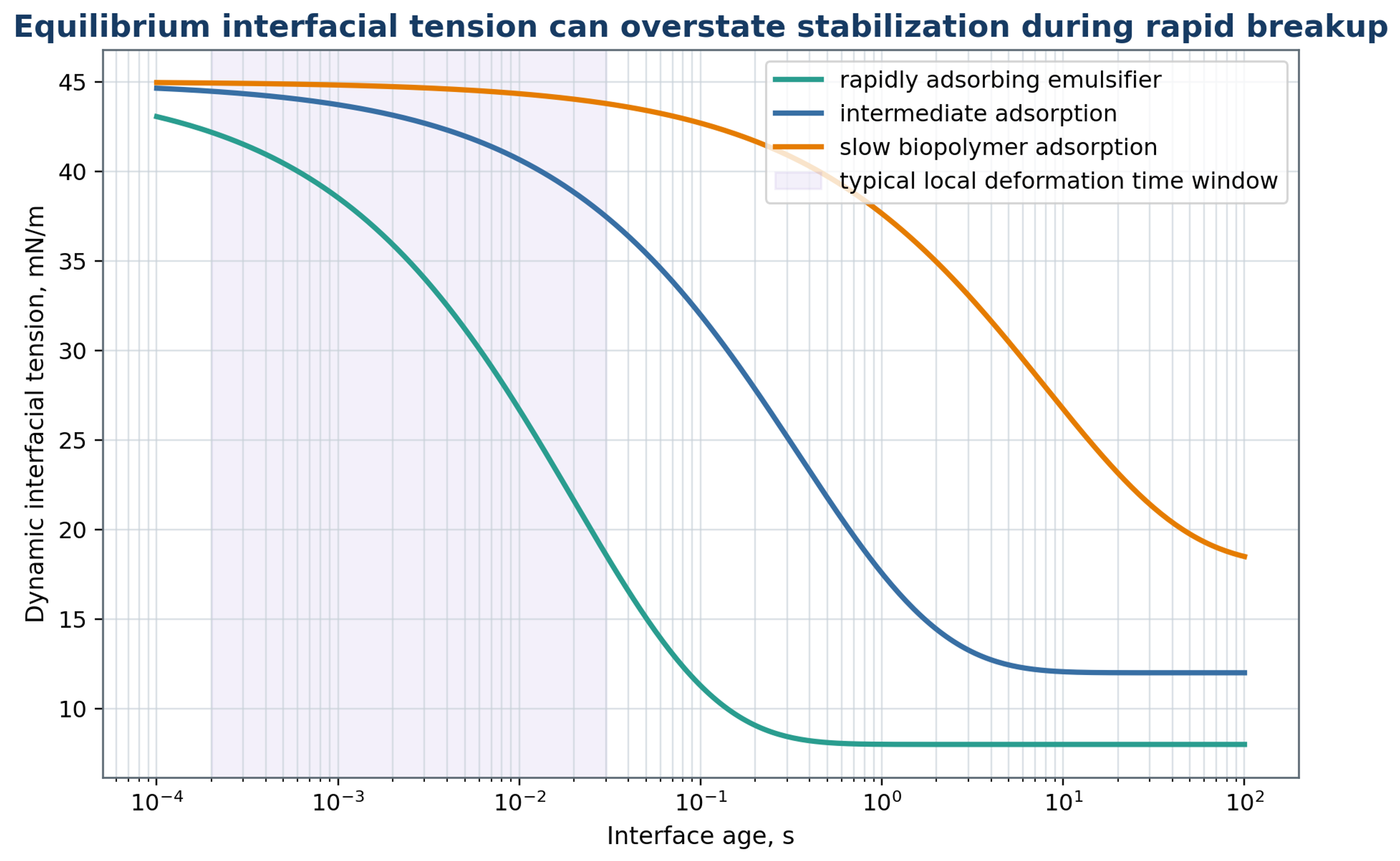
Figure 5.1. Schematic dynamic interfacial tension histories for relatively fast, intermediate, and slow adsorption. The curves illustrate a distribution of adsorption responses and are not numerical evaluations of the single exponential approximation in equation (5.1).
5.2 Adsorption, surface coverage, and interfacial rheology
Adsorption determines the amount and state of emulsifier present at the interface, while interfacial rheology describes the mechanical response of the resulting layer. These properties are related but not identical. A formulation can contain enough emulsifier in total and still fail to protect newly formed droplets if transport is slow or a substantial fraction is unavailable for adsorption. As an equilibrium approximation for a single class of adsorption sites, the Langmuir relation is
where is surface excess, is the limiting coverage, K is an adsorption equilibrium constant, and is bulk emulsifier concentration. The concentration convention and units used for K must be consistent with those of .
For a specified adsorbed mass per unit area, the minimum mass required to cover the total interface is estimated by
where is the required surface concentration expressed as mass per unit area. This is an interfacial inventory calculation rather than a complete formulation dosage.
The ratio of available emulsifier to the amount required for the calculated interface is
where denotes the mass that can contribute to adsorption under the process conditions.
A coverage ratio below unity identifies an inventory deficit for the assumed area and target coverage. A ratio above unity does not establish kinetic stability. Some emulsifier may remain in bulk aggregates, bind to other formulation components, partition into the second liquid, or reach the interface too slowly. The mass balance and the adsorption timescale must therefore be assessed separately.
Padron reported a nonmonotonic relation between surfactant concentration and mean droplet size in a batch rotor stator mixer, despite the accompanying reduction in equilibrium interfacial tension [2]. Adsorption dynamics and interfacial dilatational response affected both deformation and stabilization. The critical micelle concentration therefore does not, by itself, identify the formulation that gives the smallest retained droplets. Concentration screening should consider the measured droplet distribution and interfacial response as well as equilibrium tension.
Interfacial deformation can also be resisted by a dilatational response, which describes how interfacial tension changes with area. The signed coefficient used here is defined by
The conventional dilatational elasticity is = A dσ/dA, whereas the signed coefficient in equation (5.6) satisfies = −. Thus, a positive conventional elastic modulus corresponds to a negative under the definition above. The magnitude || is used when discussing the resistance of an interface to deformation [31].
A large magnitude of interfacial elasticity can oppose rapid changes in area and thereby influence breakup as well as stabilization after breakup. Gradients of interfacial tension generate Marangoni stresses that oppose interfacial motion and can retard film drainage. Protein and polymer layers may also display time dependent elastic and viscous responses. Consequently, equilibrium tension alone cannot describe the resistance of a coated droplet to deformation or the behavior of the film between colliding droplets.
Interfacial response also depends on exchange of emulsifier with both liquid phases. Oscillating drop measurements by Kovalchuk and coauthors showed that the frequency dependent modulus of a nonionic surfactant at a water and hexane interface could be described only after accounting for partitioning and transport on both sides of the interface [32]. For process interpretation, this means that a modulus measured at one frequency and phase composition should not be transferred directly to a different deformation timescale or solvent pair. The appropriate interfacial measurement should reproduce the relevant chemical environment.
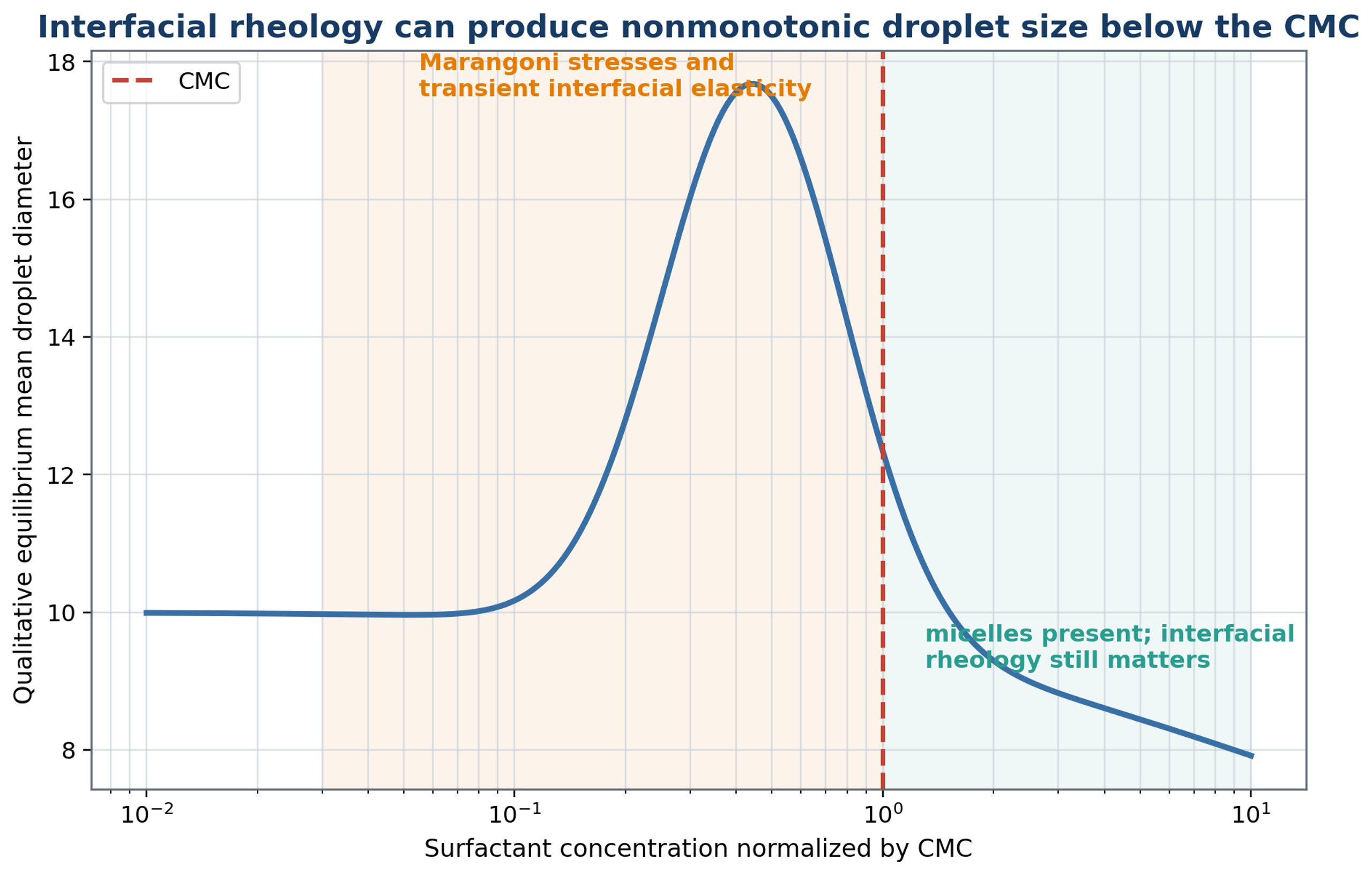
Figure 5.2. Conceptual nonmonotonic droplet response near the critical micelle concentration, motivated by the role of adsorption and interfacial rheology discussed by Padron [2]. The curve is schematic and is not a reproduced experimental dataset.
Table 5.1. Formulation variables that control rotor stator emulsification.
| Variable | Breakup effect | Stabilization effect | Required measurement |
|---|---|---|---|
| Interfacial tension | Lower tension reduces capillary resistance | May reflect adsorption only after sufficient time | Dynamic and equilibrium tension at process temperature |
| Emulsifier concentration | Can lower tension and alter interfacial mobility | Provides surface coverage | Free concentration, CMC region, adsorption time |
| Continuous phase viscosity | Raises viscous stress but damps turbulence | Slows creaming and film drainage | Flow curve at process temperature |
| Dispersed phase viscosity | Resists internal circulation and necking | Can slow film deformation | Viscosity at process temperature |
| Density difference | Minor direct breakup effect | Controls creaming or sedimentation | Density of both phases |
| Phase fraction | Raises collision rate and apparent viscosity | Increases surface demand and inversion risk | Composition, conductivity, rheology |
| Temperature | Usually lowers viscosity and tension | Changes adsorption, oxidation, and vapor pressure | Inlet, outlet, and cumulative temperature history |
| Dissolved gas | Changes cavitation inception | Can promote foam and cushion collapse | Dissolved oxygen or gas content |