
Technical publication
Back to publications
Other
Emulsification and Homogenization in Rotor-Stator Mixers
okozyuk.com
Published
Read complete publication for whole-document Find and printing. Browser Find and native printing on this reader include only loaded content.
2 Emulsion fundamentals and product specifications
A quantitative description of the emulsion must precede the selection of equipment or operating conditions. Phase continuity determines which liquid carries momentum and transports emulsifier, while the size distribution determines interfacial area and the fraction of droplets most susceptible to separation. The following definitions establish a consistent basis for comparing formulations and for connecting measured droplet populations to the calculations used later in the article.
2.1 Emulsion classes and topology
Emulsion classification establishes which phase carries the flow, which phase forms droplets, and what structural features the process must preserve. In an oil in water emulsion, oil droplets are surrounded by an aqueous continuous phase; in water in oil emulsion, aqueous droplets are surrounded by oil. Multiple emulsions contain droplets within larger carrier droplets, as in water in oil in water systems. At high internal phase fractions, close packing can cause droplet deformation and a marked increase in viscosity. Pickering emulsions are distinguished by the adsorption of solid particles at the interface. These categories describe different structural and stabilization requirements and cannot be selected solely from the operating range of a mixer [6, 7, 19, 20].
The terms macroemulsion, submicron emulsion, nanoemulsion, and microemulsion denote different physical situations. Conventional emulsions and nanoemulsions are thermodynamically unstable, although appropriate formulations may remain kinetically stable for the required storage period. Microemulsions are thermodynamically stable, self-assembled structures within particular composition and temperature regions, often requiring substantial surfactant and sometimes a cosurfactant. Mechanical mixing facilitates compositional uniformity but does not make an unsuitable formulation thermodynamically stable. Accordingly, a reproducible product specification should state measured droplet statistics, the measurement method, phase fraction, temperature, and storage conditions in addition to any descriptive size category [6, 7].
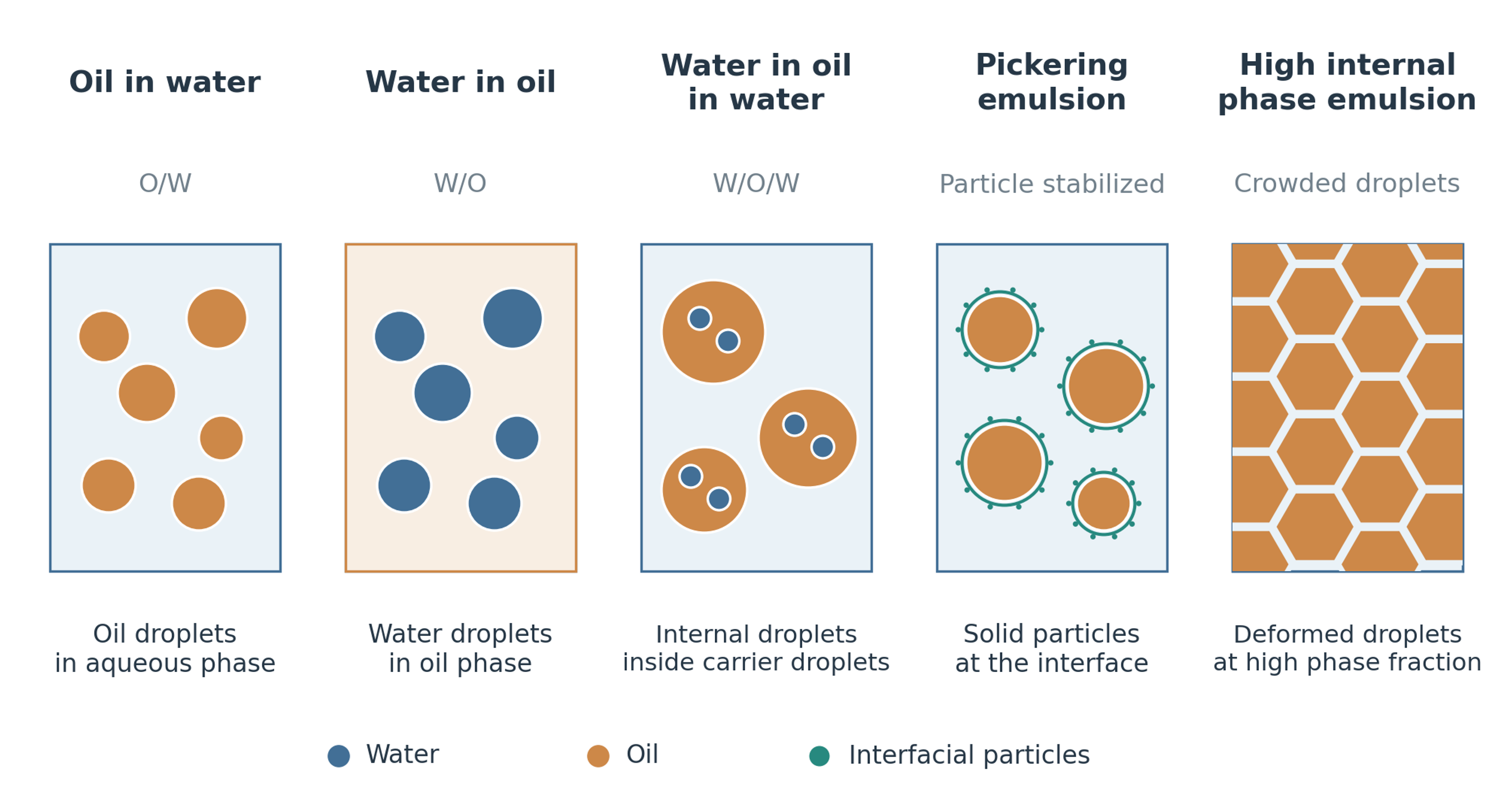
Figure 2.1. Representative liquid dispersion structures. The continuous phase, dispersed phase, internal topology, and stabilizing mechanism must be identified before process conditions are selected. The drawings are schematic and do not define droplet sizes.
Table 2.1. Practical classification of liquid dispersion systems. Size ranges are approximate and overlap among industries.
| System | Typical scale | Stability basis | Rotor stator design implication |
|---|---|---|---|
| Coarse emulsion | 1 to 100 µm or larger | Kinetic | Moderate stress may be sufficient, but coarse tail controls separation |
| Submicron emulsion | 0.1 to 1 µm | Kinetic | High local stress and rapid adsorption are both required |
| Nanoemulsion | About 20 to 500 nm | Kinetic | Small stator features, high tip speed, multiple exposure, and strong stabilization may be needed |
| Microemulsion | Commonly 10 to 100 nm structures | Thermodynamic over a composition region | Formulation is controlling; mechanical energy is secondary |
| Multiple emulsion | Internal and external drops from submicron to tens of micrometres | Kinetic and hierarchical | Second stage stress must not destroy internal droplets |
| Pickering emulsion | Broad | Particle adsorption | Particle wettability and adsorption energy control stability |
| High internal phase emulsion | Frequently 0.74 dispersed volume fraction or greater | Crowding and interfacial film | Very high viscosity and phase inversion risk influence pumping and head selection |
The amount of dispersed liquid affects interfacial area, droplet interactions, and the rheological state of the emulsion. Assuming additive phase volumes, the dispersed phase volume fraction is defined as
where and denote the dispersed and continuous phase volumes, respectively. The definition applies to the phase volumes at the temperature used for the calculation.
Phase topology can change during addition, heating, or continued processing when the formulation approaches inversion. Such a change can alter conductivity, apparent viscosity, circulation, power demand, and coalescence behavior abruptly. The sequence and rate of phase addition therefore form part of the process specification. Samples taken before and after a change in processing conditions should be checked for phase continuity when inversion is plausible.
2.2 Droplet size distribution and mean diameters
Droplet size distributions connect the microscopic structure of an emulsion to its interfacial area and macroscopic behavior. A single mean diameter cannot describe these features completely. A distribution weighted by number emphasizes the large population of small droplets, whereas a distribution weighted by volume emphasizes the larger droplets that contain most of the dispersed material. Comparisons between studies must therefore identify both the weighting basis and the particular statistical measure. For discrete size classes, the generalized moment mean diameter is
where is the number of droplets assigned to size class i, is the representative diameter of that class, and p and q are distinct moment orders.
The arithmetic mean on a number basis is obtained by taking the first and zeroth moments:
The Sauter mean diameter expresses the ratio of dispersed volume to interfacial area and is consequently useful for calculations involving adsorption and interfacial transport:
The volume weighted mean diameter gives greater weight to coarse droplets and is defined as
Percentile diameters describe positions within a cumulative distribution rather than ratios of moments. For a cumulative distribution weighted by dispersed phase volume, the span is commonly expressed as
where the percentile symbols , , and refer to the diameters below which 10%, 50%, and 90% of the dispersed volume occur. These percentile labels must be distinguished from the moment mean defined above. Reporting them explicitly as , , and , and reporting moment means as , , and , avoids this notational ambiguity when tabulating measurements.
The coarse fraction can determine stability even when the mean diameter changes little. A small number of large droplets may dominate visible separation, gravitational migration, filtration behavior, and optical microscopy while making only a limited contribution to the number mean. A useful specification therefore combines an area related measure such as with a coarse sensitive measure such as or the 90th volume percentile, together with distribution width and the measurement basis. Direct comparison of values obtained by different instruments also requires attention to dilution, optical assumptions, and the lower and upper limits of detection [2, 3, 5, 8].
Recent experiments also demonstrate why the mechanism underlying a distribution should be established rather than assumed. L’Estimé and coauthors observed approximately lognormal droplet distributions in their surfactant stabilized model emulsions and found that mean size followed a capillary scaling based on continuous phase viscosity more closely than a Reynolds number scaling [5]. These findings support a viscous deformation interpretation for the investigated system. They do not imply that all rotor stator emulsions obey the same distribution or that turbulent inertial breakup is absent under other conditions.
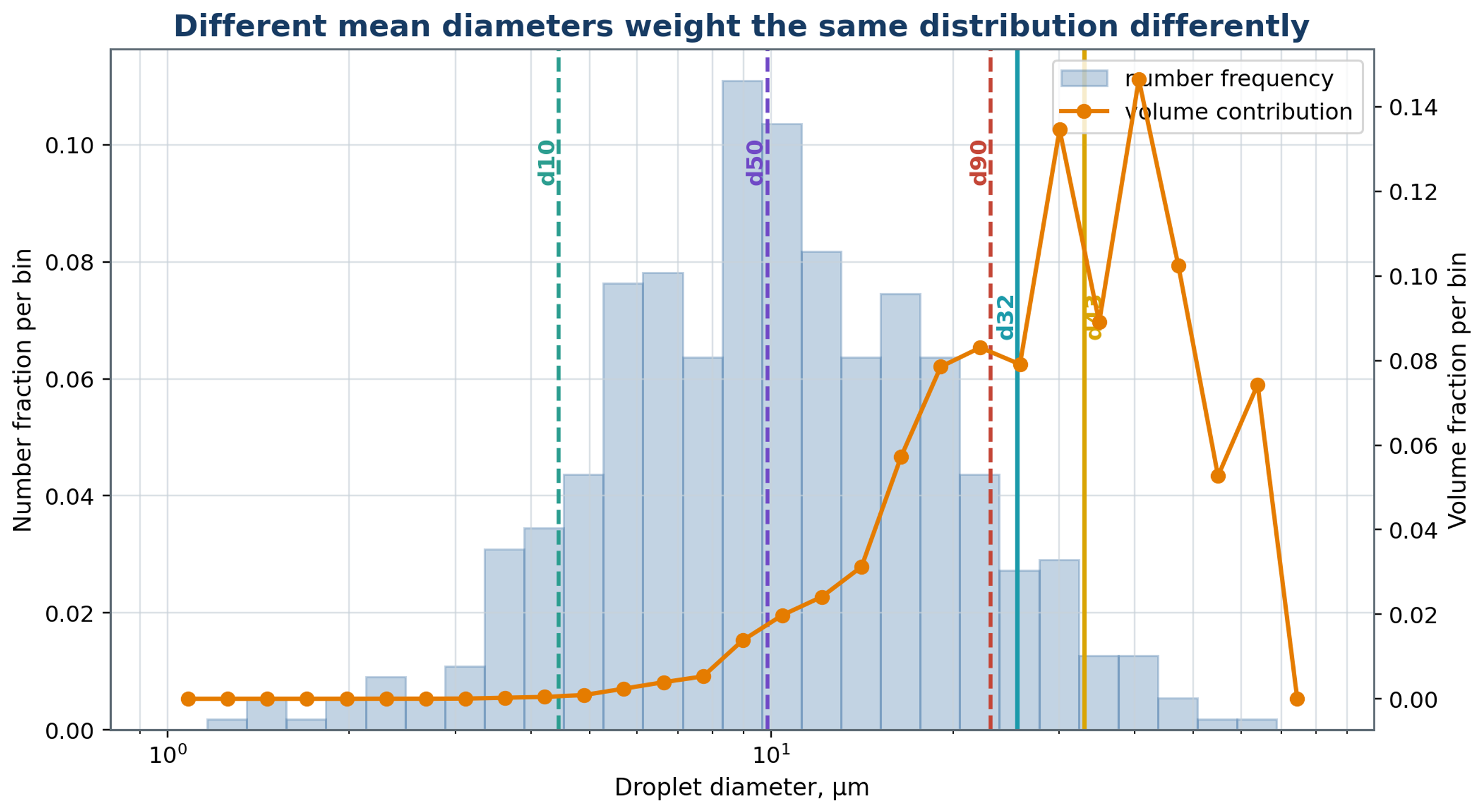
Figure 2.2. Illustrative number and volume weighting of a droplet distribution. The percentile markers in this retained example refer to the number distribution; they should not be confused with the volume percentiles used in equation (2.6). The surface and volume moment means weight the same population differently.
2.3 Interfacial area and emulsifier demand
Interfacial area provides the link between the desired droplet size and the amount of stabilizer required. As droplets are fragmented, a fixed dispersed volume is distributed over a larger surface, which must be supplied with emulsifier. For spherical droplets, the use of the Sauter mean diameter makes the area relation valid for a polydisperse population as well as for a monodisperse one. The interfacial area per unit emulsion volume is
where a has units of m² m⁻³. The relation assumes that the dispersed phase is represented adequately by discrete spherical droplets.
For an emulsion of total volume V, the corresponding total interfacial area is
At constant phase fraction, a tenfold reduction in produces a tenfold increase in interfacial area. The ideal amount of adsorbed emulsifier required at a specified surface coverage increases by the same factor. A plateau in droplet size can therefore arise from insufficient available emulsifier or slow adsorption even when the mixer can generate additional disruptive stress. This area balance also explains why the final stages of size reduction can require a substantial change in formulation relative to the incremental reduction in diameter.
Interfacial tension produces a pressure difference between the interior and exterior of a spherical droplet. For a uniform interface and negligible gravitational deformation, the Young Laplace relation gives
where is interfacial tension and d is droplet diameter. The expression uses diameter rather than radius.
Capillary pressure increases as droplet diameter decreases. Continued fragmentation therefore requires progressively larger local stresses or a reduction in the interfacial tension relevant to the deformation time. Simultaneously, additional interface must be stabilized. An apparent limiting size during prolonged processing can reflect capillary resistance, finite exposure, or a balance between breakup and coalescence. It should not be interpreted directly as a size imposed by the stator openings.
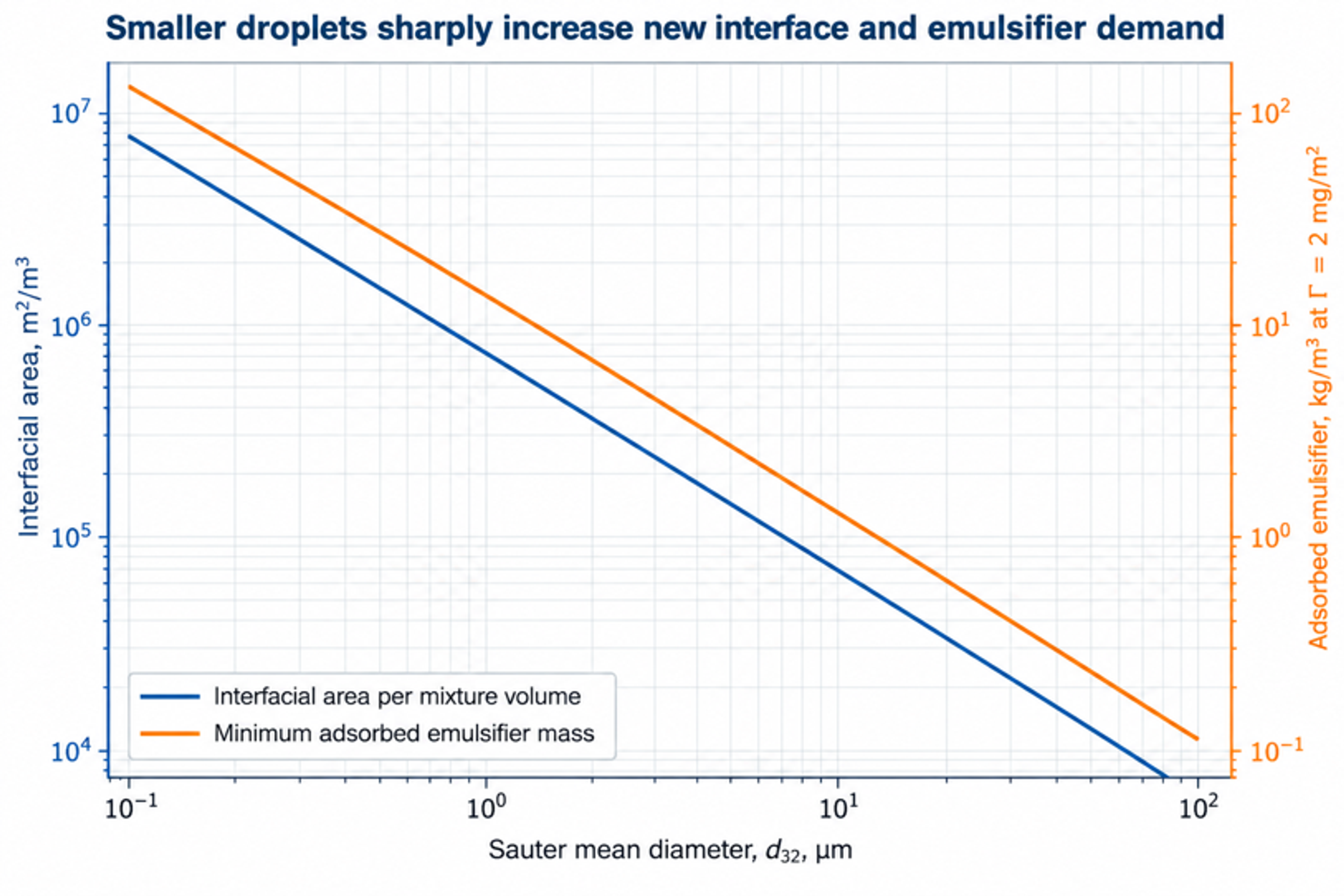
Figure 2.3. Illustrative interfacial area and adsorbed emulsifier demand as functions of Sauter mean diameter at fixed phase fraction. Both scale inversely with diameter according to equations (2.7), (2.8), and (5.4).