
Technical publication
Back to publications
Other
Emulsification and Homogenization in Rotor-Stator Mixers
okozyuk.com
Published
Read complete publication for whole-document Find and printing. Browser Find and native printing on this reader include only loaded content.
1 Introduction
Emulsification and homogenization are related operations through which the internal structure of a liquid product is established and controlled. An emulsion consists of droplets of one liquid dispersed within another liquid that is immiscible or only partly miscible with it. Homogenization has a broader meaning and includes the reduction and redistribution of droplets, solid particles, aggregates, and other inhomogeneities. In processing systems containing two liquid phases, the same rotor stator device may form a coarse dispersion, reduce droplet size, modify the distribution, and improve bulk uniformity. These functions are relevant to foods, dairy products, beverages, cosmetics, pharmaceutical and veterinary formulations, coatings, polymer dispersions, agrochemical concentrates, fuel emulsions, lubricants, extraction processes, and chemical reactions [1, 2, 3, 4, 5, 6, 7].
The process objective is a droplet population that satisfies the required product function at an acceptable throughput and energy input. Relevant attributes include phase topology, mean diameter, distribution width, the coarse fraction, and stability during subsequent handling and storage. Reducing droplet size increases interfacial area and can improve resistance to creaming, optical properties, texture, reaction rates, or mass transfer. The same reduction may increase emulsifier demand, alter apparent viscosity, intensify interfacial chemical contact, and make later phase separation more difficult. Thermal exposure, air incorporation, oxidation, erosion, mechanical loading, contamination control, and cleaning must therefore be considered together with droplet size. Product requirements provide the basis for mixer selection and process development [1, 2, 3, 4, 5, 6, 7, 8].
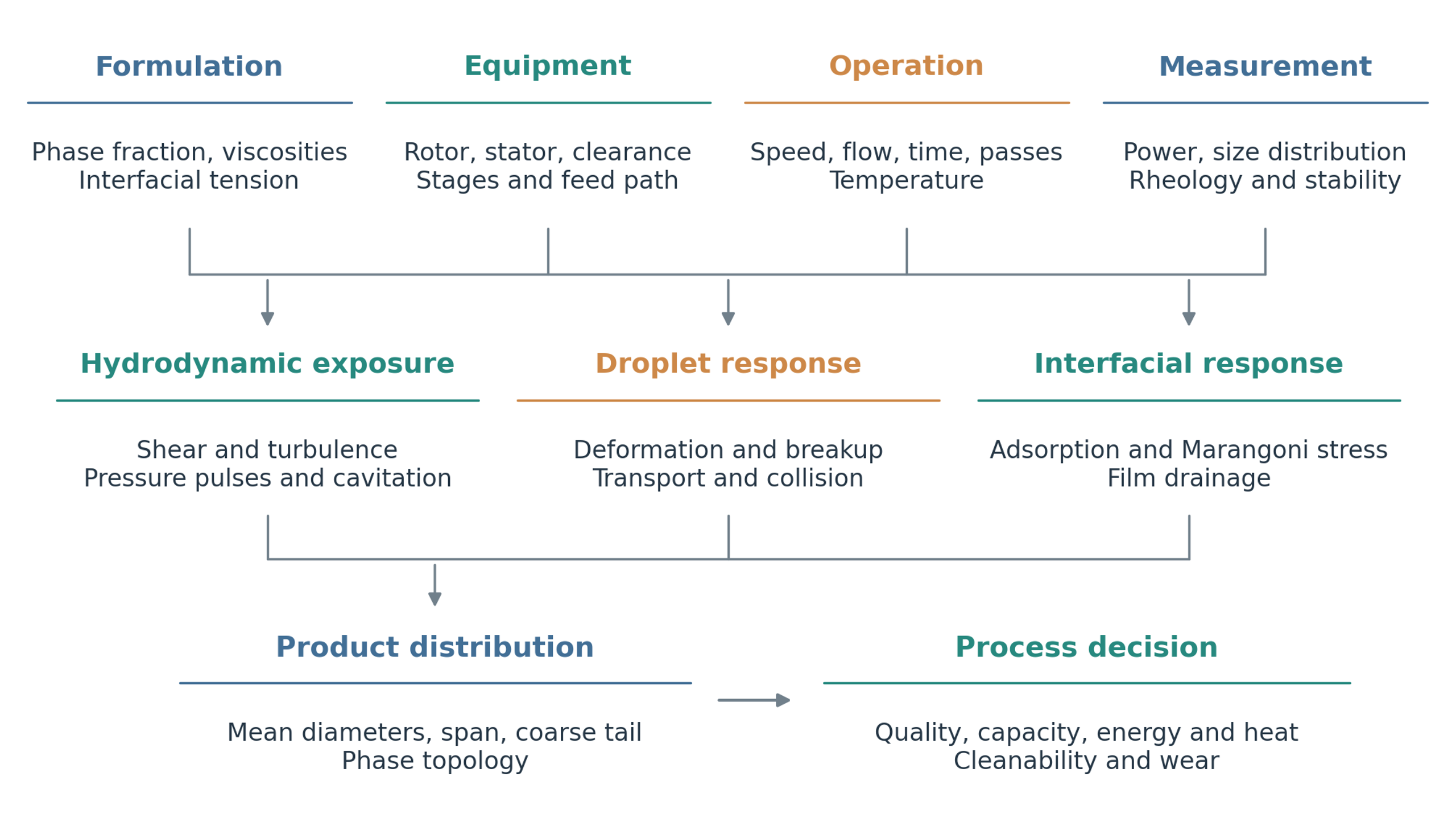
Figure 1.1. Conceptual framework for rotor stator emulsification. Formulation, equipment, operation, and measurement determine hydrodynamic exposure, droplet response, interfacial stabilization, and the resulting product distribution.
Rotor-stator equipment is operated either as an immersed head in a batch vessel or as an enclosed unit through which a liquid stream passes. In an immersed arrangement, liquid is generally drawn toward the head, accelerated through the rotor and stator, and returned to the vessel through radial discharge. Further processing depends on circulation back to the active region. In an inline arrangement, the feed passes through a defined series of internal passages, although bypass, back mixing, and unequal flow between passages can still produce a distribution of exposures. A recirculation loop combines an inline mixing head with a vessel and external piping, allowing repeated treatment while feed addition, temperature, and inventory are controlled separately [1, 3, 10, 11, 12].
Related devices are described in Russian and Ukrainian literature as rotary pulsation apparatus, rotary impulse apparatus, rotor pulsation homogenizers, and equipment for discrete impulse energy input. In these machines, periodic overlap of rotor and stator openings creates variations in velocity and pressure in addition to the shear and turbulence associated with rotation. Differences in terminology and construction should be recognized when comparing published results. The common engineering question is how the geometry establishes the local stress history and how the entire product receives sufficient exposure without excessive energy dissipation or mechanical loading [13, 14, 15, 16, 17, 18].
A central distinction is required between droplet breakup and interfacial stabilization. Breakup occurs when hydrodynamic stresses deform a droplet sufficiently to overcome capillary and viscous resistance. Stabilization requires surfactants, proteins, polymers, or particles to reach the newly formed interface and reduce the probability of coalescence. A mixer may provide adequate disruptive stress while producing a coarse or unstable product if adsorption is slow, the supply of stabilizer is insufficient, or droplets collide before protective layers develop. The analysis developed below therefore couples the mechanical processes responsible for fragmentation with the transport and interfacial processes responsible for retaining the resulting droplets [2, 4, 5, 6].
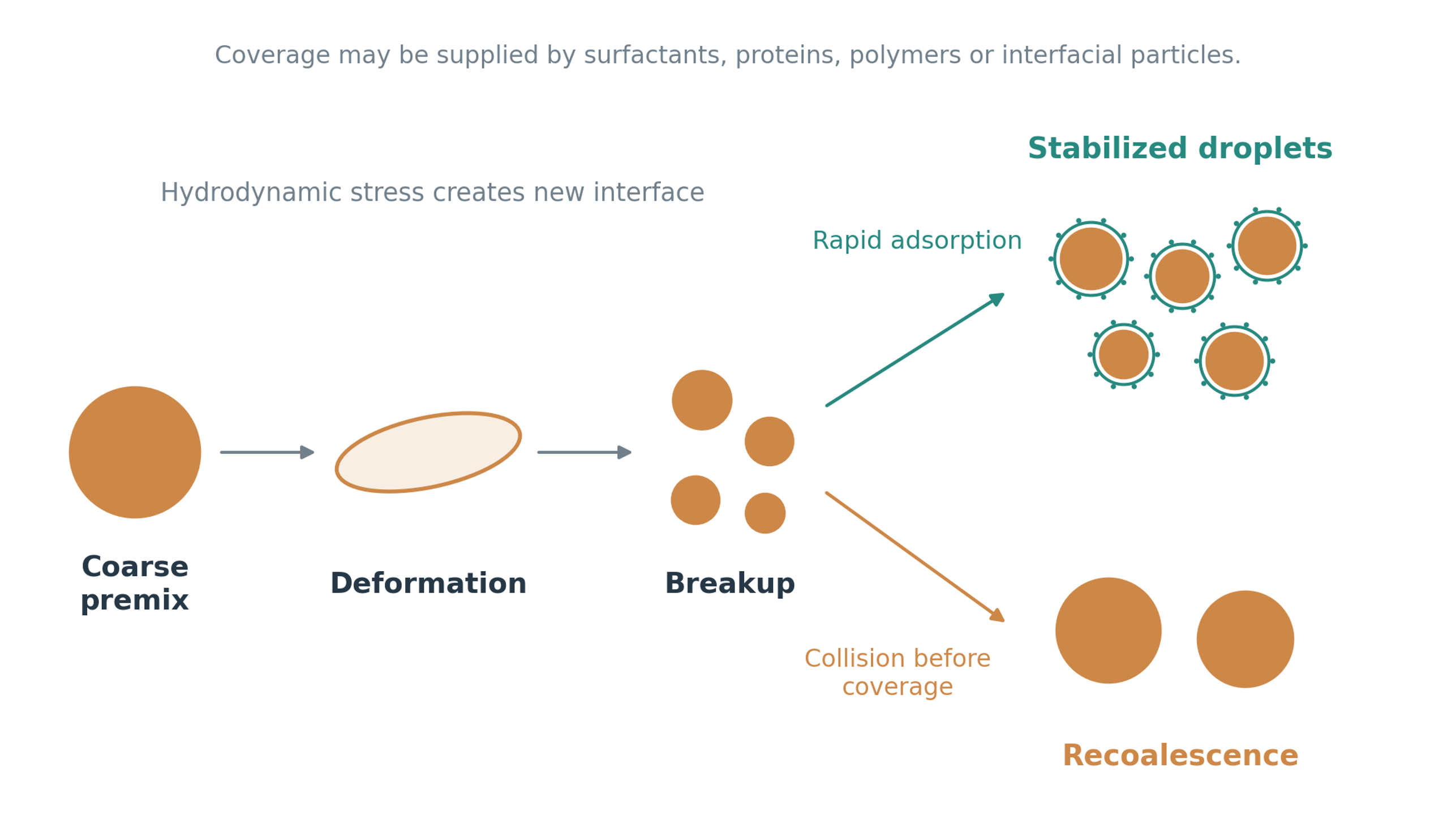
Figure 1.2. Droplet deformation, fragmentation, and interfacial stabilization. Rapid coverage preserves the newly created interface, whereas insufficient coverage permits recoalescence. The two outcomes depend on both formulation and collision history.