
Technical publication
Back to publications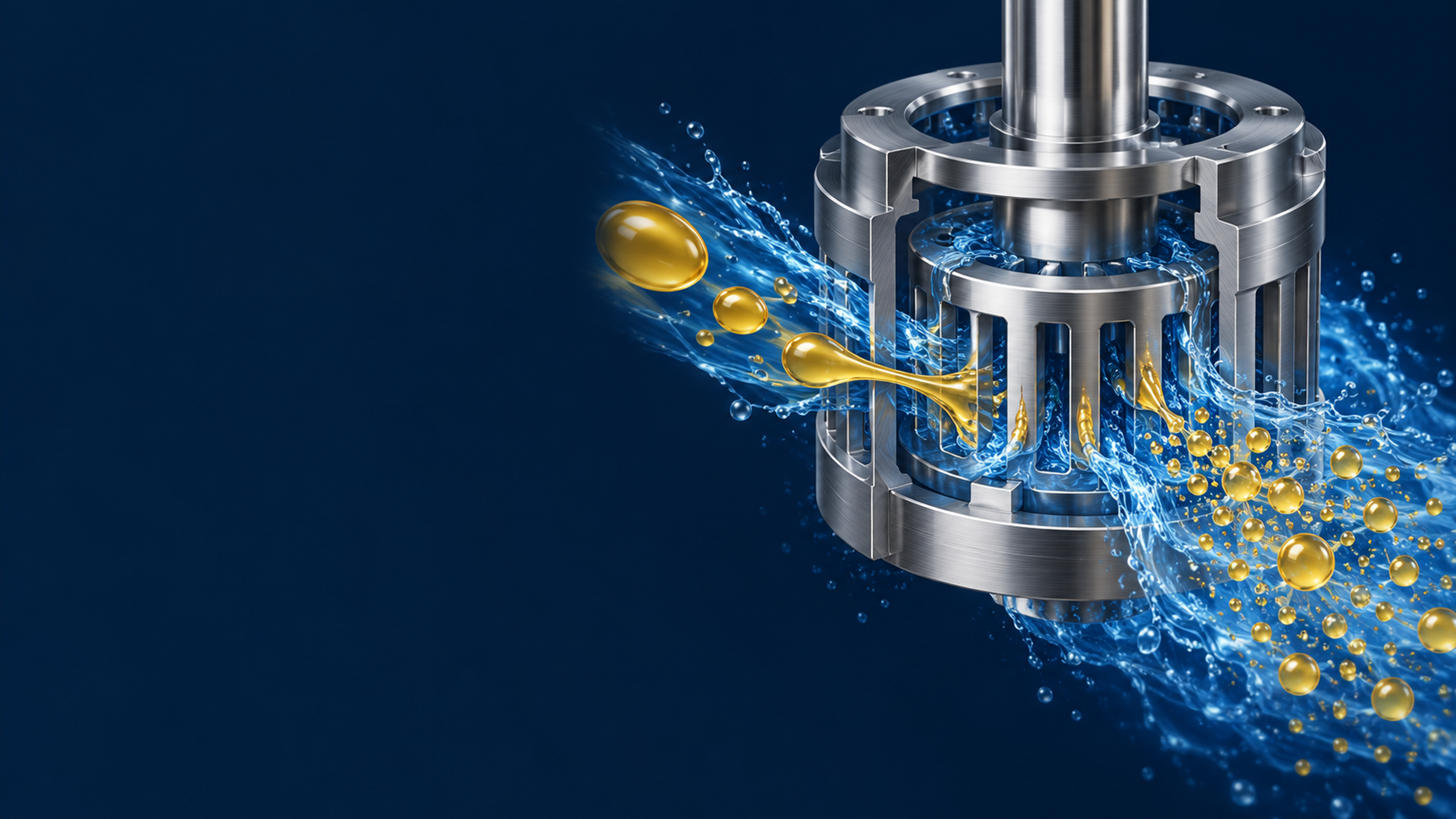
Other
Emulsification and Homogenization in Rotor-Stator Mixers
okozyuk.com
Published
Read complete publication for whole-document Find and printing. Browser Find and native printing on this reader include only loaded content.
Emulsification and Homogenization in Rotor-Stator Mixers
O. Kozyuk, Ph.D.
Abstract
Emulsification in rotor-stator mixers involves the formation of new interfaces between immiscible liquids and the stabilization of those interfaces against coalescence. Fluid passing through the mixing head experiences acceleration, deformation within rotor passages and clearances, discharge through stator openings, and subsequent redistribution in the surrounding liquid. Depending on geometry and operating conditions, the stress history includes viscous shear, extension, turbulent fluctuations, periodic pressure variations, and, in some devices, hydrodynamic cavitation. The resulting droplet population therefore reflects the combined effects of hydrodynamic stress, exposure time, phase properties, and interfacial transport. A description based solely on rotational speed or nominal clearance is insufficient to establish the final distribution or its stability.
This article presents a scientific and engineering framework for emulsification and homogenization in immersed batch mixers and enclosed flow through devices. Droplet size statistics, interfacial area, adsorption, deformation criteria, population balances, power consumption, thermal effects, physical stability, and scale up are considered within a common formulation. Particular attention is given to the distinction between the capacity to disrupt droplets and the capacity to stabilize the newly formed interface. Published research, accessible theses, technical documentation, and rotary pulsation studies are used to identify the assumptions and limitations of the governing relationships. A worked example illustrates the calculation of interfacial area, emulsifier demand, equivalent pass number, specific energy, and temperature rise. The analysis indicates that reliable process design requires simultaneous control of local stress, exposure distribution, adsorption kinetics, and heat generation. The example and conceptual figures provide engineering illustrations; they do not constitute validation of a specific formulation or commercial mixer.
Keywords: rotor-stator mixer; emulsification; homogenization; droplet breakup; interfacial stabilization; population balance; specific energy; scale up.