
Technical publication
Back to publications
Other
Emulsification and Homogenization in Rotor-Stator Mixers
okozyuk.com
Published
Read complete publication for whole-document Find and printing. Browser Find and native printing on this reader include only loaded content.
12 Special emulsion systems and applications
Application requirements determine which combination of droplet size, rheology, stability, temperature, and containment is acceptable. The same generator can produce different outcomes when the continuous phase, emulsifier, phase fraction, or intended structure changes. The examples below apply the general framework to food emulsions, pulsation homogenization, water in oil systems, concentrated structures, multiple emulsions, and particle stabilized interfaces.
12.1 Oil in water food and beverage emulsions
Food emulsions illustrate the need to combine hydrodynamic control with interfacial and product requirements. Milk, cream, nondairy beverages, sauces, dressings, flavor dispersions, and formulations containing lipophilic ingredients commonly use oil in water structure. Proteins, modified starches, gums, phospholipids, and suitable molecular emulsifiers provide different stabilization mechanisms. Rotor stator processing can prepare the premix or produce the final dispersion when the available stress and adsorption kinetics are sufficient [6, 7]. Studies with other homogenizer types provide useful formulation and stability comparisons but should not be treated as direct evidence of rotor stator performance [19].
The processing window must also account for temperature, oxidation, flavor retention, microbial control, contamination, and cleaning. An acceptable droplet distribution does not demonstrate that protein functionality or sensory quality has been retained. Chemical, microbiological, and sensory measurements should be selected according to the product and evaluated alongside droplet size and physical stability.
12.2 Milk homogenization and Ukrainian pulsation research
Milk homogenization provides a specific example of processing an emulsion with a complex natural interface. Native fat globules are surrounded by a membrane, while the aqueous phase contains proteins, lactose, minerals, and other constituents. Size reduction changes creaming, optical properties, texture, and the interfacial area available for protein adsorption. Ukrainian investigations include both apparatus with a vibrating rotor and related pulsation devices with an oscillating perforated piston. These configurations share periodic acceleration mechanisms, but their geometry and exposure histories should be distinguished [16, 17, 39, 40].
Samoichuk and Ivzhenko described a calculation approach for a pulsation homogenizer with a vibrating rotor, in which periodic passage overlap, and axial motion contribute to unsteady flow [16]. In a separate experimental study, Deynichenko and coauthors used a crank driven perforated piston rather than a conventional rotating workhead. They reported an average milk fat globule size of approximately 0.8 µm and specific energy not exceeding 3.4 kJ kg⁻¹ for a tested condition with 10 mm oscillation amplitude and 150 s⁻¹ frequency [17]. These results support investigation of controlled acceleration, but they do not establish a universal performance advantage or a direct scale up law for rotor stator mixers.
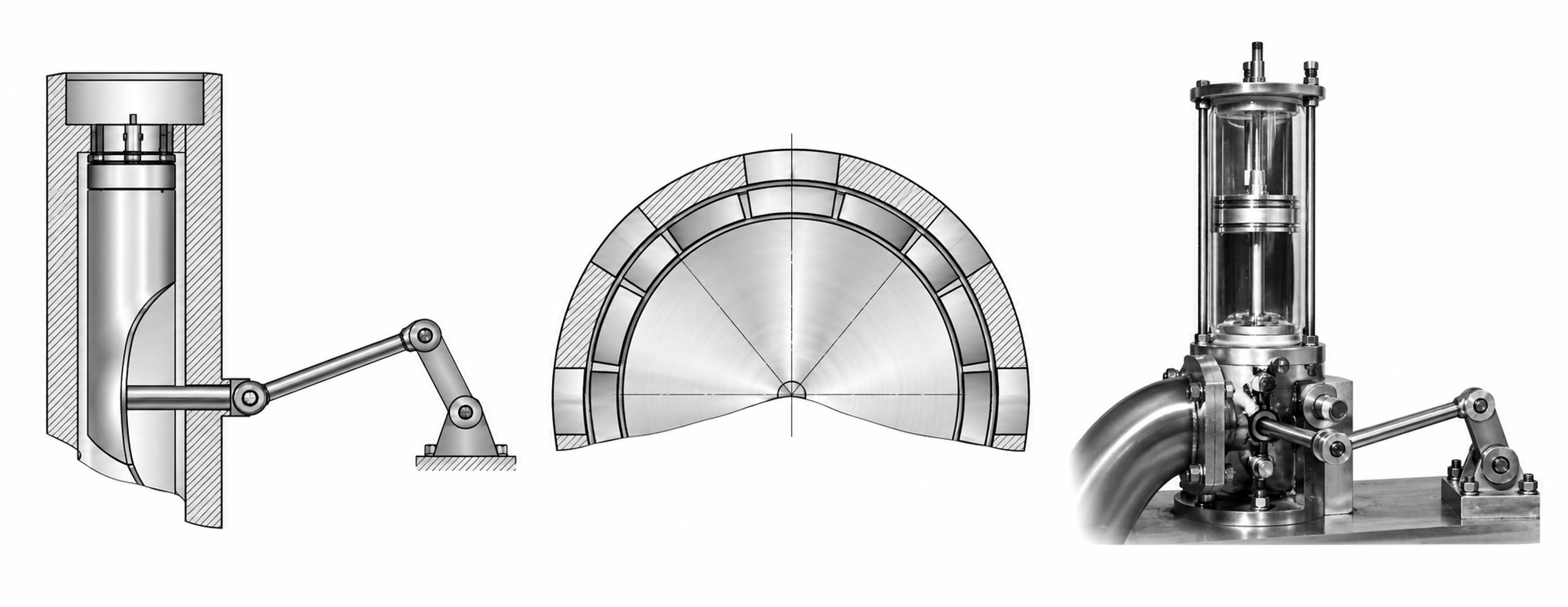
Figure 12.1. Two related pulsation technologies. The longitudinal and radial views at left and center show the vibrating rotor concept; the apparatus at right shows the reciprocating perforated piston concept. The views are not dimensional apparatus drawings.
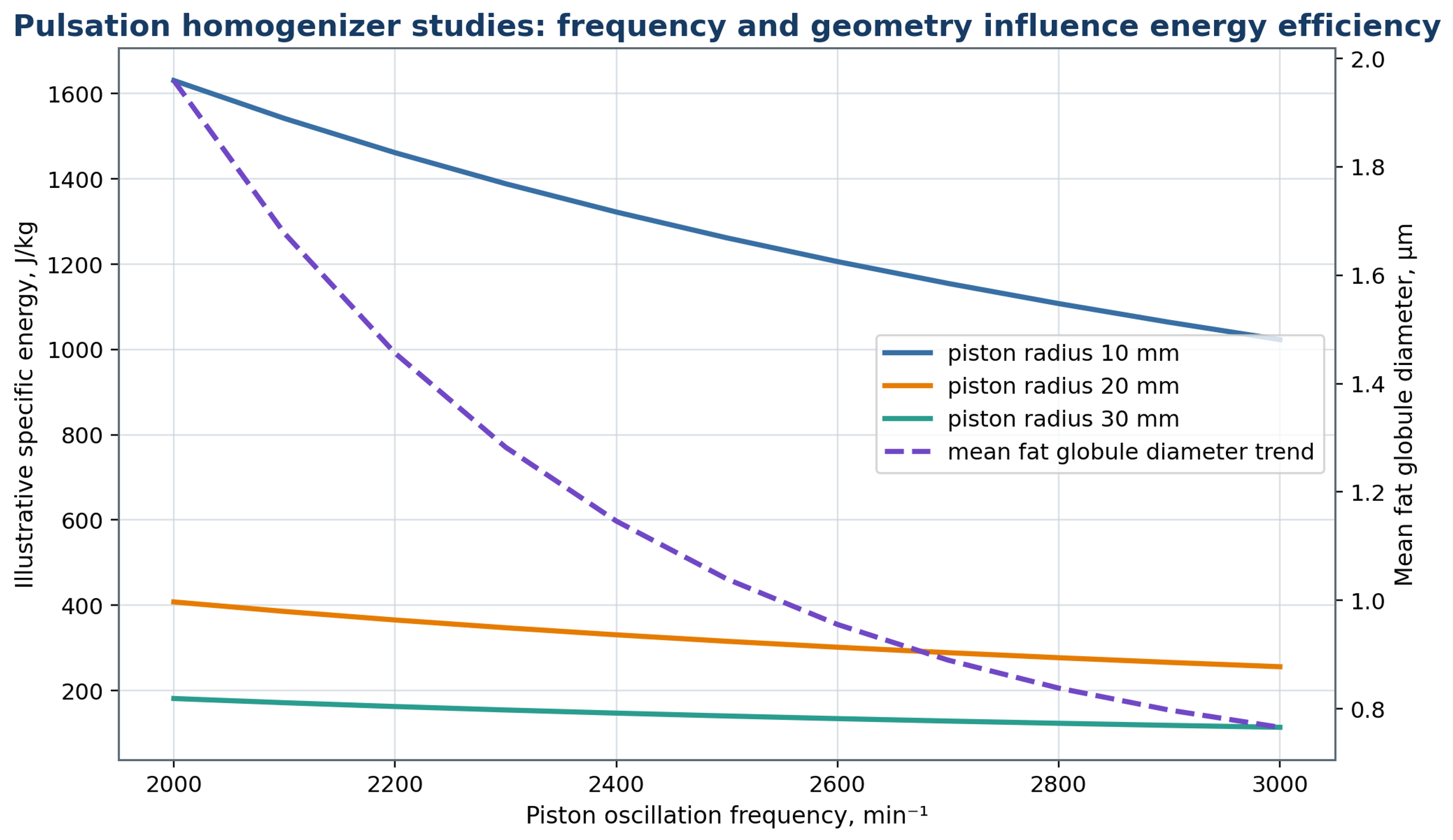
Figure 12.2. Conceptual trends linking oscillation frequency and geometric parameters to mean fat globule size and specific energy, motivated by pulsation studies [16, 17, 39, 40]. The frequency range and radius labels are hypothetical illustration parameters and do not reproduce the experimental conditions of the cited papers.
12.3 Water in oil and fuel emulsions
Water in oil emulsification differs from oil in water processing because the more viscous oil often forms the continuous phase. Lipophilic emulsifiers may be needed, and dispersed water can settle when its density exceeds that of the oil. High continuous phase viscosity can suppress turbulence and limit circulation, requiring appropriate pumping, temperature control, or generator selection. Local water accumulation should be avoided because it can produce large domains or promote inversion before the intended structure is established.
For fuel emulsions, droplet distribution and storage stability must be considered together with corrosion, combustion behavior, and compatibility with pumps and injectors. Dissolved gas, volatile constituents, and pressure fluctuations affect both processing and containment requirements. The materials, seals, elastomers, and electrical equipment must be selected for the specified fuel and operating environment.
12.4 High internal phase and structured emulsions
High internal phase emulsions couple droplet deformation to the development of a concentrated material structure. As the dispersed phase loading increases, droplets become crowded and can develop nonspherical shapes, yield stress, and pronounced shear thinning. The resulting product may cease to circulate effectively through a conventional batch head even while the head continues to draw power. Bulk agitation, auxiliary pumping, or staged addition should therefore be considered as part of the emulsification system.
The composition path is particularly important in these systems. Rapid addition can produce local inversion or isolated large domains that are difficult to process later. Controlled addition near a well-supplied inlet, together with adequate vessel turnover, improves the uniformity of contact. After the desired droplet distribution has been established, a less intense finishing stage may be appropriate when further processing would damage the intended structure.
12.5 Multiple emulsions
Multiple emulsions require preservation of an internal dispersion while a second interface is formed. Water in oil in water system is commonly prepared by first forming stabilized primary water in oil emulsion and then dispersing it into the external aqueous phase. The second operation must create the outer droplets without extensively rupturing the primary structure. Lower stress, larger openings, or shorter exposure may therefore be appropriate in the second stage, subject to verification of both external size and internal integrity.
External droplet size alone cannot establish the success of encapsulation. Measurements should include encapsulation efficiency or release, with microscopy, conductivity, or an appropriate tracer method used to examine the internal structure. A narrow external size distribution can coexist with substantial leakage of the enclosed phase.
12.6 Pickering emulsions and particle stabilized interfaces
Pickering emulsions are stabilized by particles adsorbed at the liquid interface. Their formation depends on particle wettability and the energetic preference for remaining at the interface, together with the rate at which particles are dispersed and transported to newly created surfaces. Rotor stator operation must provide adequate dispersion while avoiding undesirable particle fragmentation or agglomeration. Particle size, contact angle, surface treatment, ionic strength, and addition sequence should be specified. Adsorption and rearrangement can be slow, so the premix and feed path may be as important as the maximum hydrodynamic stress.
12.7 Rotor-stator nanoemulsions
Submicron emulsions can be produced by rotor stator processing under suitable formulation and operating conditions, although the result cannot be inferred from a machine designation alone. Gazolu Rusanova and coauthors reported droplets of approximately 100 to 500 nm using modified starch; gum Arabic gave larger droplets in their study, associated with slower adsorption and more coalescence [6]. Other experiments have related size to turbulent inertial stresses and viscosity effects [4], while observations of approximately lognormal distributions provide evidence for repeated stochastic fragmentation under the conditions investigated [5]. These studies describe different formulations and regimes rather than one universal nanoemulsion mechanism.
A nanoemulsion designation should be accompanied by the measured distribution, weighting basis, and test method. A number weighted mean below 500 nm can coexist with a relevant volume fraction above 1 µm. Dynamic light scattering, laser diffraction, microscopy, and separation tests probe different features of the sample and can respond differently to dilution or aggregates. The measurement method, optical assumptions, and preparation protocol should be reported with the size result.
Beverage nanoemulsion formulations have also been disclosed in patent literature on high shear processing [41]. A patent specification establishes a disclosed formulation and process concept; its claims do not replace an independent comparison of droplet distributions, stability, and energy consumption under common test conditions.
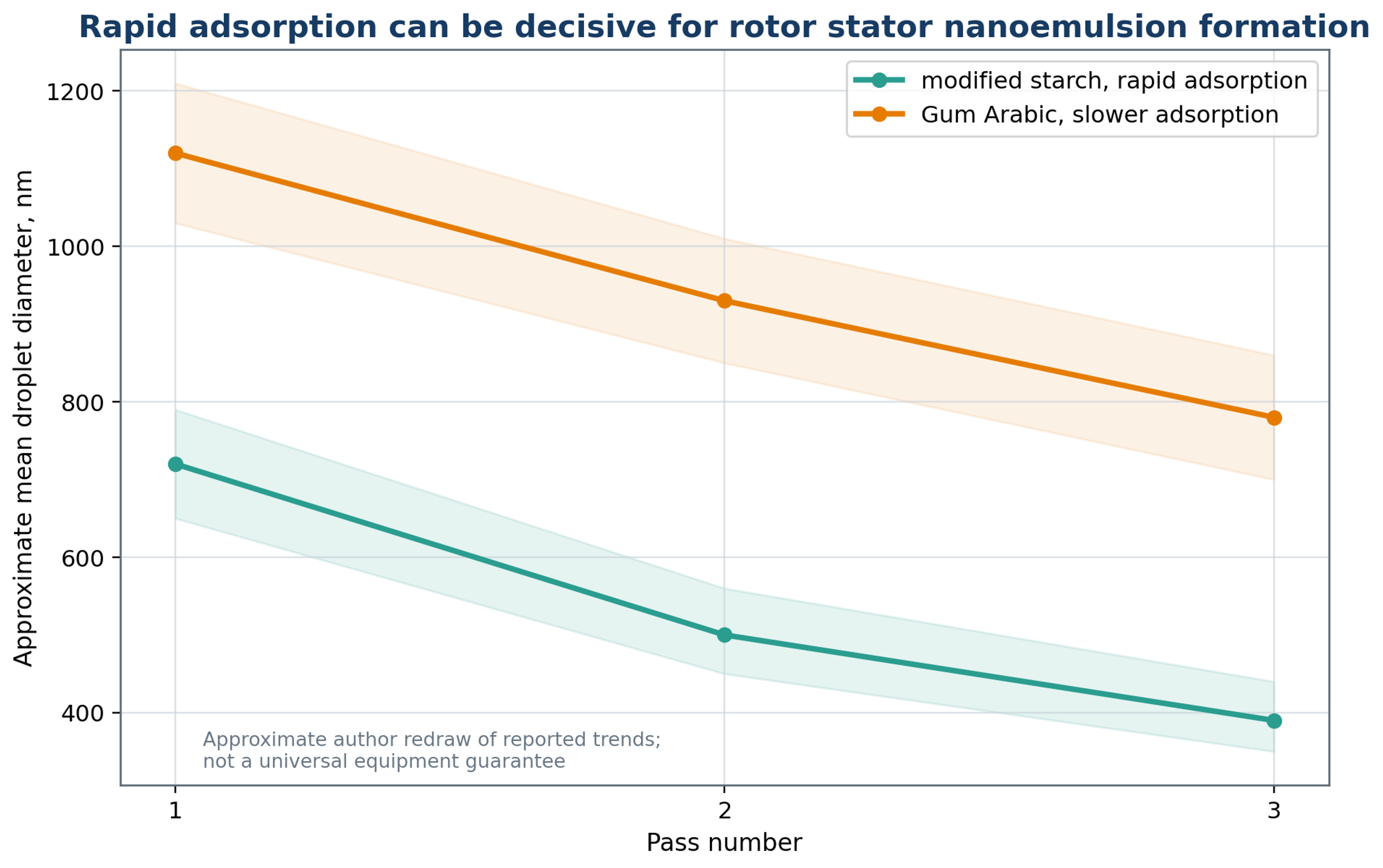
Figure 12.3. Schematic pass dependent trends for modified starch and gum Arabic emulsifiers, motivated by the formulation effects reported by Gazolu Rusanova and coauthors [6]. The curves are illustrative, and the shaded regions represent schematic formulation variability rather than measured confidence intervals.
Table 12.1. Application specific rotor stator priorities.
| Application | Primary quality target | Dominant process concern | Recommended additional measurement |
|---|---|---|---|
| Milk and cream | Fat globule distribution and creaming | Protein interaction and heat | Microscopy, creaming index, viscosity |
| Mayonnaise and dressing | Texture and phase stability | High viscosity and inversion | Rheology, conductivity, oiling off |
| Beverage flavor emulsion | Fine stable DSD and optical quality | Ripening and flavor loss | Turbidity, storage, volatile retention |
| Cosmetic cream | Sensory texture and stability | Air, heating, batch reproducibility | Rheology, microscopy, microbial control |
| Pharmaceutical emulsion | Dose uniformity and stability | Contamination and active degradation | Assay, sterility strategy, particle count |
| Agrochemical concentrate | Dilution stability and sprayability | High active loading and crystals | Dilution test, nozzle test, sedimentation |
| Fuel emulsion | Stable water distribution | Safety, corrosion, volatility | Flash point strategy, corrosion, engine test |
| Polymer latex or coating | Particle and droplet uniformity | Viscosity, reaction, foam | Solids, rheology, film performance |