
Technical publication
Back to publications
Other
Emulsification and Homogenization in Rotor-Stator Mixers
okozyuk.com
Published
Read complete publication for whole-document Find and printing. Browser Find and native printing on this reader include only loaded content.
11 Stability after rotor-stator processing
The state of the emulsion at the mixer outlet is only the initial condition for storage or subsequent processing. Gravitational migration, aggregation, coalescence, molecular transfer, and phase inversion can each change the product after hydrodynamic treatment has stopped. Identifying the active mechanism is necessary because reducing the initial mean diameter does not provide the same protection against every instability [6, 7, 20].
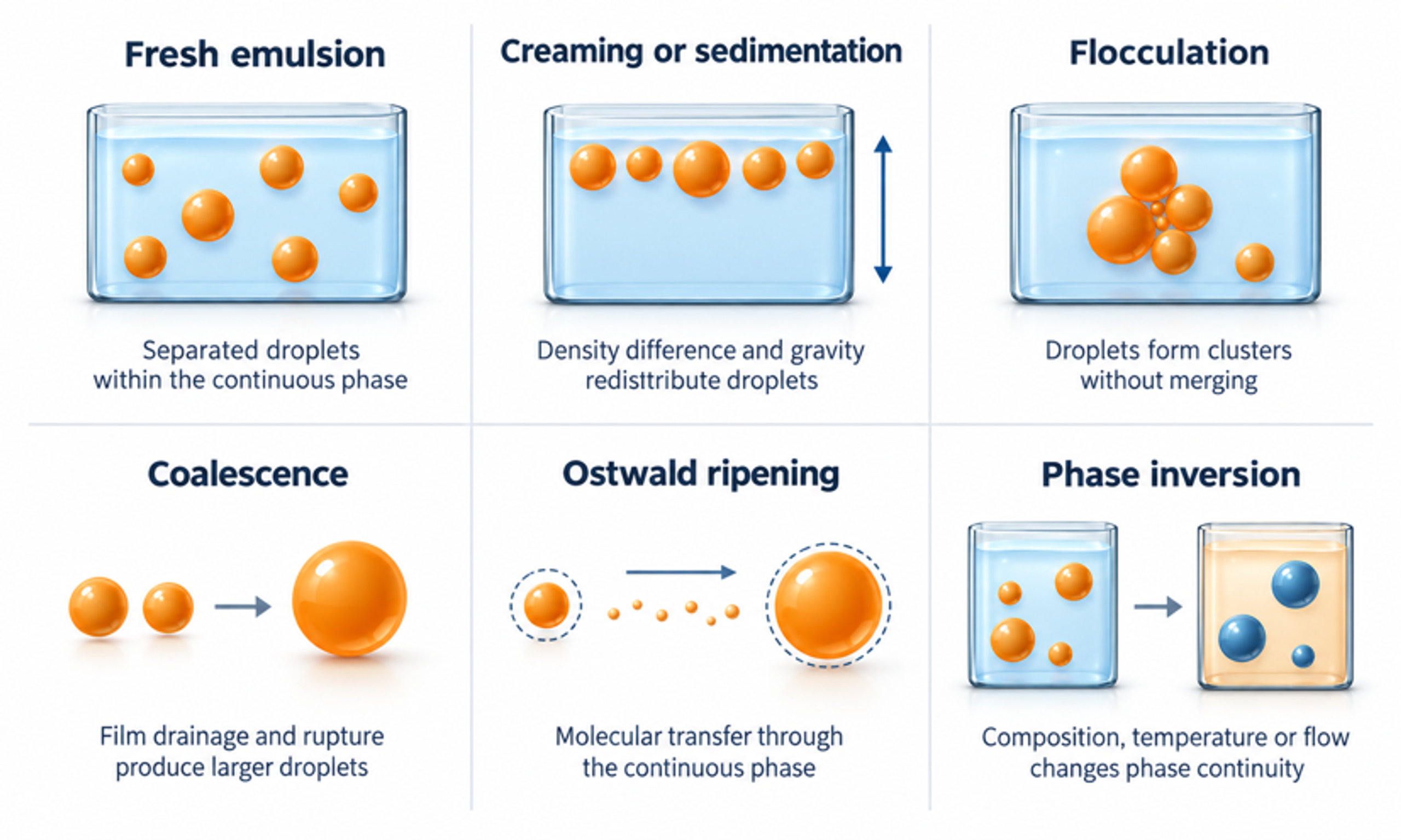
Figure 11.1. Principal physical destabilization mechanisms in emulsions: gravitational migration, flocculation, coalescence, Ostwald ripening, and phase inversion. The mechanisms change different aspects of the droplet population and require different diagnostic measurements.
11.1 Creaming and sedimentation
Gravitational separation redistributes droplets after processing and can occur without an increase in their individual diameters. Droplets that are less dense than the surrounding liquid rise by creaming, whereas denser droplets settle. For a dilute population of spherical droplets at low Reynolds number, the Stokes estimate provides a useful first assessment of the dependence on density difference, diameter, and continuous phase viscosity:
Here, g is gravitational acceleration. The sign of the density difference determines the direction of migration; the magnitude is used when comparing separation rates. The expression corresponds to rigid sphere drag and is a useful approximation for droplets with an effectively immobilized interface.
Quadratic dependence on diameter makes the coarse population particularly important. With otherwise unchanged properties, reducing diameter from 20 µm to 2 µm decreases the predicted Stokes velocity by a factor of one hundred. At larger dispersed phase fractions, hydrodynamic interactions can hinder relative motion. A commonly used screening form is
where n is an empirical exponent that must be appropriate to the dispersion and concentration range.
The hindered motion expression should be interpreted as an approximation. Flocculation, non-Newtonian rheology, concentration gradients, temperature gradients, and container geometry can dominate actual storage behavior. In addition, a freely mobile liquid interface has a different drag from a rigid sphere. Measured separation profiles are therefore needed to establish shelf life rather than relying solely on a calculated terminal velocity.
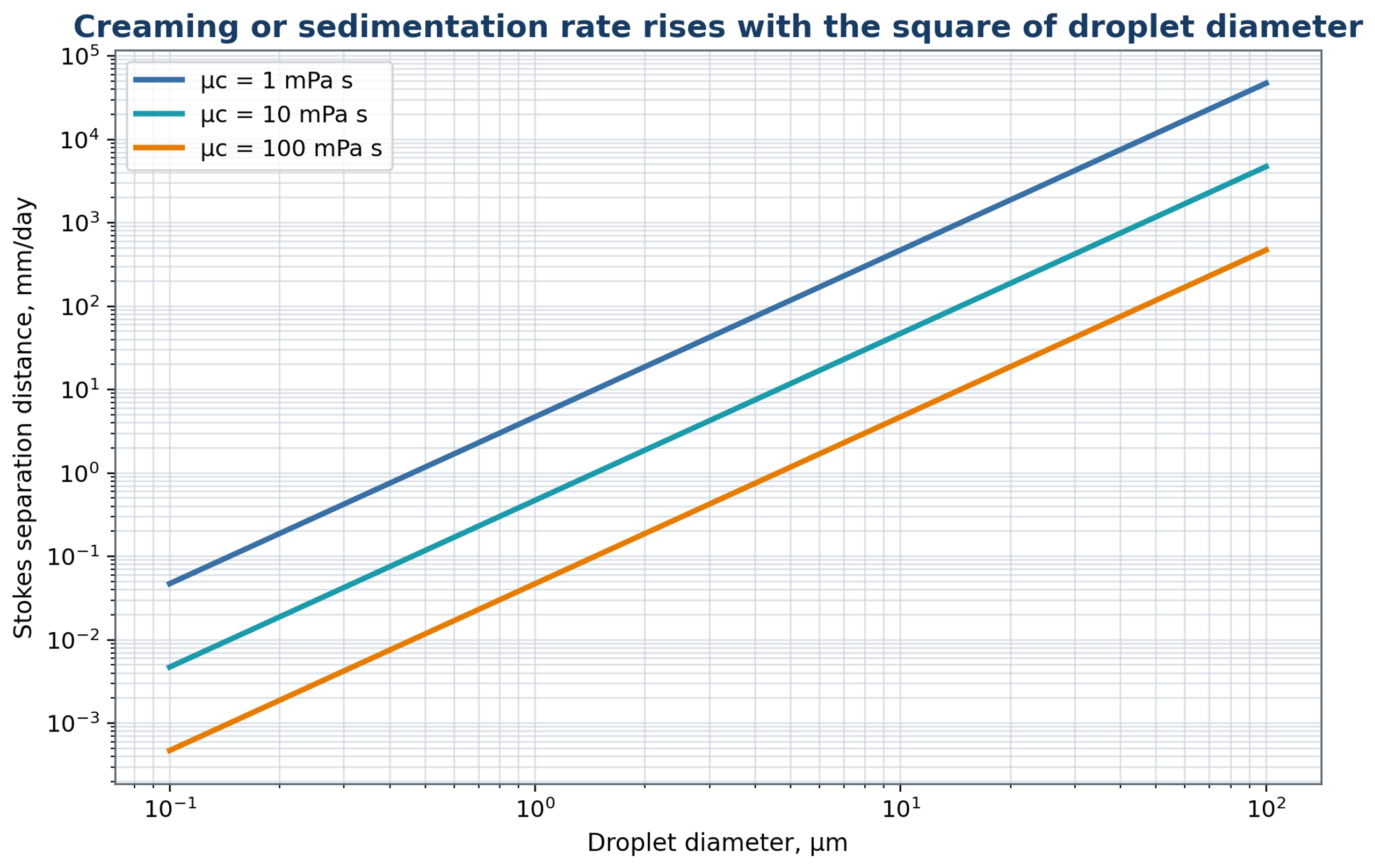
Figure 11.2. Stokes migration estimates for a density difference of approximately 100 kg m⁻³ and the continuous phase viscosities indicated, following equation (11.1). The calculation assumes dilute, spherical droplets with an effectively immobilized interface and creeping flow.
11.2 Flocculation and coalescence
Aggregation and coalescence change emulsion structure through different mechanisms and require different corrective measures. Flocculation produces clusters while preserving the individual droplet interfaces; it may be reversible and can increase the measured particle size without increasing primary droplet diameter. Coalescence combines droplets after the intervening liquid film drains and ruptures. Microscopy, controlled dilution, rheology, and droplet sizing under defined dispersion conditions help distinguish these processes.
Processing can improve stability by distributing emulsifier and reducing droplet size, but the same flow can increase collisions or damage weak interfacial structures. Measurements should therefore be made promptly after processing and repeated after a defined rest interval. An increase in with relatively little change in a number sensitive mean suggests growth of a coarse population, although this observation alone does not distinguish recoalescence from flocculation or a sampling artifact.
The competition between thermal motion and gravitational migration can be screened using the Stokes Einstein estimate of Brownian diffusivity:
where is Boltzmann constant and is absolute temperature. The expression assumes a spherical dispersed object in a Newtonian continuous phase.
A gravitational Peclet number based on the droplet diameter is
A small value indicates that Brownian diffusion is relatively important on the diameter length scale, whereas a large value indicates stronger gravitational transport. This comparison does not itself predict aggregation, which also depends on electrostatic, steric, and other interfacial interactions.
11.3 Ostwald ripening
Ostwald ripening is a molecular transport mechanism rather than a collision process. Material dissolves from droplets with higher curvature and is transported through the continuous phase to larger droplets. The mechanism is relevant when the dispersed liquid has appreciable solubility in the continuous liquid. Under idealized ripening conditions, a selected characteristic droplet size can follow a cubic growth relation:
where is an effective ripening constant. It depends on solubility, diffusivity, molar volume, temperature, and interfacial tension, and its numerical value depends on the definition of characteristic diameter.
Mechanical size reduction cannot permanently suppress ripening when molecular transfer is favored by the formulation. Possible formulation measures include a less soluble oil component, a suitable inhibitor of ripening, a different continuous phase, or a lower storage temperature. Their effectiveness must be established experimentally. Even an initially narrow nanoemulsion distribution can grow if molecular transfer remains appreciable.
11.4 Phase inversion and rheology
Phase inversion changes the identity of the continuous phase and can therefore change rheology, conductivity, pumping behavior, and apparent processing efficiency abruptly. Catastrophic inversion is associated with an increase in dispersed phase loading beyond the range sustainable by the existing structure. Transitional inversion results from changes in temperature, composition, salinity, or emulsifier affinity that alter the preferred interfacial curvature. Conductivity, viscosity, and microscopy provide complementary evidence during formulation addition and processing.
Concentrated emulsions commonly exhibit shear thinning and may develop yield stress. Their apparent viscosity controls pumpability and bulk circulation, while the viscosity at the local deformation rate affects transport through the head. Rheology should be measured before and after processing at the intended product temperature. An increase in viscosity can arise from finer droplets, flocculation, a higher phase fraction, or partial inversion, so rheological data should be interpreted together with droplet and topology measurements.
Table 11.1. Stability tests and their engineering interpretation.
| Test | Primary observation | Useful interpretation | Limitation |
|---|---|---|---|
| Immediate laser diffraction or imaging | DSD and coarse tail | Breakup result before aging | Sampling and dilution can alter flocs |
| Centrifugation | Accelerated separation | Relative formulation screening | Does not duplicate long term gravity exactly |
| Conductivity | Continuous phase identity | Detects inversion in many systems | Not useful when both phases are weakly conducting |
| Rheology | Viscosity, yield stress, thixotropy | Structure and processability | Cannot distinguish droplet refinement from flocculation alone |
| Microscopy | Droplet shape, flocs, coalescence | Direct structural evidence | Limited field of view and resolution |
| Turbiscan or vertical optical scan | Migration and clarification profiles | Separation kinetics without opening container | Optical contrast and multiple scattering affect response |
| Storage at multiple temperatures | Realistic aging | Detects coalescence, ripening, oxidation | Requires time and controlled packaging |
| Freeze thaw or thermal cycling | Stress resistance | Reveals interfacial and phase instability | May exceed actual product use conditions |