
Technical publication
Back to publications
Other
Emulsification and Homogenization in Rotor-Stator Mixers
okozyuk.com
Published
Read complete publication for whole-document Find and printing. Browser Find and native printing on this reader include only loaded content.
10 Energy consumption and thermal management
An energy balance places droplet refinement in the context of power demand and thermal exposure. It also provides a common basis for comparing batch and continuous operation. The following relations distinguish shaft power, net process power, specific energy, interfacial free energy, and cooling duty; these quantities should be evaluated over the same material inventory and processing interval.
10.1 Shaft power, hydraulic power, and specific energy
Energy measurements provide a basis for comparing operating conditions and estimating the thermal load. Electrical input includes losses in the drive and motor, whereas shaft power is obtained from the rotational speed and transmitted torque. The distinction is necessary when comparing equipment with different motors or mechanical arrangements. For rotational speed in revolutions per second, the shaft power is
where denotes torque. Torque must be distinguished from the absolute temperature symbol used later in the thermal motion equations.
The net power assigned to the process is obtained by subtracting an appropriate mechanical baseline from the loaded power measured on the same basis:
The hydraulic power associated with a specified pressure difference and volumetric flow is
For a steady process, the specific energy delivered per unit mass is
where the denominator is the mass flow rate. For a batch, the corresponding accumulated specific energy is
where is the batch mass and the integral includes any variation of net power during processing.
For steady inline operation, the energy input per unit processed volume is
with representing the volumetric throughput.
An average power density based on a defined active volume is
These quantities describe different features of operation. Specific energy characterizes the cumulative energy demand and provides a basis for a thermal balance; active volume power density describes an average intensity within a selected region. Neither quantity directly specifies the local dissipation maxima responsible for individual breakup events. The active volume definition, baseline correction, auxiliary pump contribution, and measurement method should therefore be reported. Installed motor rating alone is insufficient for an energy comparison [1, 3, 10].
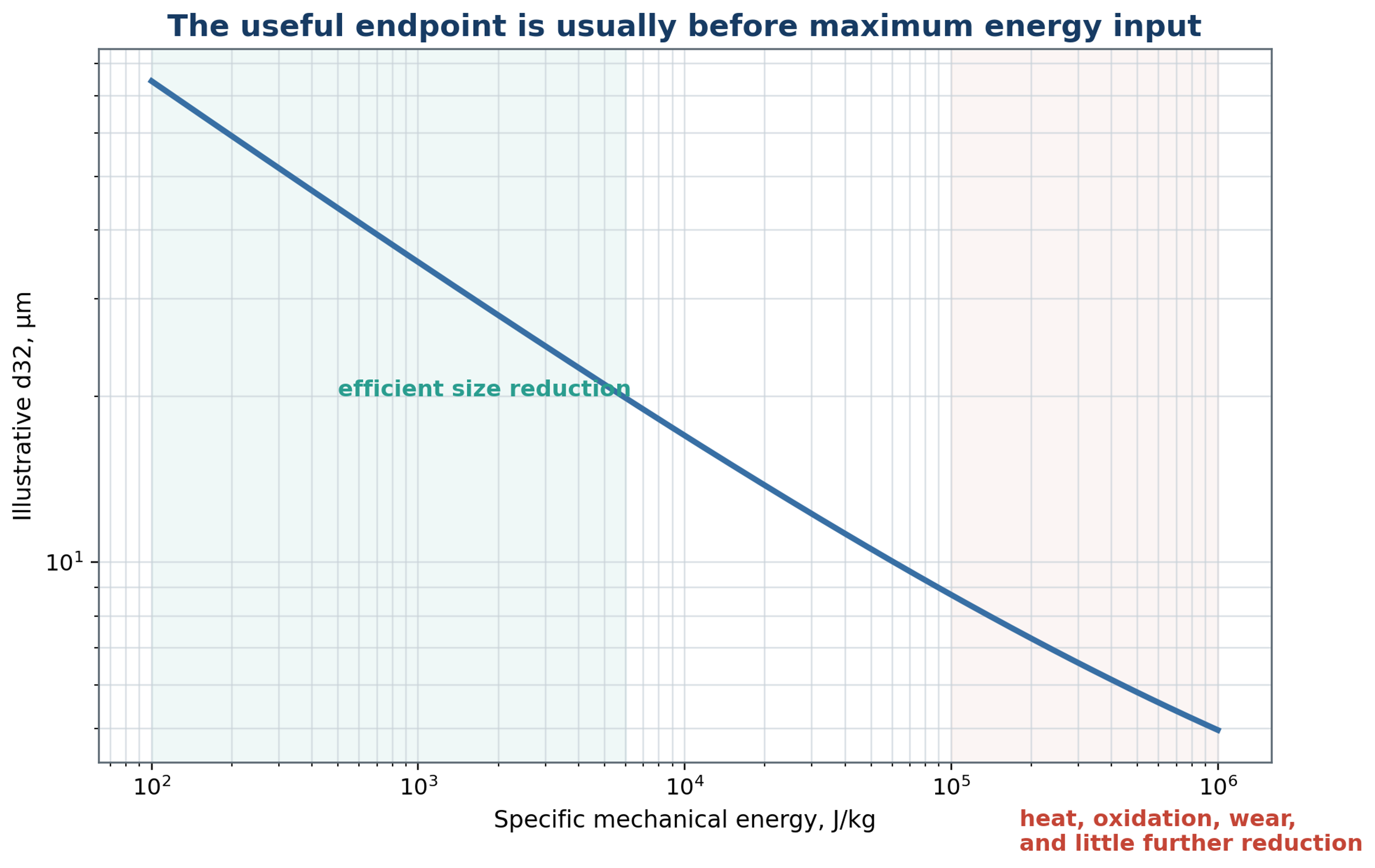
Figure 10.1. Conceptual relationship between specific energy and droplet reduction. The shaded regions illustrate diminishing returns and possible thermal or mechanical penalties. The indicated energy ranges are schematic and must not be used as universal operating limits.
10.2 Minimum interfacial work and energetic efficiency
Creating additional droplet surface requires interfacial free energy, although this requirement represents only a small fraction of the mechanical input. If interfacial tension can be treated as constant over the change in area, the increase is
where and are the initial and final interfacial areas. When interfacial tension changes with surface age or composition, this expression is a screening approximation to the corresponding interfacial work.
A convenient apparent interfacial energy efficiency is defined as
where is the measured net energy delivered during the same processing interval.
The resulting efficiency is generally small because much of the input is dissipated as heat or used in circulation and other fluid motion. Its interpretation also depends on dynamic interfacial tension, adsorption, coalescence, and deviations from spherical droplet shape. The metric is most useful for comparisons made with the same formulation, definition of input energy, and method of estimating area. It does not quantify the universal thermodynamic efficiency of the mixer.
10.3 Temperature rise and cooling duty
The thermal calculation connects energy consumption to formulation stability and cooling requirements. If all of the specified net energy is retained as sensible heat within the product, the estimated adiabatic temperature increase is
where is the effective heat capacity of the emulsion over the temperature interval considered.
For a steady stream that must be cooled from to a lower target temperature, the sensible cooling duty is
Heat transfer to the vessel, housing, and surroundings can reduce the measured temperature rise. The adiabatic estimate provides an upper bound only for the energy terms and material inventory included in the balance; pump heat, chemical heat release, and other inputs must be added where relevant. Cooling capacity should be evaluated for the highest intended load and viscosity, including recirculation. Because cooling changes viscosity and adsorption kinetics, temperature control also changes the emulsification conditions.
Kinematica describes MEGATRON inline systems with single or multistage working chambers and options for heating or cooling jackets. Such provisions permit thermal management to be integrated with the processing head, but jacket availability alone does not define the cooling rate or product temperature. The required thermal duty and residence history must be established from the actual power input, flow rate, and heat transfer conditions [38].
10.4 Energy based process endpoint
An energy based endpoint identifies the earliest verified condition at which the full product specification is satisfied. Suitable acceptance variables include , , span, storage stability, temperature, and a chemical or sensory measure appropriate to the formulation. Further processing should be supported by a measurable benefit. Investigations of milk pulsation homogenization illustrate the value of evaluating dispersion and energy together, although the reported relationships remain specific to the apparatus and operating conditions [16, 17, 39, 40].