
Technical publication
Back to publications
Other
Emulsification and Homogenization in Rotor-Stator Mixers
okozyuk.com
Published
Read complete publication for whole-document Find and printing. Browser Find and native printing on this reader include only loaded content.
13 Scale up and technology transfer
Technology transfer requires preserving the product attributes that motivated the original processing conditions. Scaling the equipment can change local stresses and exposure distributions in different ways, so agreement in a single operating parameter is insufficient evidence of equivalent processing. The following discussion compares common scaling criteria and describes the pilot measurements needed to establish their useful range [1, 3].
13.1 Why geometric similarity is insufficient
Scale up requires reproduction of a product response across changes in equipment size and processing rate. Geometric similarity is insufficient because a change in rotor diameter also changes velocity, power, torque, local residence, circulation, and the proportion of material occupying active regions. Clearance and manufacturing tolerances may not scale proportionally, and changes in heating or adsorption history can alter the formulation response. A transferable process description must therefore identify the variables that control both breakup and stabilization [1, 3, 10].
A useful hierarchy begins with product requirements and then considers the associated stress, exposure, residence distribution, energy, and thermal conditions. Mechanical limitations are applied to the candidate operating range. This sequence prevents a convenient equipment parameter from becoming the sole acceptance criterion when the droplet distribution or stability has changed.
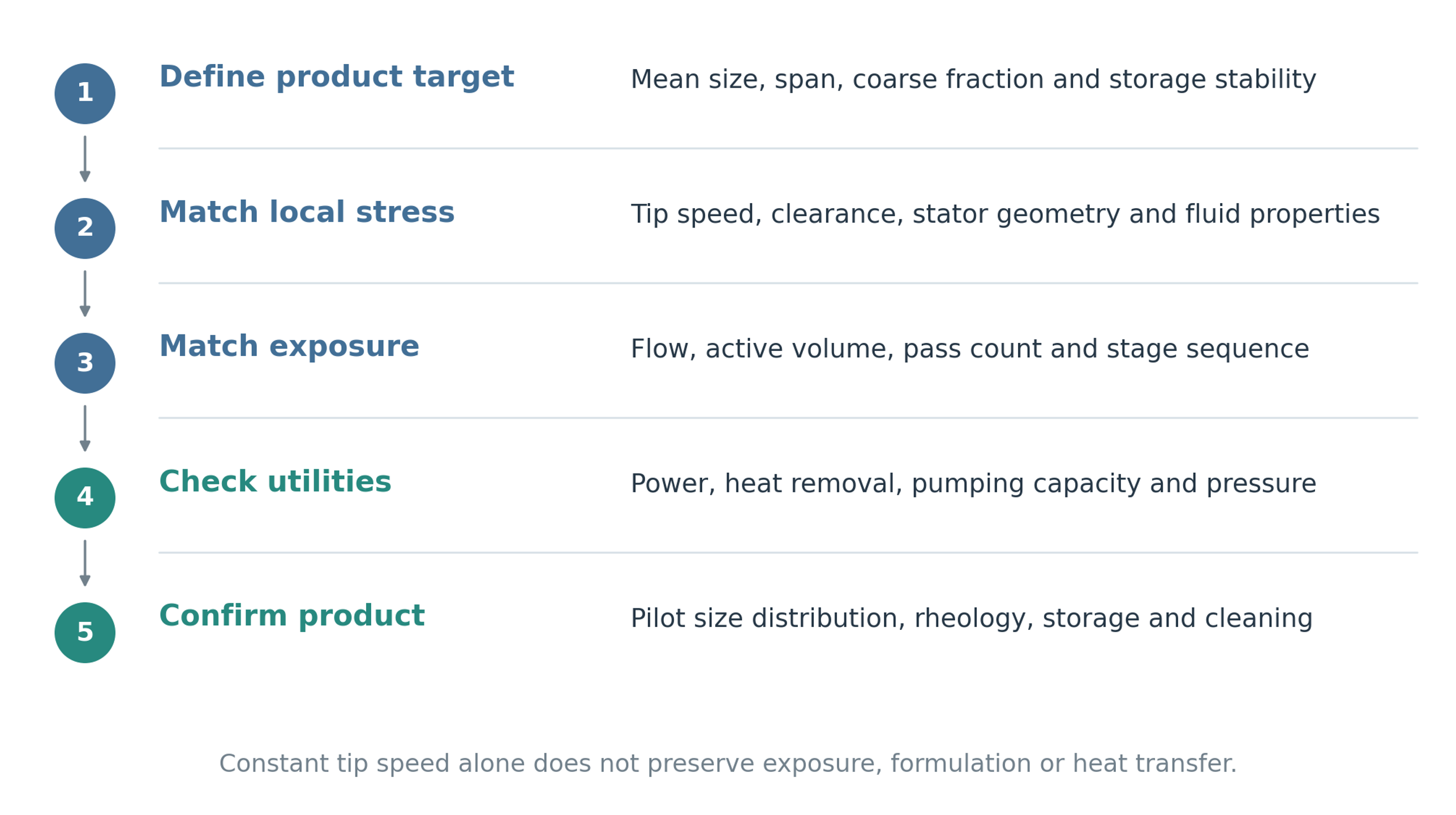
Figure 13.1. A sequence for transferring an emulsification process to a larger scale. Product specifications, local stress, exposure, utilities, and validation must be considered together; matching tip speed alone is insufficient.
13.2 Common scale up criteria
Several scale up criteria are useful as controlled comparisons, provided their physical meaning and limitations are stated. Constant tip speed maintains a characteristic peripheral velocity and requires
which gives the corresponding speed relation
Maintaining the rotor Reynolds number instead requires
and, for unchanged density and viscosity, gives
For the same definition of processed material inventory, constant power per unit mass requires
Equality of mean active region residence time requires
Equality of the nominal velocity gradient across the radial clearance requires
These criteria cannot generally all be maintained when scale changes. For example, constant tip speed requires speed to vary inversely with diameter, whereas constant Reynolds number requires an inverse square dependence for unchanged fluid properties. The relevant criterion should follow from the breakup regime and validated process response. Hall obtained useful mean size scaling with tip speed at comparable residence time, but the influence of open area and other geometric differences remained significant [3]. The coarse fraction and subsequent stability require separate validation.
13.3 Scale out and modular operation
Parallel operation provides an alternative when increasing the size of a single head would create excessive torque, tip speed, or manufacturing difficulty. Several units can retain a previously validated geometry and provide flexibility in capacity and maintenance. This approach transfers part of the engineering problem to the manifold: flow, pressure, temperature, and feed composition must be distributed consistently. Unequal branches can create a broad or bimodal combined product even when each head performs adequately under its own conditions.
13.4 Pilot validation matrix
Pilot validation should determine the operating region in which both size reduction and stabilization are reproducible. The experimental factors should include rotor speed, flow or processing time, stator geometry, phase fraction, emulsifier concentration, temperature, and a defined gas condition. The responses should include , , span, net power, temperature, viscosity, and storage behavior. Recording these variables together allows an apparent improvement in mean size to be assessed against its energy, thermal, and stability consequences.
The experimental domain should also reflect the fluids used to establish a correlation. For example, Campardelli and coauthors evaluated paraffin, soybean oil, and isopropyl myristate in oil in water emulsions at different phase ratios and rotor speeds. Such controlled variation allows fluid property and operating effects to be separated more clearly than a single formulation trial. Applying the fitted relationship to another geometry or formulation still requires verification [4].
Table 13.1. Minimum pilot matrix for a new rotor stator emulsion.
| Factor | Suggested levels | Primary response | Secondary response |
|---|---|---|---|
| Rotor speed | Low, center, high within mechanical limit | DSD and coarse tail | Power, heat, air ingestion |
| Flow or residence | At least three levels | Capacity and DSD | Pressure loss and exposure distribution |
| Stator geometry | Coarse, intermediate, fine | DSD and throughput | Fouling and cleaning |
| Phase fraction | Minimum, nominal, maximum | DSD and rheology | Inversion and pumpability |
| Emulsifier level | Below, near, above expected coverage | Recoalescence and storage | Cost and sensory constraints |
| Temperature | Low, nominal, maximum allowed | Viscosity and DSD | Degradation and vapor pressure |
| Pass number | 1, 2, 3, 5, endpoint value | Diminishing return curve | Oxidation and heat |
| Gas condition | As received and controlled degassed state | Reproducibility and foam | Cavitation and oxidation |
13.5 Statistical and uncertainty considerations
Quantitative comparison requires separation of true process effects from sampling and measurement variability. Replicate runs capture variation in premix preparation, temperature, hydrodynamic exposure, and analysis. Regression or response surface is valid only over the investigated region unless its transfer is independently demonstrated. Extrapolation across viscosity, composition, geometry, or scale can otherwise produce a precise numerical prediction with little physical support.
For a calculated result y = f(x₁, x₂, …, xₙ), the first order propagation of uncorrelated input uncertainties is
where and denote standard uncertainties in the result and input quantities, respectively. Correlated inputs require covariance terms that are not included in this simplified expression.
Uncertainty should include droplet measurement repeatability, sample location, dilution, refractive index assumptions, and instrument operating conditions. Model parameters and estimated circulation rates can contribute additional uncertainty. A claimed scale effect should be evaluated relative to the combined uncertainty rather than inferred solely from a small difference between fitted means.