
Technical publication
Back to publications
Industrial applications
Emerging Frontiers in Hydrodynamic Cavitation
okozyuk.com
Published
Read complete publication for whole-document Find and printing. Browser Find and native printing on this reader include only loaded content.
9 Critical Minerals, Spent Catalysts, and Lithium Processing
9.1 Scope and Process Integration
Lithium is produced from continental brines, geothermal or oilfield brines, hard rock minerals such as spodumene, clays, and recycled lithium ion batteries. Selective separation is governed by mineralogy, acid or alkali chemistry, magnesium to lithium ratio, impurity precipitation, solvent or sorbent selectivity, and product crystallization. Cavitation does not provide lithium selectivity by itself. Its credible role is process intensification: exposing fresh surface, dispersing reagents, accelerating leaching, improving gas liquid carbonation, conditioning particles for flotation, and controlling nucleation [13,35-37].
Direct peer reviewed evidence for hydrodynamic cavitation in primary lithium extraction remains limited. Ultrasound assisted cavitation provides the strongest adjacent evidence. Okonkwo et al. used ultrasound with molasses and methanesulfonic acid to intensify leaching of Li, Co, Ni, and Mn from spent batteries [35]. These observations support the mechanisms of surface cleaning, fragmentation, boundary layer disruption, and reagent transport, but acoustic cavitation cannot be assumed to reproduce the energy distribution or scale behavior of a continuous hydrodynamic device. Comparative development should therefore use equal specific energy and equal temperature history for HC, mechanical agitation, and ultrasound.
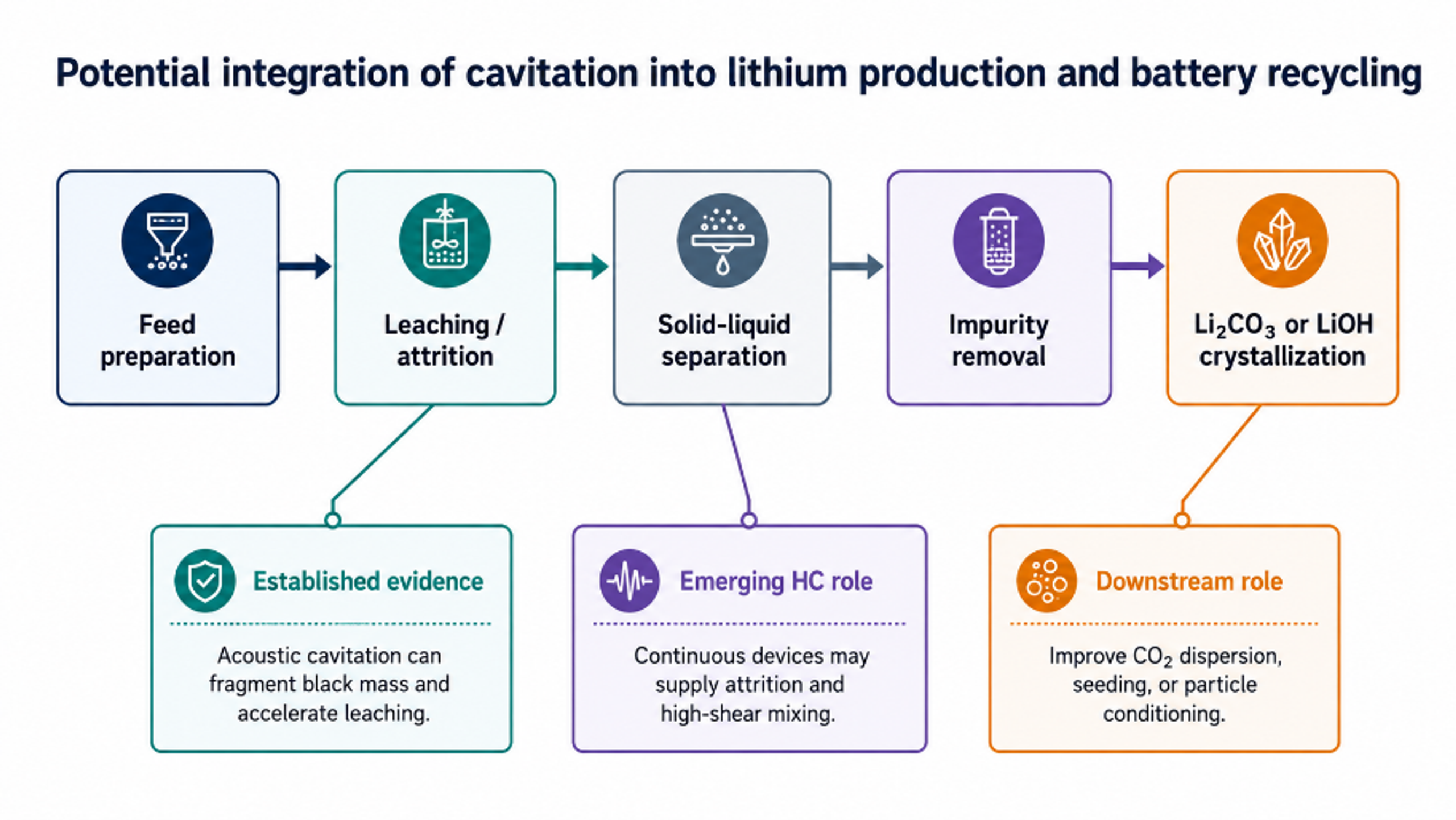
Figure 9.1. Potential integration of cavitation into lithium production and battery recycling. [70].
9.2 Leaching and Particle Activation
In hard rock and black mass leaching, reaction rate can be limited by surface films, product layers, agglomeration, and diffusion through the liquid boundary layer. A rotor stator, orifice, Venturi, or vortex cavitation device can recirculate slurry and impose repeated pressure, shear, and impact events. Expected benefits include deagglomeration, removal of passivating films, improved wetting, and increased mass transfer coefficients. Potential disadvantages include excessive fines, separator loading, erosion, and contamination from device materials.
Scale up must preserve slurry transport and avoid plugging. A bypass or recirculation loop is often more practical than placing the restriction in the full solids flow. Solids concentration, maximum particle size, hardness, gas generation, and viscosity should be included in the design. Temperature rise from hydraulic energy must be measured because apparent cavitation benefits can otherwise be attributed incorrectly to heating.
Lithium recovery must be reported on a lithium mass basis, not only as solution concentration.
X is fractional leaching conversion, kapp is an apparent rate constant that combines reaction and transport, and n is an empirical reaction order.
is lithium recovery yield per electrical energy, a useful comparison metric for alternative intensification methods.
9.3 Carbonation, Precipitation, and Impurity Control
Lithium carbonate production requires controlled supersaturation and impurity management. Cavitation can improve carbon dioxide dispersion or promote seed generation, analogous to the calcium carbonate crystallization results discussed earlier. It can also be counterproductive if uncontrolled nucleation produces ultrafine crystals that are difficult to filter or if magnesium and calcium co precipitate. Battaglia and coworkers reported up to 80% lithium recovery and 99% product purity in a NaOH/CO2 process with an ethanol wash, emphasizing the influence of magnesium, calcium, and sulfate [36]. Baum and coworkers reviewed the need to integrate extraction, concentration, and purification rather than optimizing a single unit operation [37].
Lithium carbonate precipitation depends on activity, temperature, ionic strength, and competing ions.
S is supersaturation ratio, is the ion activity product, and Ksp is the solubility product. Nucleation increases sharply above the metastable zone.
Table 9.1. Potential cavitation integration points in lithium production
| Process step | Potential cavitation function | Expected benefit | Principal uncertainty |
|---|---|---|---|
| Ore or black mass slurry preparation | Deagglomeration, wetting, attrition | Higher exposed surface and more uniform reagent contact | Erosion, fines generation, plugging and metal contamination |
| Acid/alkali leaching | Boundary layer disruption and surface cleaning | Faster kinetics or lower reagent/temperature requirement | Selectivity and energy benefit must be proved at equal temperature |
| Brine carbonation | CO2 dispersion and gas liquid mass transfer | Faster carbonate formation or pH adjustment | Co precipitation of Mg/Ca and gas disengagement |
| Seed crystallization | Nucleation and secondary attrition | Controlled induction time and potential continuous operation | Ultrafine crystals may be difficult to filter |
| Impurity or mineral flotation | Fine bubble generation and surface activation | Improved recovery of selected hydrophobic phases | Requires selective reagent chemistry; HC is not selective alone |
9.4 Uranium, Rare Earths, and Other Solid Liquid Leaching Systems
The same boundary layer disruption and particle activation mechanisms apply to uranium ores, rare earth bearing solids, spent catalysts, and other critical mineral feeds. Cavitation reduces the stagnant liquid film, exposes fresh mineral surface, fragments weak product layers, disperses agglomerates, and can accelerate redox reactions when the required oxidant or lixiviant is present. It does not replace mineral specific chemistry, grinding, solid liquid separation, solvent extraction, or ion exchange [68].
This simplified oxidation step illustrates ferric oxidation of tetravalent uranium before dissolution in an acidic leach. Actual solution chemistry includes uranyl complexes and mineral specific reactions [68].
Experiments reviewed by Ladola and coworkers reported enhanced uranium leaching under cavitation, but the evidence base is small and feed dependent. Scale up must address abrasive wear, acid compatibility, radiological containment, off gas, fine solids, and the possibility that cavitation creates a difficult to filter colloidal fraction. For radioactive or toxic materials, the reactor and sampling system must remain fully enclosed, and the benefit must be demonstrated at equal reagent dose, temperature, particle size, and electrical energy [68].