
Technical publication
Back to publications
Industrial applications
Design and Operating Principles of Rotor-Stator Mixers
okozyuk.com
Published
Read complete publication for whole-document Find and printing. Browser Find and native printing on this reader include only loaded content.
8. Detailed Description of Operating Principles
In rotor-pulsation apparatuses, the principal hydromechanical effect arises from periodic changes in flow cross sectional area as rotor perforations move relative to stator openings. Alignment of the passages permits fluid flow, while partial obstruction produces local throttling, acceleration, or redirection and generates sharp pressure fluctuations upstream and downstream of the overlap region. This principle is used in liquid dispersion equipment, including fertilizer preparation systems described by Voitiuk and Borkhalenko [4]. The pulsations can be accompanied by strong turbulence or cavitation, but their amplitude and the onset of cavitation depend directly on the geometry of the working zone and hydraulic boundary conditions [5, 6, 7].
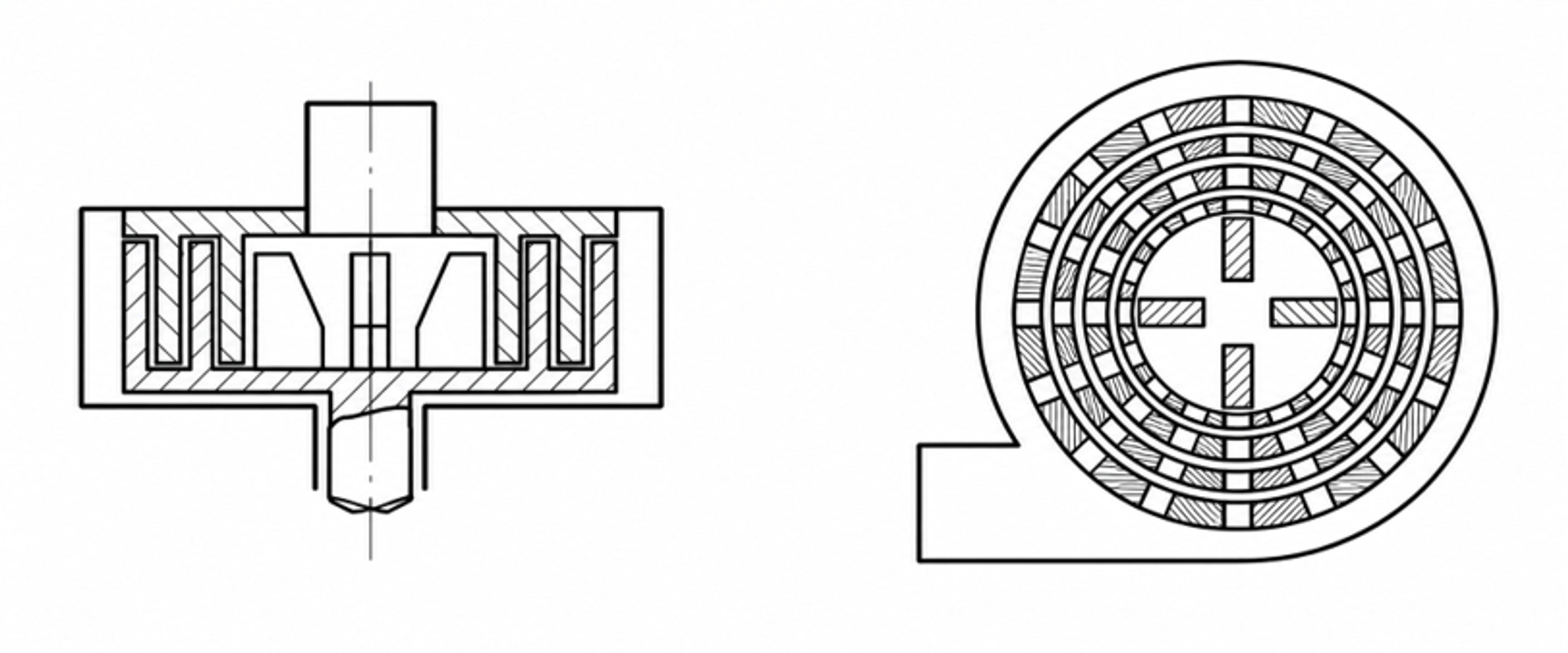
Figure 8.1. Concentric rotor-stator pair shown in sectional and plan views. Simplified illustrative reconstruction based on a rotor-pulsation design [4].
The operation of a conventional batch mixing head can be divided conceptually into four interrelated functions:
-
Intake: Transport of feed material to the rotor inlet.
-
Acceleration and deformation: Transfer of momentum to the moving fluid and initial deformation of the incoming material by the rotating rotor elements.
-
Intensive shear: Passage of fluid through narrow rotor-stator gaps and stator openings, accompanied by steep velocity gradients and extensional deformation.
-
Discharge and circulation: Formation of high velocity discharge jets that entrain surrounding liquid and complete the vessel's bulk circulation loop.
These functions do not constitute distinct thermodynamic stages. They overlap both spatially and temporally within the active fluid volume [9, 10].
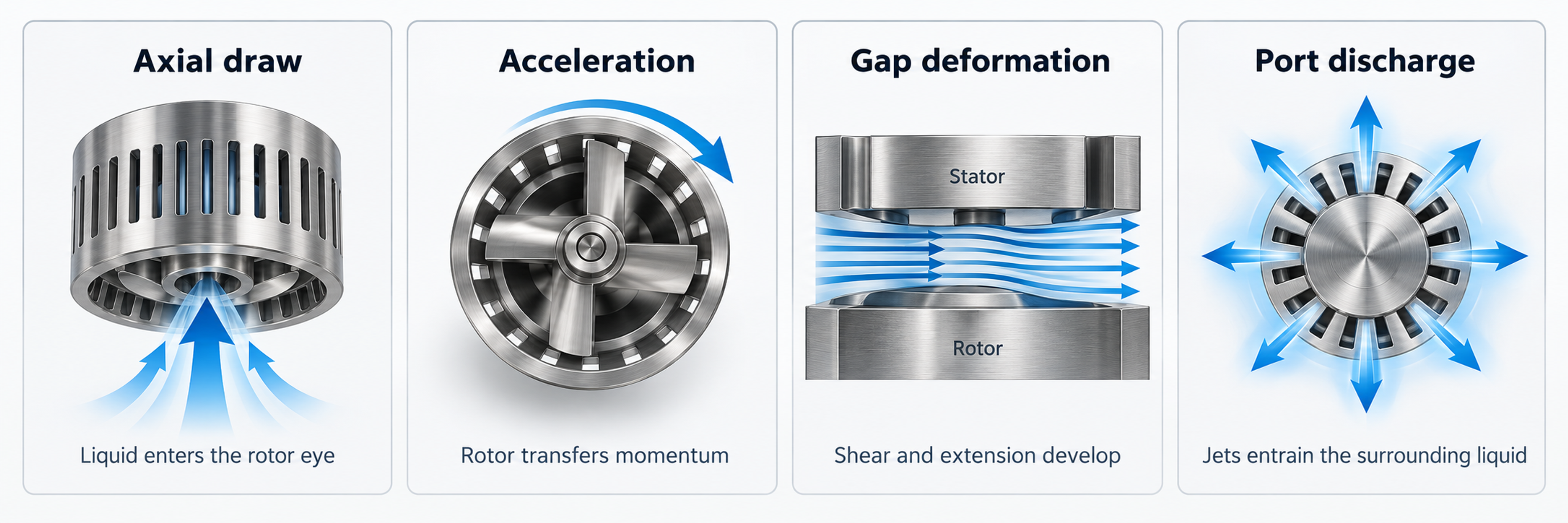
Figure 8.2. Four overlapping functions of a conventional mixing head: intake, acceleration, deformation, and discharge [1].
In inline mixers, an analogous momentum transfer process takes place within sealed housing. Interaction of the rotor with the incoming flow, together with redistribution of velocity, pressure, and turbulence by the stator and outlet manifold, means that outlet pressure can influence the conditions inside the mixing head. Backpressure can, for example, suppress vapor formation and cavitation, but its effect on throughput and energy consumption must be evaluated using the actual system head versus flow characteristic.
Four characteristic time scales are useful when interpreting experimental data: the period of one shaft revolution, the passage time of an individual perforation element, residence time in the active deformation region, and overall circulation or tank turnover time. These quantities often differ by orders of magnitude. Increasing the frequency of rotor-stator interactions does not necessarily increase the rate of tank recirculation, while increasing bulk flow may reduce the specific energy imparted during each pass at a fixed tip speed. Considering all these factors avoids attributing every change in product quality to nominal shear rate alone.