
Technical publication
Back to publications
Industrial applications
Design and Operating Principles of Rotor-Stator Mixers
okozyuk.com
Published
Read complete publication for whole-document Find and printing. Browser Find and native printing on this reader include only loaded content.
7. Rotor Geometry and Its Effects on Hydrodynamics and Process Energy
Rotor geometry governs angular momentum transfer, the head versus flow characteristic, local relative velocity profiles, and the frequency of hydrodynamic interaction with the stator. Different working element configurations provide different mechanisms of hydromechanical action:
-
Straight blades primarily generate radial flow with developed turbulent wakes that promote bulk mixing.
-
Wedge shaped blades produce converging and diverging flow regions with pronounced shear and axial extension, helping to break up structures in emulsions and suspensions.
-
Toothed crowns or rings intermittently obstruct flow passages at high frequency, producing pressure and flow pulsations.
-
Pin elements generate strong separated flows and vortex structures.
-
Concentric ring assemblies enable multilevel processing at several active radii with progressively increasing circumferential speeds.
Modern dispersers often combine these geometries within a single working assembly. The combined effects of the individual elements must be analyzed separately to interpret power dissipation, energy transfer efficiency, and the final particle size distribution correctly [3, 6, 7, 9].
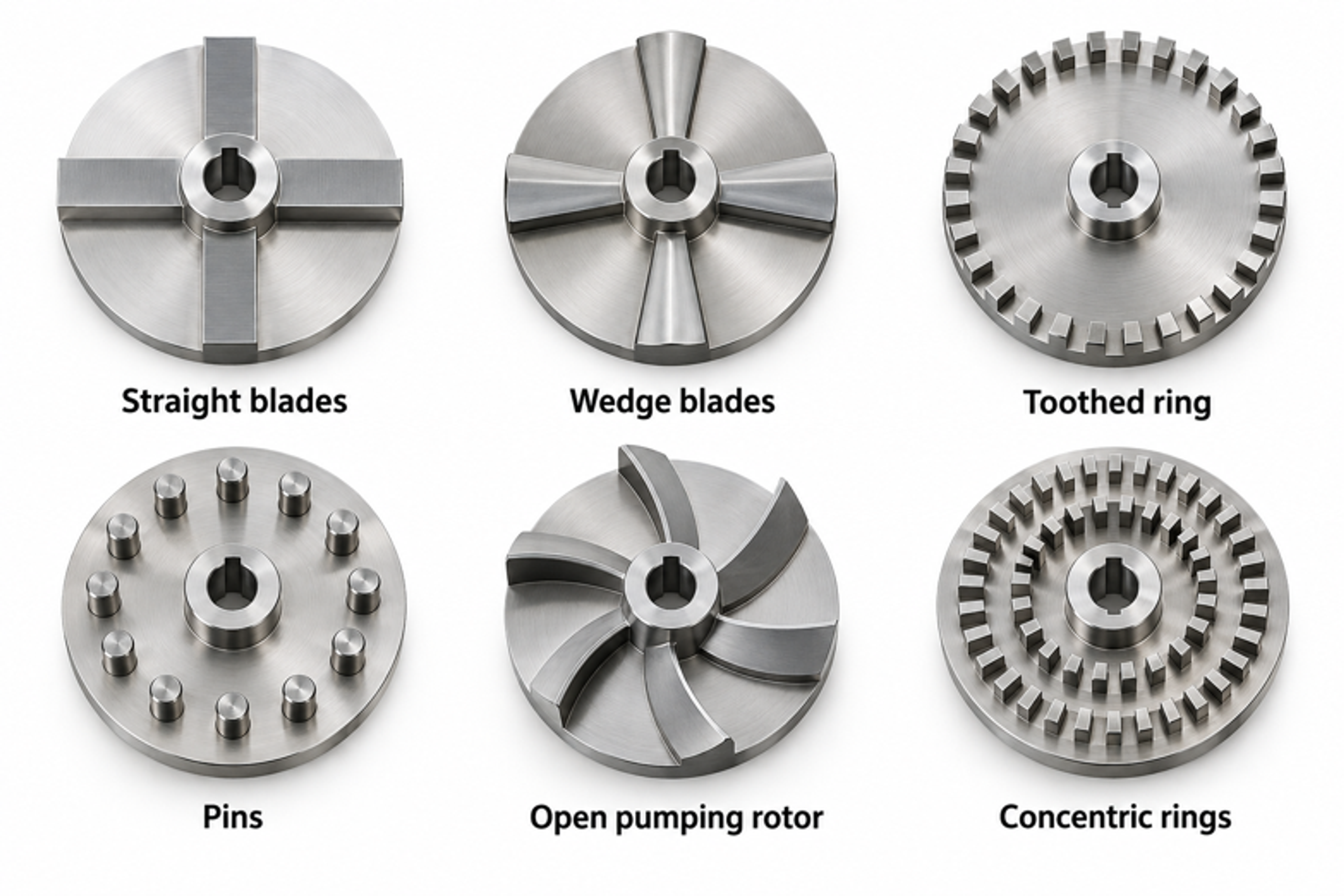
Figure 7.1. Representative rotor types shown schematically in plain view. Differences in blades, teeth, pins, and active radii affect pumping action and interaction with the stator [1].
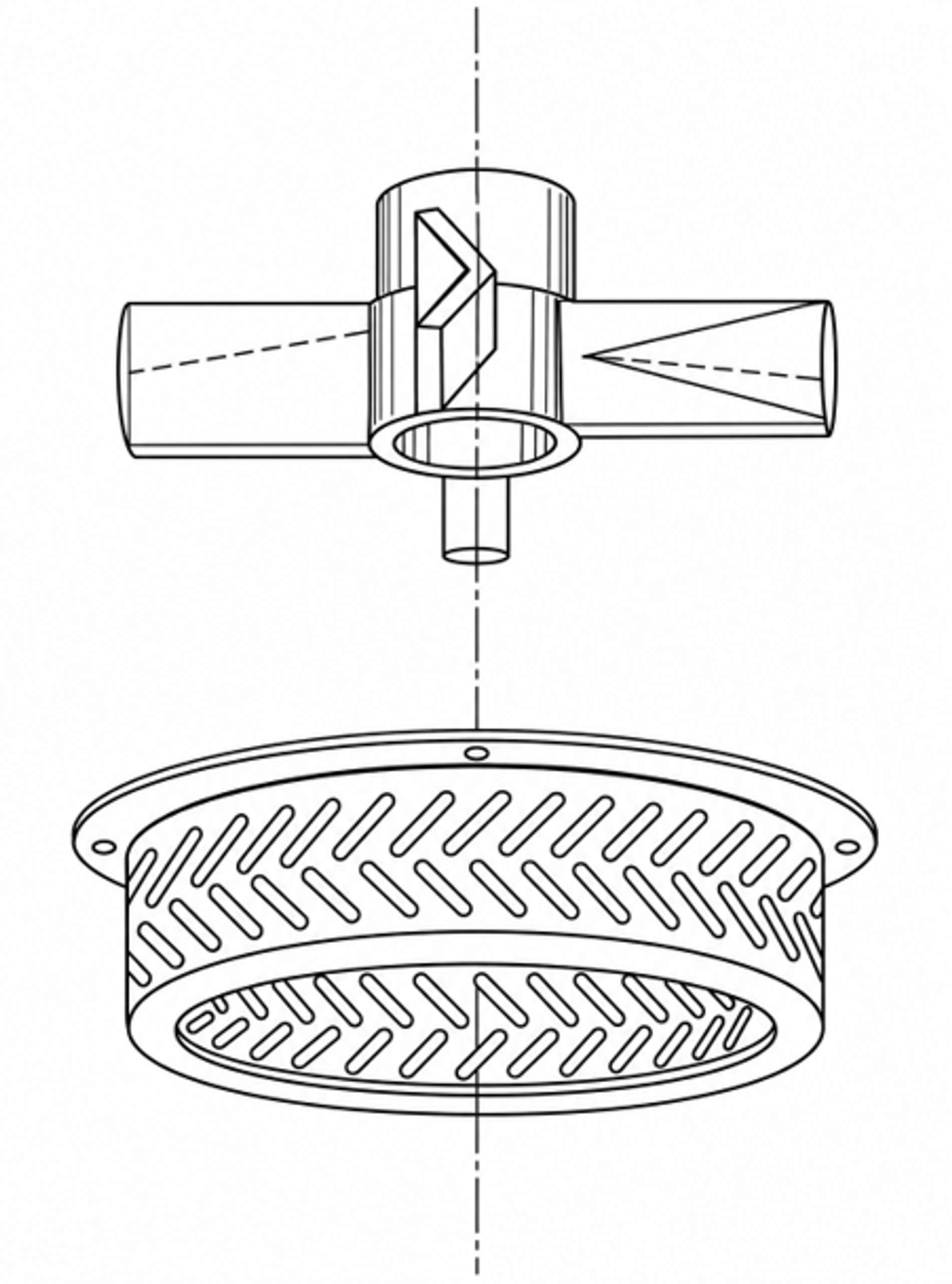
Figure 7.2. Concept of a four-blade wedge rotor with matching inclined stator slots. Redrawn from Figure 3 of U.S. Patent 6,000,840. [9].
Table 7.1. Functional characteristics of principal rotor types
| Rotor type | Principal action | Suitable processes | Important parameters |
|---|---|---|---|
| Straight blade disk | Radial pumping, gap shear, and blade-wake turbulence. | General dispersion and emulsification. | Blade height, number, leading-edge thickness, and clearance. |
| Wedge blade | Convergent deformation and pressure generation. | Fine dispersion, deagglomeration, and emulsification. | Wedge angle, orientation, and stator slot angle. |
| Toothed ring | Periodic channel obstruction and repeated shear at tooth tips. | Rotor-pulsation treatment and high-frequency mixing. | Tooth count, phase, radial overlap, and clearance. |
| Pin rotor | Vortex shedding and high local speeds around pins. | Cavitation, extraction, and reactive mixing. | Pin diameter and pitch, clearance, and cavitation number. |
| Open high throughput rotor | Strong axial entrainment and bulk circulation with distributed shearing edges. | Powder wetting, hydration, and batch processing of viscous products. | Pumping coefficient, free area, and head position. |
| Multiring rotor | Multiple concentric active zones with increasing tip speed. | Multistage single pass treatment. | Diameter of each ring, free flow area between stages, and stage sequence. |
| Cavity or hole rotor | Repeated low-pressure regions inside cavities or holes. | Rotational hydrodynamic cavitation. | Hole diameter and depth, cone angle, number of holes, and pressure recovery. |
Rotor replacement or modernization requires comprehensive verification of structural and hydrodynamic compatibility with adjacent machine components. Checks must include precise shaft mounting, direction of rotation, available drive torque relative to startup and operating loads, and geometric and functional compatibility with the stationary stator.
The conceptual wedge rotor illustration depicts a four-blade configuration interacting with paired inclined stator slots, as described in the patent literature [9]. It is intended only to illustrate the operating principle; overall dimensions, tolerances, and component identifiers have intentionally been omitted. Consequently, it cannot serve as a manufacturing drawing, a basis for direct fabrication, or a reliable source of radial rotor-stator clearance dimensions.