
Technical publication
Back to publications
Industrial applications
Design and Operating Principles of Rotor-Stator Mixers
okozyuk.com
Published
Read complete publication for whole-document Find and printing. Browser Find and native printing on this reader include only loaded content.
6. Types of Stators
The stator determines hydraulic resistance, edge interactions, and the character of the discharge flow. Its main parameters are open area, hole or slot dimensions, wall thickness, edge profile, clearance, and the spatial arrangement of openings. General purpose heads commonly use interchangeable screens. Rotor-pulsation apparatuses may use toothed rings, opposing disks, or stationary crowns that interact periodically with rotor channels [4, 5, 6, 7].
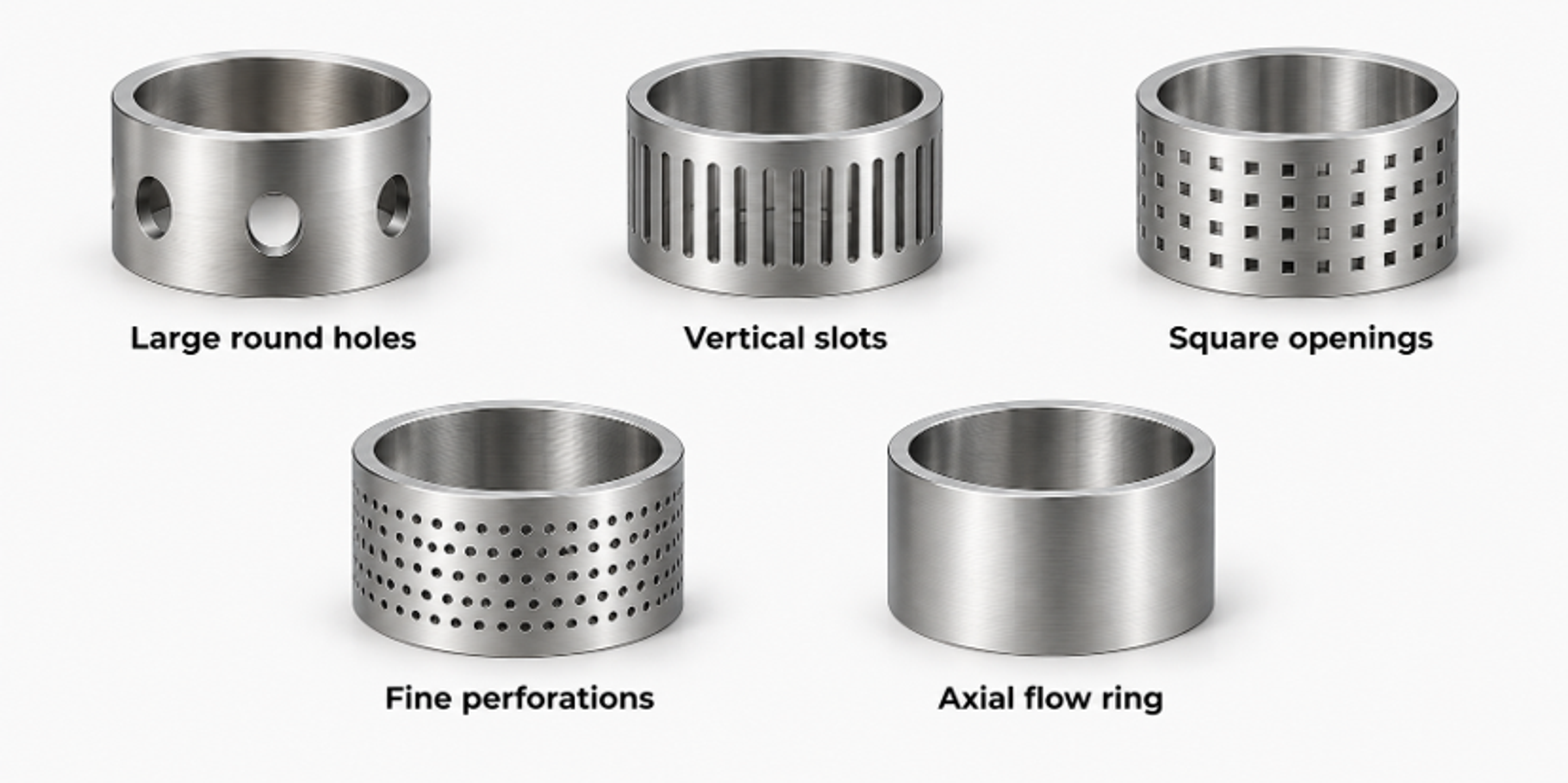
Figure 6.1. Functional screen geometries: large round holes, vertical slots, square openings, fine perforations, and an axial-flow ring [10].
Table 6.1. Functional characteristics of principal stator types
| Stator type | Hydraulic action | Typical application | Design limitation |
|---|---|---|---|
| Large round holes | Large open area, intense radial jets, and relatively low pressure loss. | General mixing, dissolution, and large soft solids. | Limited deformation at fine scales without a small gap or high tip speed. |
| Vertical or diagonal slots | Long shearing edges and directional jets. | Fibrous materials, deformable solids, gels, and rapid breakup. | Stress concentration and wear can occur at slot ends. |
| Square-hole screen | High edge density and greater flow restriction than large round holes. | Pigment dispersion, colloidal suspensions, and fine solids. | Prone to blockage by large soft lumps. |
| Finely perforated emulsifying screen | Many small jets and high local deformation. | Liquid emulsification and fine dispersion. | High pressure loss, heating, and demanding cleaning requirements. |
| Toothed stator ring | Periodic alignment with rotor teeth and pronounced pressure modulation. | Rotor-pulsation treatment, homogenization, and mass transfer. | Frequency and amplitude depend on tooth number and relative phase. |
| Pin stator | Separated wakes, local vortices, and potential cavitation behind obstacles. | Rotational cavitation and reaction processing. | Severe erosion and fatigue are possible under cavitating conditions. |
| Conical stator | Variable clearance and progressive acceleration. | Viscous materials and controlled pressure recovery. | Axial position and thermal expansion change the clearance. |
| Opposing stator disks | Short axial passages and repeated disk interactions. | Multistage rotor-pulsation assemblies. | Precise alignment and dependable control of axial forces are required. |
Hole count alone does not adequately characterize a stator. The same total open area can be achieved using a few large holes or many small holes, but the total edge length, jet size, wall thickness, and interactions with rotor position will differ. Cleanability and the risk of blockage by fibers should be assessed using the same geometry that forms the basis of hydrodynamic analysis.