
Technical publication
Back to publications
Industrial applications
Design and Operating Principles of Rotor-Stator Mixers
okozyuk.com
Published
Read complete publication for whole-document Find and printing. Browser Find and native printing on this reader include only loaded content.
4. Single-Element Systems and Combined Tank Installations
4.1 High Throughput Batch Mixing Heads
High throughput batch heads are designed to combine localized dispersive action with vigorous bulk circulation rather than to maximize throttling through a fine screen. Scott Turbon high-shear batch mixers illustrate this design philosophy: their heads draw material from both above and below the assembly and redistribute it throughout the process vessel.
Such mixing heads operate through three successive functional steps:
Step 1. The rapidly rotating head draws in material from above and below. Specially profiled discharge passages create intensified turbulence and local pressure reduction, allowing high velocity discharge through the nozzles.
Step 2. As the material traverses the nozzles, it experiences intense turbulent motion and shear deformation, then returns to the vessel with substantial kinetic energy, promoting rapid mixing [11].
Step 3. Continued entrainment of fresh material from the upper and lower regions establishes powerful circulation within the vessel and sustains homogenization throughout the process [11].
Scott Turbon classifies its interchangeable shear elements into three principal types: the cage shear element (Type A), toothed disk (Type B), and smooth disk (Type C). These options suit different operating duties:
Type A (cage shear element): Designed for efficient emulsification and incorporation of powdered ingredients.
Type B (toothed disk): Intended for processing high-viscosity formulations.
Type C (smooth disk): Provides greater fluid throughput with reduced shear intensity [13].
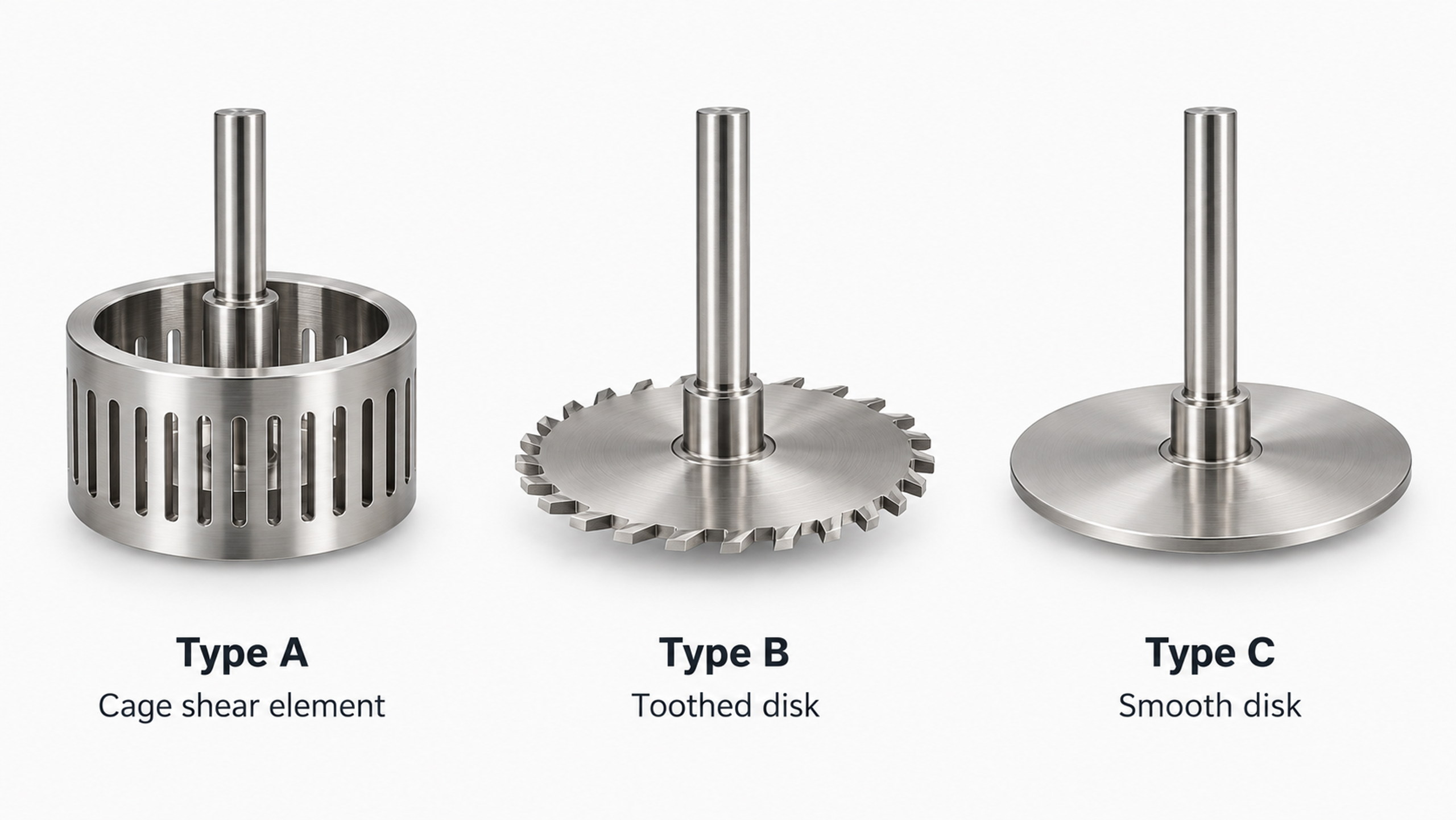
Figure 4.1. Simplified representations of Scott Turbon Type A, B, and C shear elements: cage shear element, toothed disk, and smooth disk [13].
High throughput heads should be distinguished from conventional assemblies in which a rotor operates inside a fixed perforated stator. Equipment should be classified on the basis of the actual interacting moving and stationary surfaces, rather than generalized commercial labels for high-shear devices.
When operating high-throughput batch mixers, maintaining ingredient incorporation as viscosity and other rheological properties change is essential. Design documentation should specify immersion depth, vessel geometry, ingredient addition points, and any auxiliary agitators. Such systems should be compared with enclosed rotor-stator heads on the basis of equivalent final product quality and measured energy use, not simply nominal rotational speed in rpm.
4.2 Enclosed Rotor-Stator Mixing Heads
In an enclosed mixing head, a bladed or toothed rotor rotates within a stationary perforated stator. Axially entering liquid is accelerated by the rotor and discharged through stator openings, producing high local velocity gradients and rapid jets. Interchangeable perforated screens allow a common drive to be adapted for size reduction, dispersion, or emulsification. Silverson, for example, distinguishes general purpose heads, slotted heads, and screens with square or fine emulsifying perforations, illustrating the direct influence of stator geometry on equipment function [10].
Flow restriction by a perforated screen substantially affects pressure distribution and throughput within the mixing head. Higher mean hydrodynamic pressure can coexist with localized low pressure regions around individual openings or behind rotor blades. Reliable assessment of cavitation therefore requires detailed consideration of local pressure, fluid temperature, and flow geometry. A fine screen or high nominal rotor speed alone is not sufficient evidence that cavitation occurs.
Silverson's axial flow design illustrates the relationship between screen geometry and discharge direction: its upward flow differs fundamentally from the radial jets produced by conventional perforated heads [10]. Thus, even substituting a different perforated screen may substantially alter both local hydrodynamic loading and the bulk circulation pattern in the vessel.
4.3 Mixers with Shear-Pumping Capability
A shear pump combines dispersive action with a rotor capable of producing useful flow. Silverson's inline mixers for high viscosity products, for example, employ a dedicated pumping rotor and interchangeable workheads; versions with tangential or vertical discharge connections are also available [14]. These designs demonstrate how pumping and processing functions can be combined while remaining functionally distinct. Actual capacity depends on fluid rheology, inlet conditions, and the hydraulic circuit.
A shear pump has a head versus flow characteristic rather than a fixed delivery rate. Changes in downstream resistance alter throughput, internal recirculation, and power distribution. For viscous or shear thinning products, motor selection must account for torque throughout the process, including startup and ingredient addition. A manufacturer's quoted water flow rate does not guarantee the same performance with a particular product.
4.4 Combining Rotor-Stator Mixers with Conventional Agitators
Conventional mixing devices can complement the localized action of a rotor-stator head. Propeller agitators promote axial transport, anchor agitators renew fluid near the wall, and scrapers improve heat transfer in highly viscous materials. A high-shear head can also be installed near the base of a sealed or vacuum vessel, while a slower agitator maintains overall circulation. Such equipment combinations should be analyzed as integrated mixing systems rather than as unrelated individual machines.
Auxiliary circulation should direct untreated material into the active region while avoiding both aeration and short-circuiting of material that has already been processed. Poor bulk exchange can create local overheating alongside stagnant, untreated regions. Conversely, excessive or poorly directed circulation can destabilize the inlet flow. An appropriate hydrodynamic balance is obtained by comparing the vessel turnover time, local residence time within the shear region, and the product's sensitivity to repeated mechanical and thermal exposure.
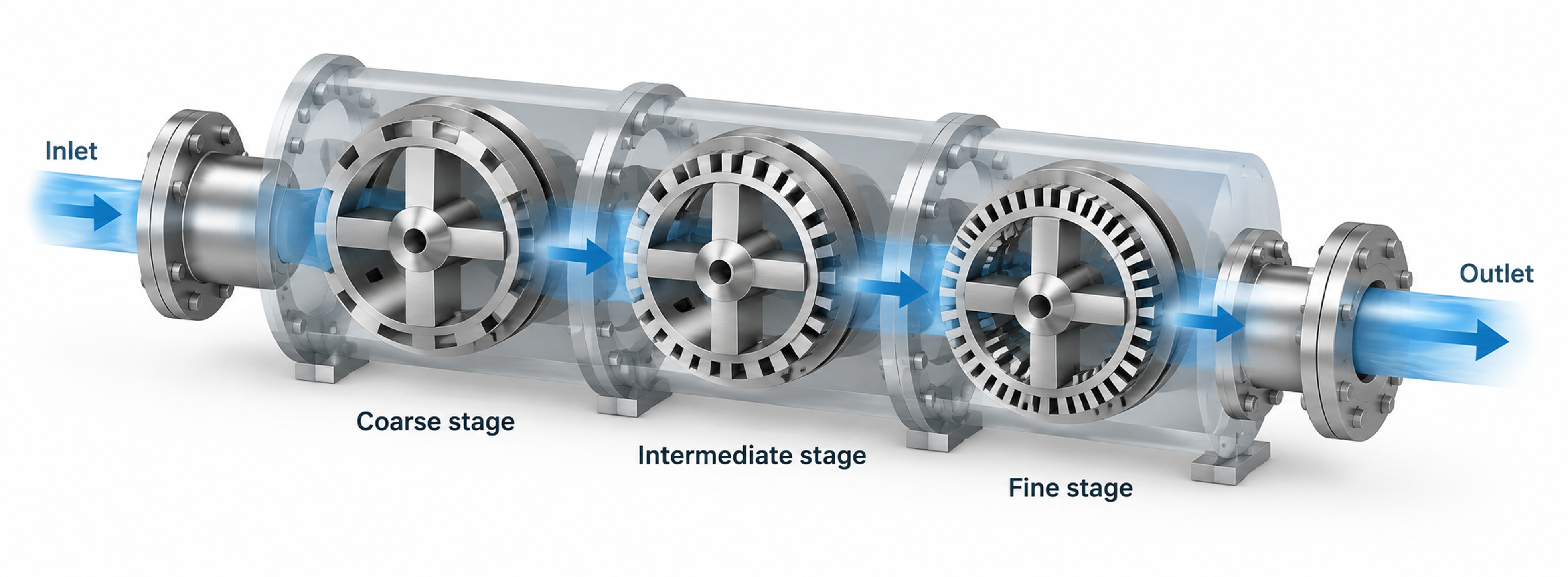
Figure 4.2. Consecutive coarse, intermediate, and fine processing zones in a conceptual inline layout. [15, 16].
Table 4.1. Single element systems and their primary functions
| Arrangement | Principal advantage | Characteristic limitation |
|---|---|---|
| Open, hig -throughput batch head | Fast powder induction, good tank circulation, and tolerance of larger particles. | Local stress and flow rate require verification for the chosen geometry. |
| Enclosed batch head | Interchangeable stators, intense local shear, and radial jets. | Large or viscous batches may require auxiliary agitation. |
| Single stage inline rotor-stator mixer | Defined flow path and compact incorporation into a process line. | Single-pass effectiveness depends on inlet distribution and flow rate. |
| Shear pump | Higher throughput and solids-handling capacity when rotor or ring geometry is chosen appropriately. | Without a finer downstream stage, the target minimum droplet or agglomerate size may not be achieved. |
| Rotor-stator head with slow agitator | Combines intense local treatment with bulk exchange and heat transfer to tank walls. | More complex mechanics and possible interactions between the flow fields. |
4.5 Comparative Analysis of Leading Manufacturers' Designs
Table 4.2. Comparison of design features and their engineering implications for equipment from leading manufacturers
| Manufacturer and series | Documented design feature | Engineering interpretation |
|---|---|---|
| Scott Turbon (batch mixing heads) | Dual sided vertical intake; interchangeable Type A, B, and C shear elements [11, 13]. | Bulk circulation, phase wetting, and local processing intensity must be assessed together. |
| Kinematica (MEGATRON® MT-V series) | One stage or three stage dispersion chambers with configurable generators, cooling jackets, and seal options [16]. | The active zone, temperature control, and seals form an integrated functional system. |
| Silverson (standard heads and HV series) | Interchangeable perforated screens and a dedicated pumping rotor in the HV series [10, 14]. | Screen-controlled shear deformation must be distinguished from hydraulic pumping capacity and pressure head. |
| IKA (DISPAX-REACTOR® DR series) | Three successive inline rotor-stator generator stages [15]. | Progressive dispersion gradients and control of flow rate and specific energy input per pass. |