
Technical publication
Back to publications
Reactors & equipment
Cavitation Driven Exfoliation of Graphene and Two Dimensional Materials
okozyuk.com
Published
Read complete publication for whole-document Find and printing. Browser Find and native printing on this reader include only loaded content.
8 Microfluidization, Wet Jet Milling, Rotor Stator Processing, and Hybrid Routes
8.1 Microfluidization
Microfluidization forces a suspension through a narrow interaction chamber at high pressure. A Z shaped or otherwise engineered channel can generate shear rates approaching 10⁸ s⁻¹ together with turbulence, collision, pressure release, and possible cavitation. Reported channel widths commonly range from approximately 87 to 400 micrometers [13,20,21]. Each pass is continuous and readily recirculated, but repeated cycling can narrow the thickness distribution while increasing edge density and eventually damaging basal planes.
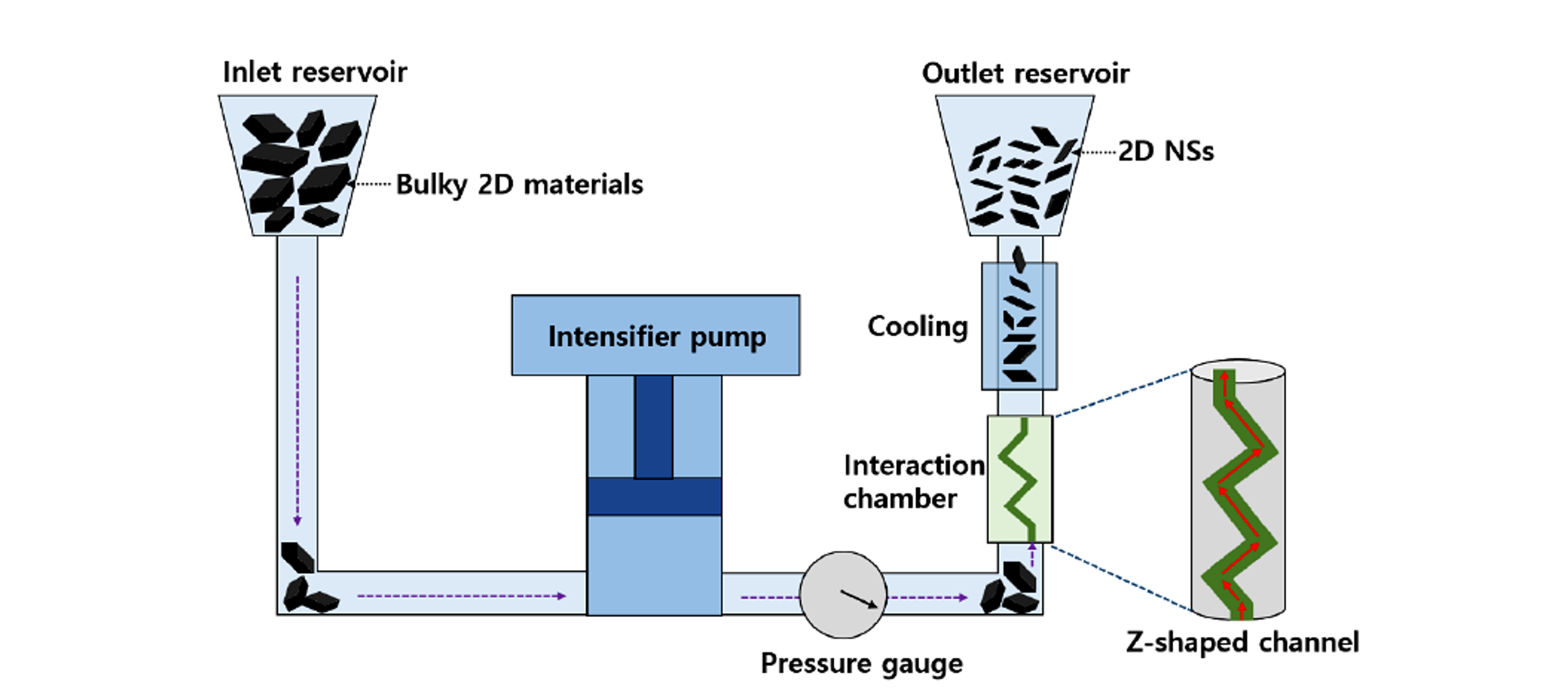
Figure 8.1. General microfluidization system with feed reservoir, intensifier pump, interaction chamber, cooling section, and outlet reservoir [13].
Karagiannidis and coauthors reported aqueous microfluidization at approximately 10⁸ s⁻¹ with graphite concentrations up to 100 g L⁻¹ and described 100 percent conversion to material with thickness below 70 nm without centrifugation yield loss. The resulting dispersions were formulated as conductive inks [21]. In that context, 100 percent yield does not mean 100 percent monolayer graphene. It refers to the defined processed nanosheet fraction and the absence of discarded coarse material. This distinction should be made explicit when commercial claims are compared.
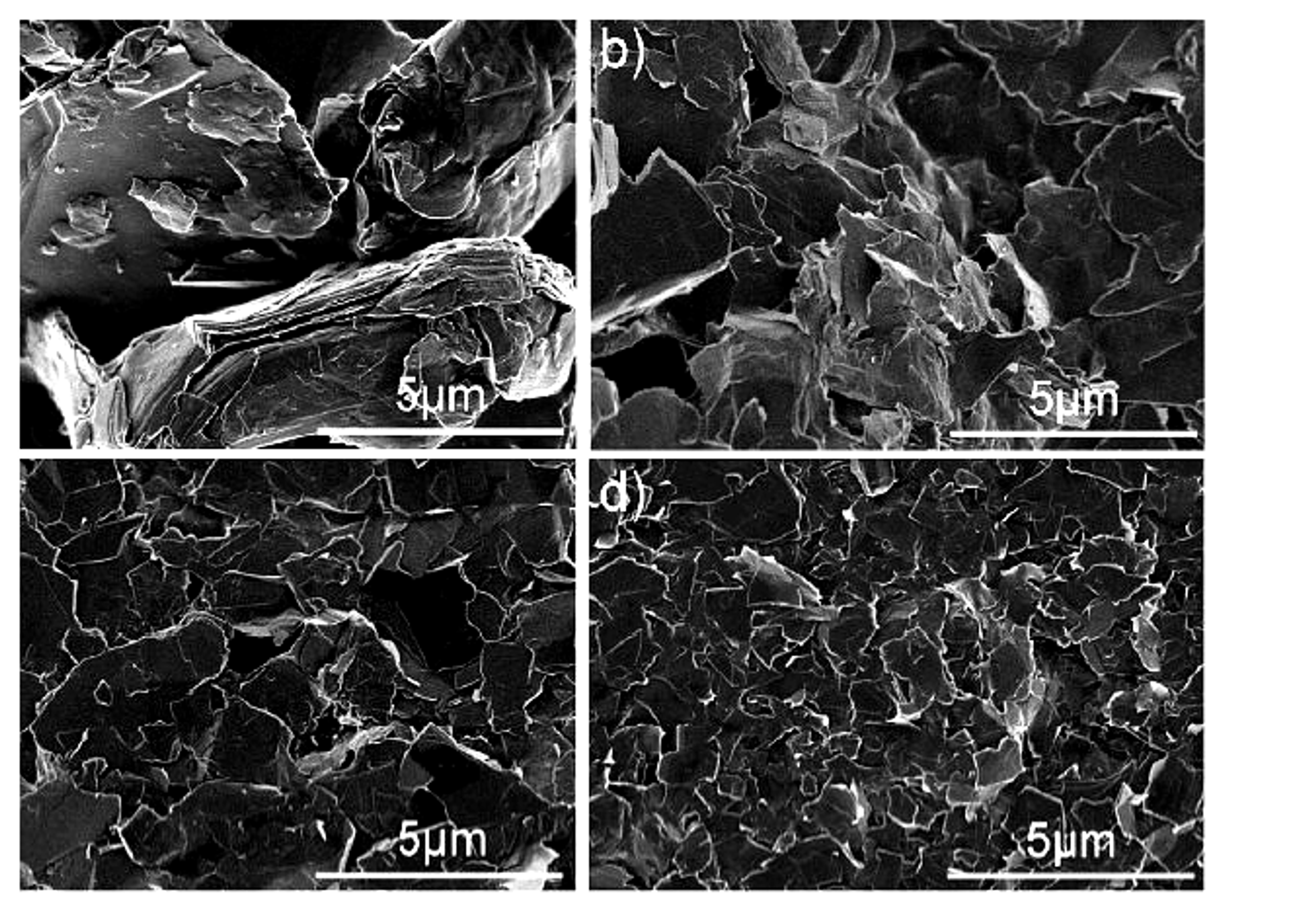
Figure 8.2. Images of graphite morphology after 0, 1, 5, and 100 passes through a Microfluidizer processor at 30,000 psi [20].
8.2 Wet Jet Milling
Wet jet milling drives a suspension through perforated disks, nozzles, or interacting jets at high pressure. The active stresses include shear at microchannel junctions, extensional flow, collision, and pressure release. The process has been applied to graphite, boron nitride, MoS₂, and WS₂ and is attractive because residence time per pass is short and throughput can be increased through pump capacity or parallelization [13]. Principal concerns include nozzle wear, blockage, pressure containment, high capital cost, flake cutting, and the need for effective cooling.
8.3 Rotor Stator High Shear Processing
Rotor stator mixers generate high velocity gradients in a narrow gap, jets through stator openings, recirculation, and repeated particle collisions. Cavitation may occur locally, but shear and impact can dominate depending on geometry. A study using 40 volume percent isopropyl alcohol in water reported 0.27 mg mL⁻¹ graphene related nanosheets after 1 h, with most flakes below 1 micrometer lateral size and approximately 2 nm thickness [15]. A 2024 study using natural graphite in water at 4,000 to 11,000 rpm for 3 to 120 min showed that graphite grade and polyvinylpyrrolidone strongly influenced sedimentation stability, with reported stability ranging from 6 days to approximately 6 months [14].
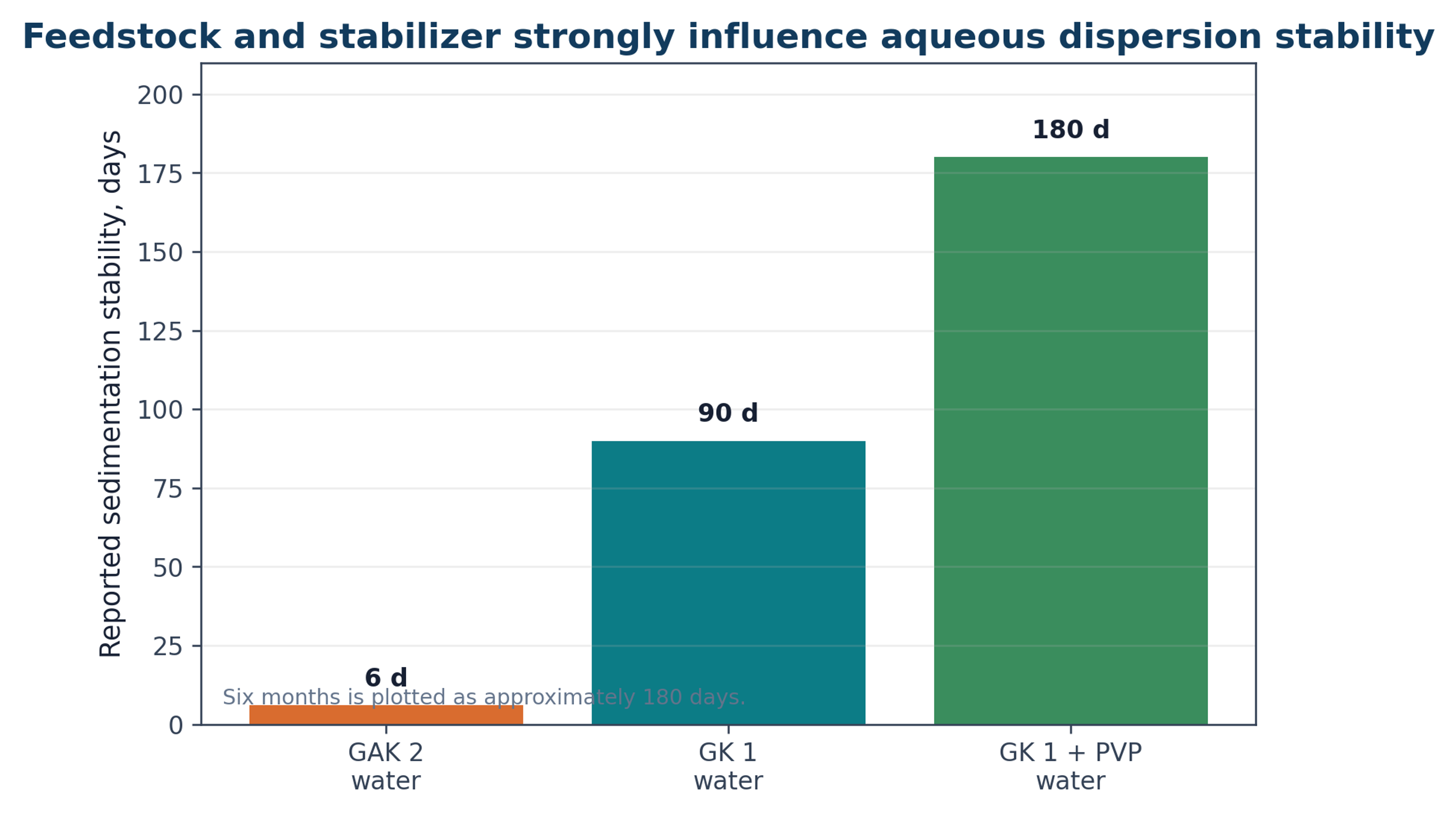
Figure 8.3. Reported sedimentation stability for two natural graphite grades and a polyvinylpyrrolidone stabilized suspension [14].
8.4 Hybrid Processing
Hybrid routes use one operation to prepare the feed for another. Examples include mild expansion before cavitation, ultrasound before a hydrodynamic chip, rotor stator wetting before a high pressure pass, sequential nozzle sizes, dual frequency ultrasound, or functionalization after exfoliation. Hybridization can reduce the burden on the most expensive or damage intensive stage, but it adds equipment, control variables, cross contamination risk, and patent complexity.
Table 8.1. Representative equipment for liquid exfoliation and cavitation processing.
| Equipment | Dominant mechanisms | Advantages | Main limitations | Best use |
|---|---|---|---|---|
| Ultrasonic bath | Distributed low intensity acoustic cavitation. | Low cost and simple screening. | Poor power quantification and slow treatment. | Early solvent and stabilizer screening. |
| Probe sonicator | Localized high intensity acoustic cavitation and microstreaming. | Fast laboratory treatment and flexible amplitude control. | Nonuniform exposure, heating, tip erosion, metal contamination. | Mechanism studies and small batch optimization. |
| Ultrasonic flow cell | Acoustic cavitation in a defined flow residence. | Better reproducibility, cooling, and recycle control. | Field calibration and bubble shielding remain important. | Pilot development when acoustic treatment is required. |
| Venturi or orifice reactor | Pressure reduction, cavitation, turbulence, and recovery collapse. | Simple geometry and continuous operation. | Erosion, pressure loss, and broad residence time if poorly designed. | Moderate pressure hydrodynamic processing. |
| Jet cavitation device | High pressure nozzles, cavitation, shock waves, and turbulent jets. | Strong treatment and direct control by pressure and passes. | Pump cost, wear, heat generation, and flake fragmentation. | High intensity recirculating exfoliation. |
| Microfluidic chip | Defined constriction, cavitation visualization, and high local shear. | Excellent mechanistic control and low active volume. | Clogging and low absolute throughput without numbering up. | Mechanism, rapid screening, and controlled microreactors. |
| Microfluidizer | High shear, extensional flow, collision, pressure release, possible cavitation. | High solids potential and industrial equipment base. | High capital and wear; repeated passes can damage flakes. | Concentrated dispersions and ink manufacture. |
| Wet jet mill | High pressure jets, shear at junctions, collision, and pressure release. | Short pass time and broad 2D material applicability. | Nozzle wear, blockage, pressure containment, and cutting. | High throughput nanosheet production. |
| Rotor stator mixer | Gap shear, jets, turbulence, collision, and local cavitation. | Widely available, scalable, and easy to integrate. | Field is complex and product can be broad. | Premixing, deagglomeration, and moderate exfoliation. |