
Technical publication
Back to publications
Reactors & equipment
Cavitation Driven Exfoliation of Graphene and Two Dimensional Materials
okozyuk.com
Published
Read complete publication for whole-document Find and printing. Browser Find and native printing on this reader include only loaded content.
9 Extension to Other Two Dimensional Nanomaterials
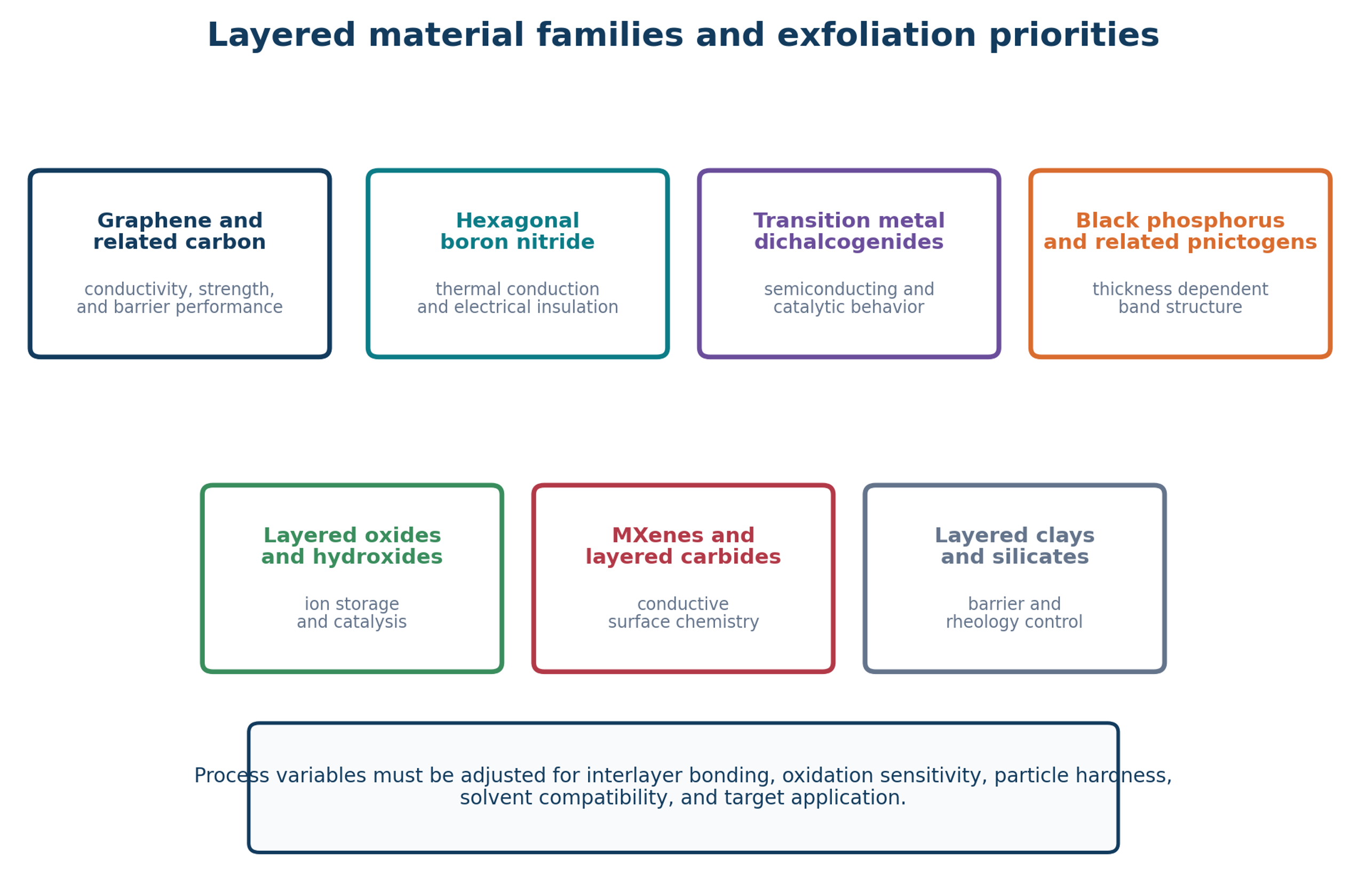
Figure 9.1. Major layered material families that can be processed by liquid exfoliation. Each family requires a different balance of stress, chemistry, oxygen control, and product stabilization [37].
9.1 Hexagonal Boron Nitride
Hexagonal boron nitride is structurally analogous to graphite but is electrically insulating and thermally conductive. It is attractive for thermal management, electrically insulating composites, lubricants, coatings, and dielectric applications. Microfluidization has produced boron nitride nanosheets in minutes rather than the prolonged sonication often required by conventional methods [13]. Because boron nitride is harder and can be more abrasive than graphite, nozzle and pump wear, metal contamination, and classification require particular attention. The product specification should include electrical resistivity in addition to thickness and lateral size.
9.2 Transition Metal Dichalcogenides
MoS₂ and WS₂ combine layered structures with semiconducting, catalytic, and tribological behavior. Their layers are chemically more complex than graphene and may be sensitive to oxidation, phase change, edge chemistry, and stoichiometry. Ultrasonic MoS₂ studies show that increasing power does not always increase concentration because cavitation shielding and fragmentation change after an optimum [18]. Wet jet and microfluidic routes can rapidly produce few layer material [13]. Quality control should include Raman peak positions and widths, XPS oxidation state, elemental ratio, and application specific performance.
9.3 Black Phosphorus and Air Sensitive Materials
Black phosphorus and related materials require oxygen and moisture control because newly exfoliated surfaces can degrade rapidly. Cavitation increases interfacial area and can accelerate undesired chemistry. Processing may require deoxygenated solvent, inert gas blanketing, low temperature, rapid transfer, antioxidants, encapsulation, or immediate formulation. A reactor that performs well for graphite in water cannot be transferred directly to black phosphorus without a complete chemical risk assessment.
9.4 Layered Oxides, Hydroxides, MXenes, and Clays
Layered oxides and hydroxides are used in catalysis and energy storage, while MXenes provide conductive surfaces terminated by oxygen, hydroxyl, fluorine, or other groups. Clays and silicates are used for barrier performance, rheology modification, and reinforcement. These materials may swell, exchange ions, dissolve, change oxidation state, or react with water. Hydrodynamic stress can assist delamination, but solvent chemistry and pH can be more influential than cavitation intensity. Process development should separate chemical activation from mechanical separation so that the contribution of each can be measured.
Table 9.1. Processing implications for selected two dimensional material families.
| Material family | Interlayer or surface issue | Promising liquid process | Additional quality controls |
|---|---|---|---|
| Graphite and graphene related carbon | Restacking, edge damage, oxygen and metal contamination. | Cavitation, high shear, microfluidization, wet jet milling. | Raman, AFM, TEM, XPS, ash, conductivity, residual stabilizer. |
| Hexagonal boron nitride | Hard and abrasive; insulating product must remain low in metal contamination. | Microfluidization, wet jet, ultrasound, rotor stator. | Thickness, thermal conductivity, electrical resistivity, elemental purity. |
| MoS₂ and WS₂ | Stoichiometry, oxidation, phase changes, edge chemistry. | Ultrasound at controlled intensity, wet jet, microfluidic processing. | Raman, XPS, elemental ratio, catalytic or electronic performance. |
| Black phosphorus | Rapid oxidation and hydrolysis of thin sheets. | Inert, low temperature, closed acoustic or microfluidic process. | Oxygen content, degradation products, encapsulation quality. |
| Layered oxides and hydroxides | Swelling, ion exchange, dissolution, pH sensitivity. | Controlled shear or cavitation combined with chemical conditioning. | Phase identity, oxidation state, composition, ion release. |
| MXenes | Surface termination, oxidation, and colloidal stability. | Gentle deagglomeration and classification after chemical delamination. | Surface terminations, oxidation, conductivity, flake size. |
| Clays and silicates | Swelling and ion exchange dominate separation. | Hydration, chemical conditioning, rotor stator or moderate cavitation. | Aspect ratio, mineral phases, exchange capacity, rheology. |