
Technical publication
Back to publications
Reactors & equipment
Cavitation Driven Exfoliation of Graphene and Two Dimensional Materials
okozyuk.com
Published
Read complete publication for whole-document Find and printing. Browser Find and native printing on this reader include only loaded content.
16 Environmental Health, Safety, and Responsible Manufacturing
Graphene related nanomaterials can become airborne during drying, powder discharge, bag opening, blending, sampling, maintenance, filter replacement, and cleanup. Toxicology and exposure information continues to develop, and broadly accepted occupational exposure limits are not established for all graphene forms. A practical approach is prevention through design, containment, exposure assessment, and a hierarchy of controls. ISO/TS 12901-1:2024 addresses occupational risk management for materials that contain and release nano objects, while ISO/TS 12901-2:2026 provides a control banding approach when quantitative toxicology and exposure data are limited [29,30].
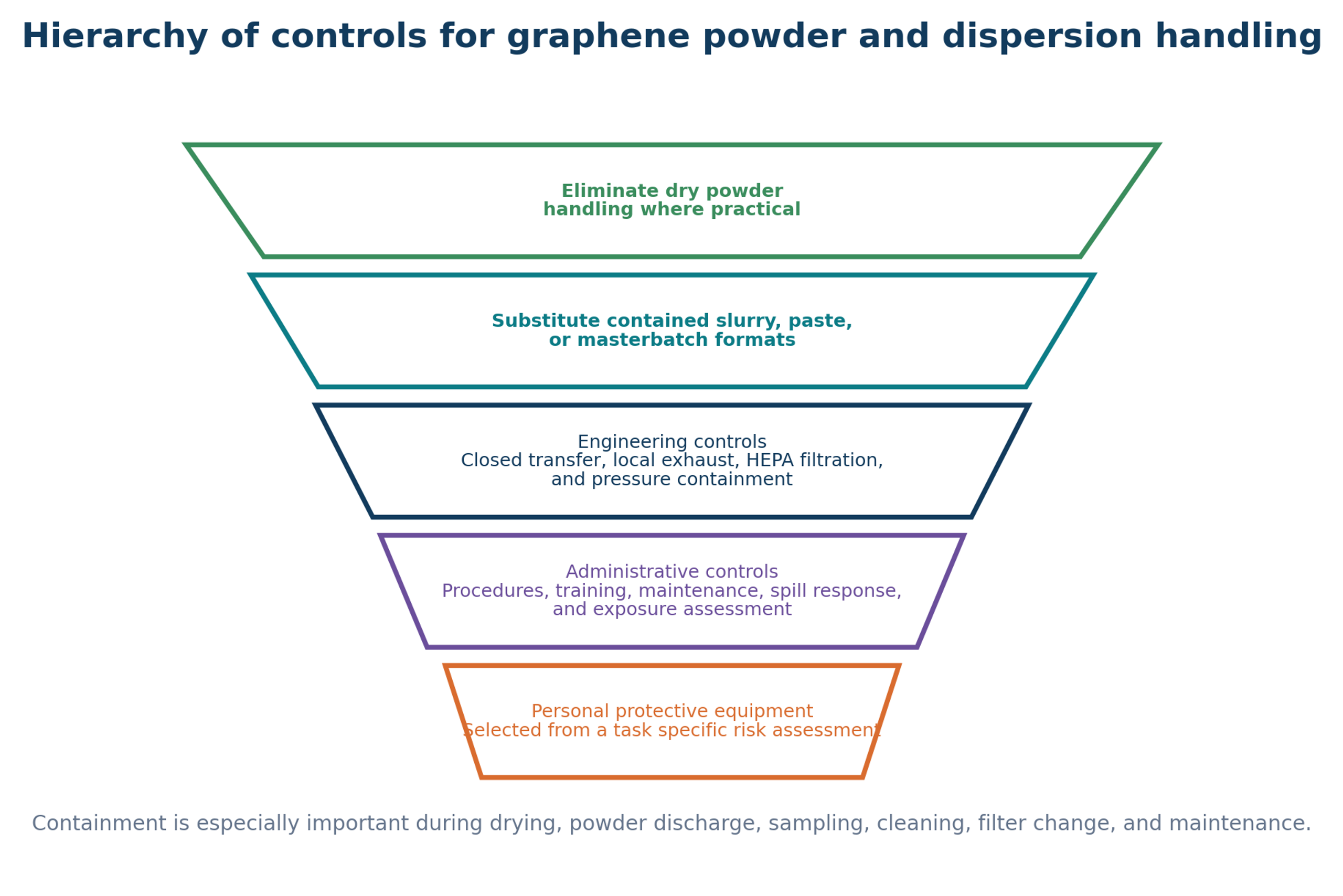
Figure 16.1. Hierarchy of controls for graphene powder and dispersion handling. Contained liquid, paste, or masterbatch formats can reduce free powder exposure [37].
OSHA guidance recommends minimizing worker exposure to nanomaterials and avoiding open air handling of free particles when practical. Closed containers, local exhaust ventilation, HEPA filtered capture, appropriate cleaning methods, and task specific personal protective equipment are core controls [31,32]. Pressurized systems additionally require pressure relief, interlocks, guards, compatible fittings, and controlled depressurization. Organic liquids introduce fire, vapor, and solvent exposure hazards, while cavitation equipment can introduce noise and vibration. A complete process hazard analysis should evaluate these hazards together.
16.1 Dust and Aerosol Control
• Prefer slurry, paste, or masterbatch transfer over dry powder transfer when product requirements allow.
• Use sealed charging, contained sampling, enclosed filtration, and local exhaust at unavoidable release points.
• Do not use dry sweeping or compressed air for cleanup. Use HEPA filtered vacuum methods or wet cleaning compatible with the material and facility.
• Monitor both background and task based aerosol concentrations using a tiered strategy that distinguishes incidental particles from process material.
• Treat used filters, wipes, protective clothing, and spill residues as nanomaterial contaminated waste according to the site waste plan.
16.2 Solvent, Pressure, and Mechanical Safety
• Select pump, valve, hose, seal, and vessel ratings above the maximum credible pressure, including blocked outlet and thermal expansion cases.
• Provide engineered pressure relief and verify safe discharge location. Do not rely only on software limits.
• Interlock access to moving rotors, intensifier pumps, and pressurized interaction chambers.
• Control solvent vapor through closed recovery, ventilation, bonding and grounding, and ignition source management.
• Measure noise and vibration around cavitating jets and ultrasonic equipment; apply isolation and hearing protection where required.
16.3 Environmental Accounting
A water based process is not automatically environmentally preferable if it uses very dilute solids, prolonged recirculation, high cooling duty, energy intensive centrifugation, and disposable filters. Conversely, an organic process is not automatically unacceptable if the solvent is efficiently recovered in a closed loop. Environmental comparison should include raw graphite, stabilizer, solvent makeup, electricity, cooling water, filter media, cleaning liquid, reject solids, emissions, and final product performance. The functional unit should be one kilogram of in specification material or one unit of application performance, not one liter of treated suspension.