
Technical publication
Back to publications
Reactors & equipment
Cavitation Driven Exfoliation of Graphene and Two Dimensional Materials
okozyuk.com
Published
Read complete publication for whole-document Find and printing. Browser Find and native printing on this reader include only loaded content.
15 Industrial Benchmarks and Commercial Positioning
Commercial graphene related products are manufactured by several routes, many of which are not fully disclosed. Cavitation processes therefore compete with shear exfoliation, electrochemical routes, plasma expansion, chemical oxidation, thermal expansion, and proprietary combinations. Public capacity statements are useful manufacturing benchmarks, but products with different layer counts, purity, lateral size, and formulation cannot be compared by tonnage alone.
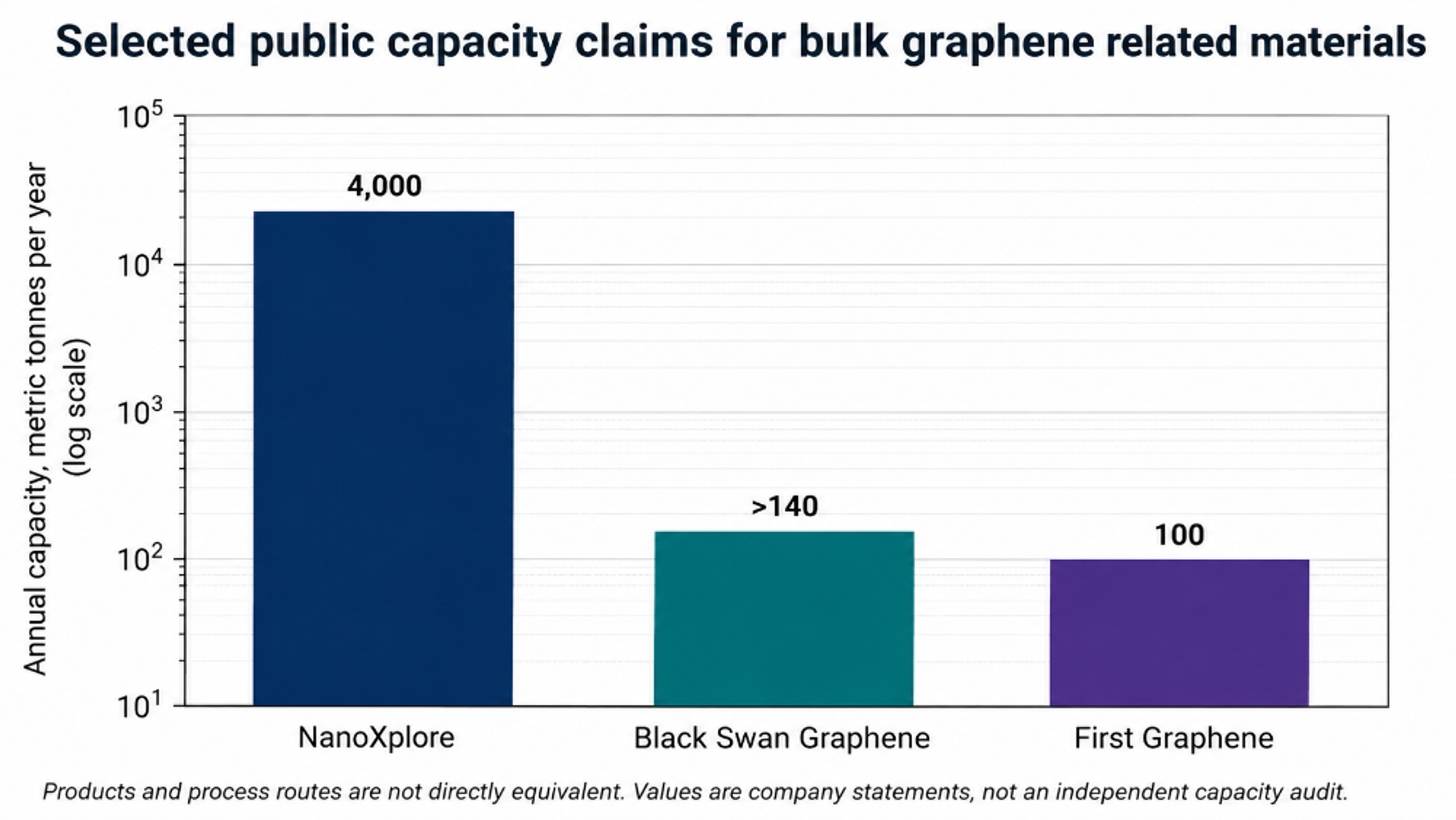
Figure 15.1. Selected publicly stated annual capacities for graphene related materials. NanoXplore reports 4,000 t y⁻¹, Black Swan Graphene reports more than 140 t y⁻¹ after its March 2026 expansion, and First Graphene reports a 100 t y⁻¹ plant [25-27].
NanoXplore describes GrapheneBlack powder with a predominant thickness of six to ten atomic layers, purity of 96 to 98 percent, and a fully automated facility capable of producing 4,000 metric tons per year [25]. Black Swan Graphene announced completion of a United Kingdom expansion on 18 March 2026, reporting more than 140 tons per year of graphene nanoplatelet capacity and industrial flow rates up to 22,000 L h⁻¹ [26]. First Graphene reports a 100 tons per year plant for PureGRAPH products [27]. Directa Plus describes a physical plasma super expansion route that produces pristine graphene nanoplatelets in powder, liquid, and paste forms [28]. These examples indicate that the market is oriented toward consistent, application ready bulk materials rather than monolayer graphene alone.
Table 15.1. Selected industrial benchmarks relevant to bulk graphene materials.
| Organization | Public product or route description | Public scale statement | Relevance to cavitation development |
|---|---|---|---|
| NanoXplore | GrapheneBlack powder and integrated composite products; proprietary mechanical liquid exfoliation description. | 4,000 metric tons per year facility; predominant 6 to 10 layers; 96 to 98% purity [25]. | Sets a high volume benchmark for cost, consistency, and downstream integration. |
| Black Swan Graphene | Graphene nanoplatelets and masterbatch products using high shear liquid processing. | More than 140 t y⁻¹ after March 2026 expansion; up to 22,000 L h⁻¹ flow [26]. | Shows industrial relevance of high pressure homogenization and continuous liquid processing. |
| First Graphene | PureGRAPH powders, dispersions, and masterbatches. | 100 t y⁻¹ manufacturing capacity [27]. | Benchmark for application specific grades, quality release, and customer integration. |
| Directa Plus | Pristine graphene nanoplatelets made by plasma super expansion and physical processing. | Modular industrial process; products supplied as powder, liquid, paste, and hybrid forms [28]. | Comparator demonstrating that cavitation must compete with other physical top down routes. |
| Microfluidics / IDEX | High pressure Microfluidizer interaction chambers and application support. | Supplier states scale from laboratory units to hundreds of liters per hour [20]. | Commercial equipment platform for concentrated, repeatable high shear processing. |