
Technical publication
Back to publications
Reactors & equipment
Cavitation Driven Exfoliation of Graphene and Two Dimensional Materials
okozyuk.com
Published
Read complete publication for whole-document Find and printing. Browser Find and native printing on this reader include only loaded content.
14 Scale Up, Process Control, and Equipment Reliability
Scale up should preserve the distribution of effective exposure rather than geometric similarity alone. A larger reactor can have the same average pressure drop but a different cavity cloud, pressure recovery zone, particle trajectory, and residence time distribution. Likewise, a larger ultrasonic vessel can have the same power per liter but substantially poorer field uniformity. Scale up should therefore combine dimensionless groups, measured local signals, and product response.
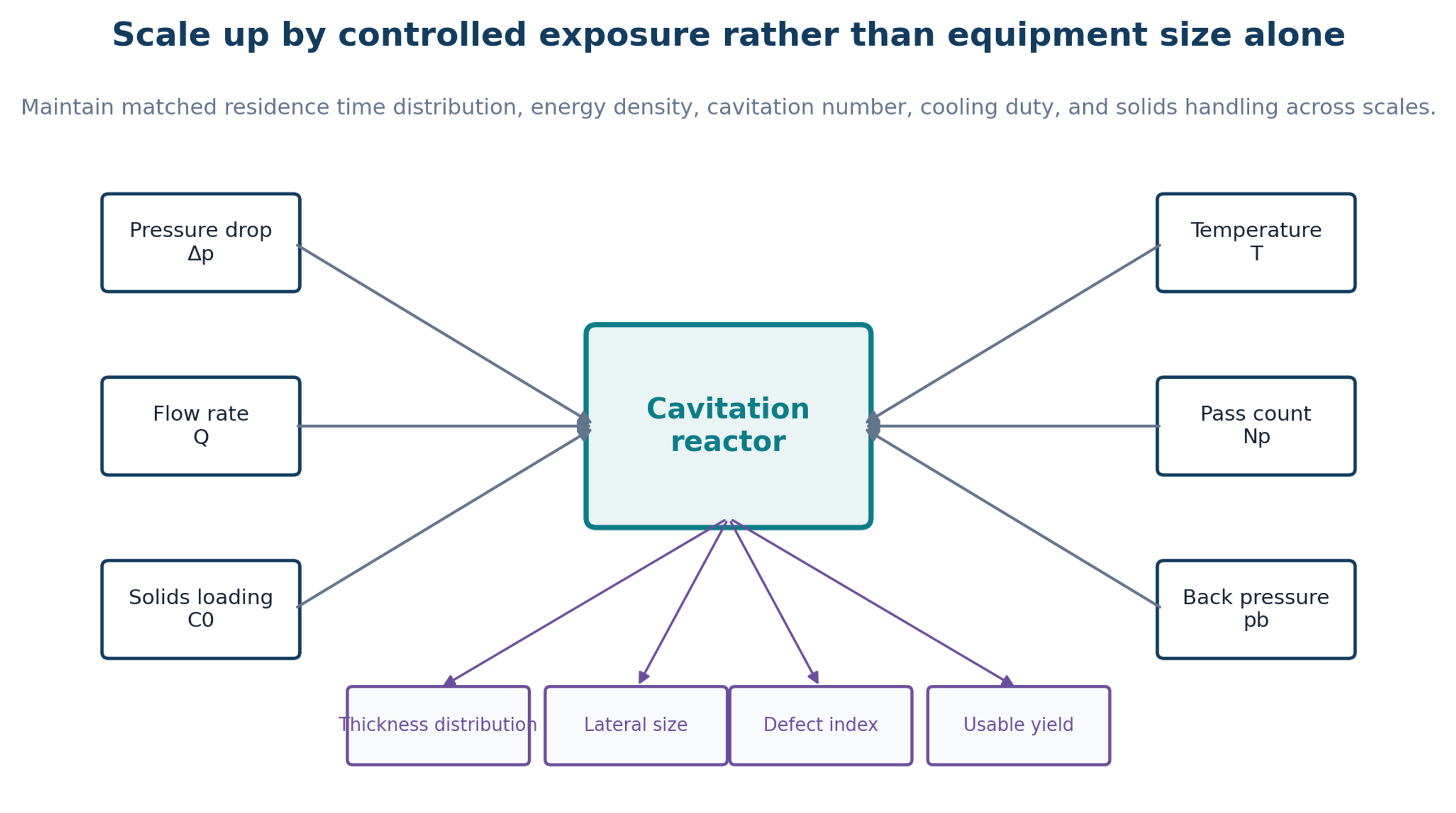
Figure 14.1. Scale up variables and product responses. Pressure drop, flow, solids loading, temperature, pass count, and back pressure must be controlled as a coupled system [37].
Eu is an Euler pressure coefficient :
Eu is a Euler type pressure coefficient that helps compare pressure driven geometries. It should be considered together with Reynolds number, cavitation number, and residence time.
is nominal residence time in the active region, Vactive is active flow volume, and Q is flow rate. A residence time distribution is preferable to one nominal value.
is cumulative nominal exposure for Np passes. Damage can depend on the interval between passes and thermal history, so equal cumulative time does not always produce equal material.
14.1 Inline Sensing
Pressure transducers upstream, within the throat or nozzle, and downstream can identify flow regime and wear related drift. Flow meters verify exposure, temperature sensors quantify cooling duty, and hydrophones or structure borne acoustic sensors can track cavitation emission. Optical absorbance or turbidity can follow dispersed solids, while inline particle imaging or focused beam reflectance can track disappearance of large particles. Conductivity, density, viscosity, and dissolved gas measurements can reveal formulation changes. A control model should use these signals to maintain a product response rather than a fixed valve position.
14.2 Wear, Erosion, and Maintenance
Cavitation collapse and abrasive graphite attack nozzles, valve seats, interaction chambers, and pump components. Wear changes geometry and therefore changes pressure drop and product quality before a catastrophic failure becomes visible. Maintenance should be condition based. Pressure flow curves, acoustic signatures, metal contamination, and dimensional inspection can provide early warning. Replaceable inserts and modular parallel channels can reduce downtime.
ER is a simple erosion rate based on component mass loss Δm, exposed area A, and operating time t. Dimensional loss at the critical throat may be a more sensitive measure than total mass loss.
14.3 Cleaning and Product Changeover
Graphene strongly colors process surfaces and can remain in dead legs, seals, filters, and heat exchangers. Cleaning validation should define acceptable carryover according to the next product. A clean in place sequence may include draining, a compatible solvent flush, dispersant or alkaline washing where materials permit, a high velocity rinse, a filtered water or solvent rinse, and verification by absorbance or total carbon. Cleaning liquid must be included in the mass and environmental balance.