
Technical publication
Back to publications
Reactors & equipment
Cavitation Driven Exfoliation of Graphene and Two Dimensional Materials
okozyuk.com
Published
Read complete publication for whole-document Find and printing. Browser Find and native printing on this reader include only loaded content.
17 Critical Comparison and Conclusions
Acoustic cavitation remains valuable because it is flexible, accessible, and well suited to screening frequency, amplitude, pressure, pulse mode, liquid composition, and mechanism. Its principal limitation is field nonuniformity during direct batch scale up. Hydrodynamic cavitation is more naturally compatible with continuous operation because pressure drop, flow, geometry, back pressure, and pass count can be defined. Its principal limitations are wear, pressure containment, blockage, heat removal, and flake fragmentation. Microfluidization and wet jet milling provide high shear and high throughput at the cost of capital intensity and possible flake cutting. Rotor stator processing is widely available and useful for premixing and moderate exfoliation, although its active mechanisms are more difficult to isolate.
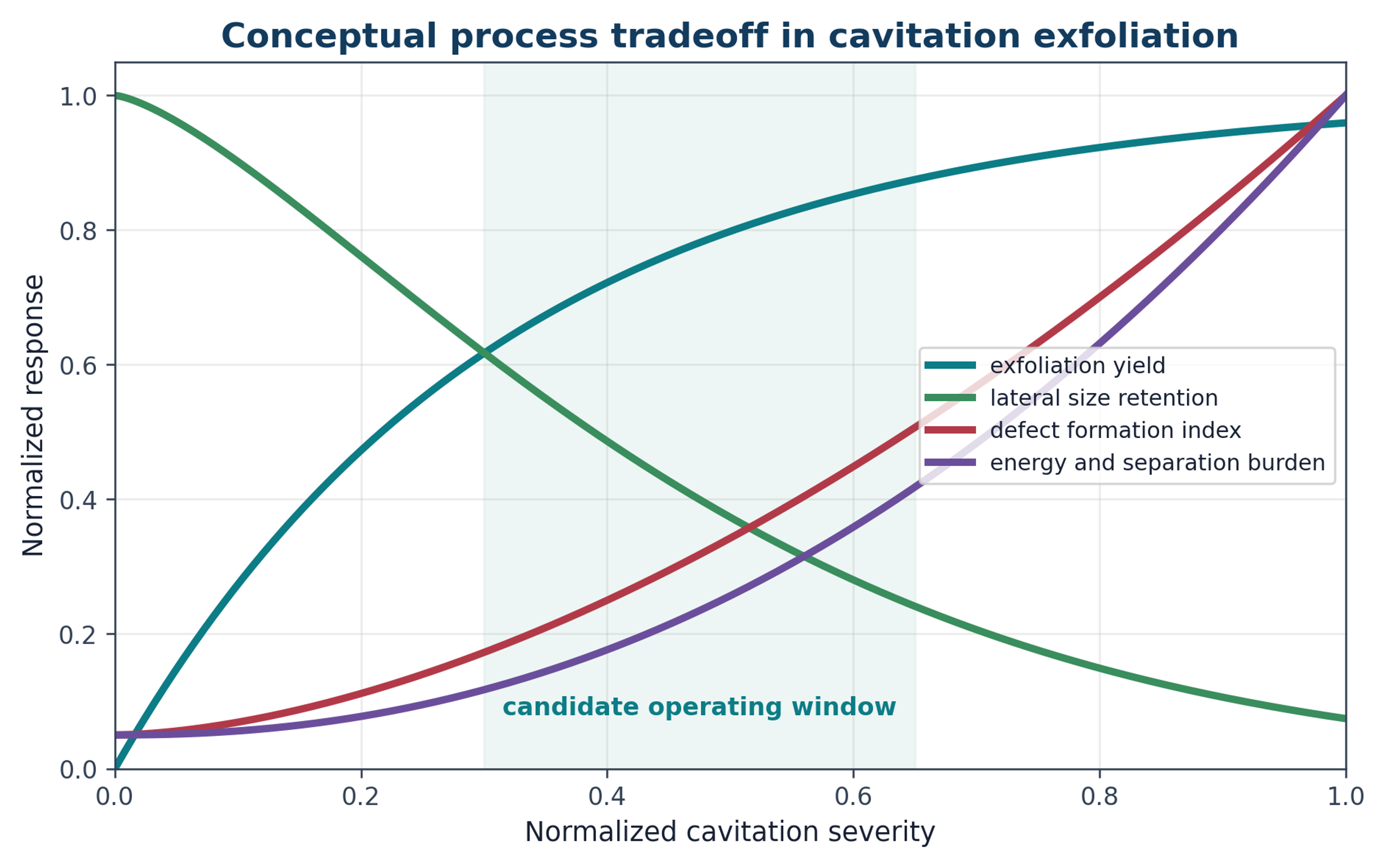
Figure 17.1. Conceptual tradeoff among exfoliation yield, lateral size retention, defect formation, and process burden as cavitation severity increases [37].
The combined literature shows that treatment severity has an optimum. Increasing time, pressure, cycle count, or acoustic power can produce thinner material, but it can also reduce lateral size, increase edge density, produce holes, degrade stabilizers, increase contamination, and lower isolated yield. The optimum is application specific. Conductive inks may benefit from small stable flakes, whereas structural composites may require platelets with high aspect ratio. A catalyst support may benefit from increased edge density, while an electronic film may reject the same defect population.
Industrial performance depends on the complete process line. Feed qualification, wetting, cavitation or high shear treatment, cooling, classification, solvent recovery, drying or formulation, quality assurance, cleaning, safety, and application conversion must be designed as one integrated system. Reactor yield before separation is not a sufficient commercial metric. A more defensible metric is the reproducible mass of in specification material produced per unit time, energy, cost, and environmental burden.
For many high volume applications, a consistent few layer graphene or graphene nanoplatelet product is more valuable than a small monolayer fraction embedded within a broad distribution. Development should therefore be specification driven. Cavitation is a powerful process intensification tool within that strategy when pressure history, residence time, chemistry, product classification, and downstream consequences are measured and controlled.