
Technical publication
Back to publications
Reactors & equipment
Cavitation-Assisted Particle Dispersion
okozyuk.com
Published
Read complete publication for whole-document Find and printing. Browser Find and native printing on this reader include only loaded content.
4 Cavitation physics and bubble particle interaction
4.1 Cavitation inception and pressure history
Hydrodynamic cavitation begins when local pressure approaches a threshold controlled by vapor pressure, dissolved gas, nuclei population, liquid tensile strength, surface roughness, and flow history. A commonly used cavitation number is:
where is a reference or recovered pressure, is saturation vapor pressure, and is a characteristic velocity. Lower values generally indicate stronger cavitation, but the inception value is specific to geometry and nuclei condition [3,21,22].
For an ideal pressure conversion through a restriction, a velocity scale is:
where is a discharge coefficient and is pressure drop. Equation (4.2) does not describe the complete multiphase field, but it shows why pressure drop strongly affects velocity, strain rate, and collapse intensity.
The radial motion of an isolated spherical bubble is described by the Rayleigh-Plesset equation. Classical treatments of cavitation and bubble oscillation provide the basis for this relation [4-6].
A polytropic approximation for the noncondensable gas pressure is:
where k is the polytropic exponent. For an empty spherical cavity that collapses from an initial radius . For a constant far field pressure difference, Equation (4.5) gives Rayleigh collapse time. The relation follows Rayleigh’s classical analysis [47].
These equations establish important trends but do not directly predict an industrial bubble cloud. In a cavitating restriction, bubbles interact with neighboring bubbles, particles, walls, turbulence, dissolved gas, and changing pressure. Cloud collapse can redistribute energy and shield inner bubbles.
4.2 Interaction stages
The interaction between a bubble and suspended particles can be divided into three overlapping stages. During nucleation and growth, the bubble displaces liquid and modifies particle trajectories. During pulsation and convection, secondary pressure forces and local recirculation can concentrate particles near the bubble interface. During asymmetric collapse, a liquid microjet forms and a pressure pulse propagates into the surrounding suspension.
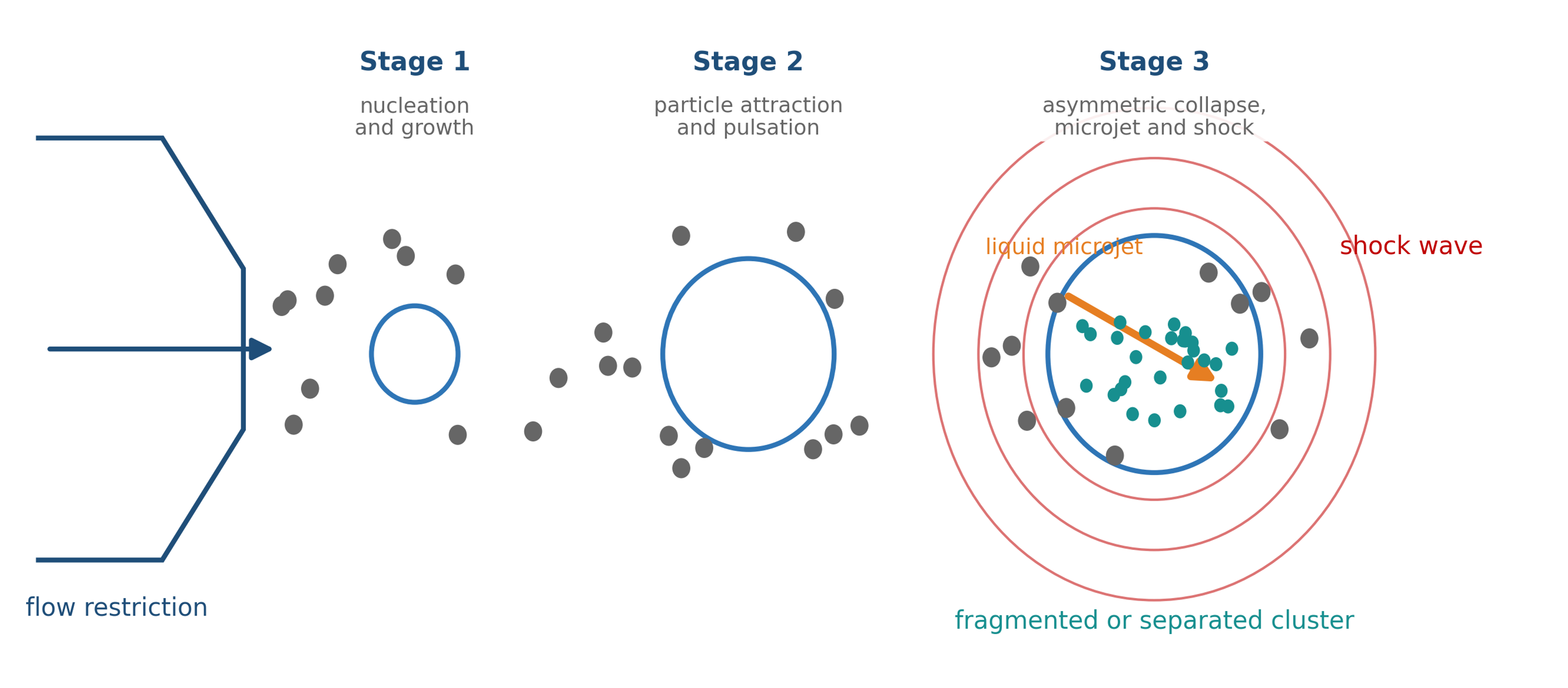
Figure 4.1. Conceptual stages of interaction between cavitation bubbles and suspended particles.
Bubble particle interaction depends strongly on bubble standoff distance, particle size relative to bubble size, particle density, surface wettability, and the recovered pressure gradient. Particles may accelerate away from a growing bubble and then move toward the collapse region. Controlled experiments have reported particle velocities spanning orders of magnitude because only a small fraction of particles intercept the most intense jet or collapse zone [10,41,42].
4.3 Microjets, shock waves, and particle loading
A bubble that collapses near a solid surface or particle generally becomes nonspherical. The side farther from the boundary accelerates toward the near side and forms a high-velocity liquid microjet. The jet penetrates the bubble and strikes the opposite interface or a nearby solid. At the same time, rapid liquid deceleration emits an outward pressure pulse. Studies show that wall or particle proximity strongly alters collapse symmetry, jet direction, and pressure transmission [8,45]. Related acoustic cavitation studies show that shock loading from collapse can fragment molecular crystals, while wall shear and collapse near a surface can remove attached material [12,13,43,44].
The peak pressure transmitted from a liquid jet into a solid can be estimated by acoustic impedance matching:
where and are sound speeds, and are densities, and is jet velocity. If the solid acoustic impedance greatly exceeds that of the liquid,
A related semiempirical stress scale used in agglomerate dispersion models is:
where is an empirical transfer coefficient [14]. These relations are scaling estimates. The stress reaching a particle depends on wave geometry, attenuation, cloud shielding, orientation, impedance mismatch, and whether the particle lies in the jet path.
Experiments and simulations show that the interaction regime changes with standoff distance and the particle to bubble size ratio. Close particles promote asymmetric collapse and direct jet loading; at larger separation, reflected pressure waves and flow-induced particle motion become more important [8,11].
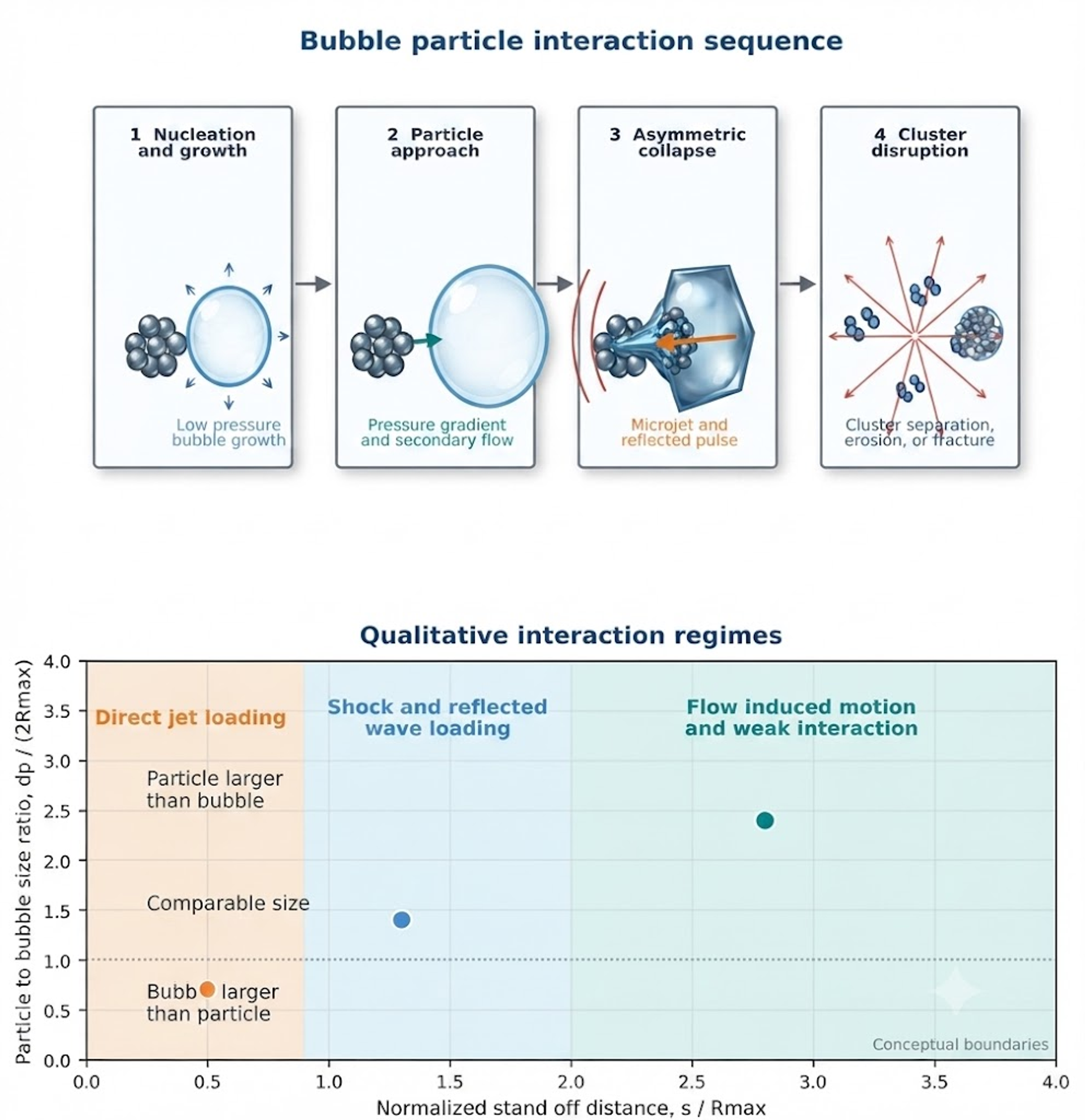
Figure 4.2. Bubble particle interaction stages and qualitative regimes as functions of normalized standoff distance and particle-to-bubble size ratio [58].
4.4 Spatial separation of stress mechanisms
Hydrodynamic cavitation equipment creates several stress zones. Extensional acceleration is strongest near a contraction. Viscous shear acts in boundary layers and narrow passages. Turbulent stress develops in the emerging jet and mixing chamber. Collapse induced stress becomes strongest during pressure recovery. The dominant particle response depends on where the particle is located relative to these zones.
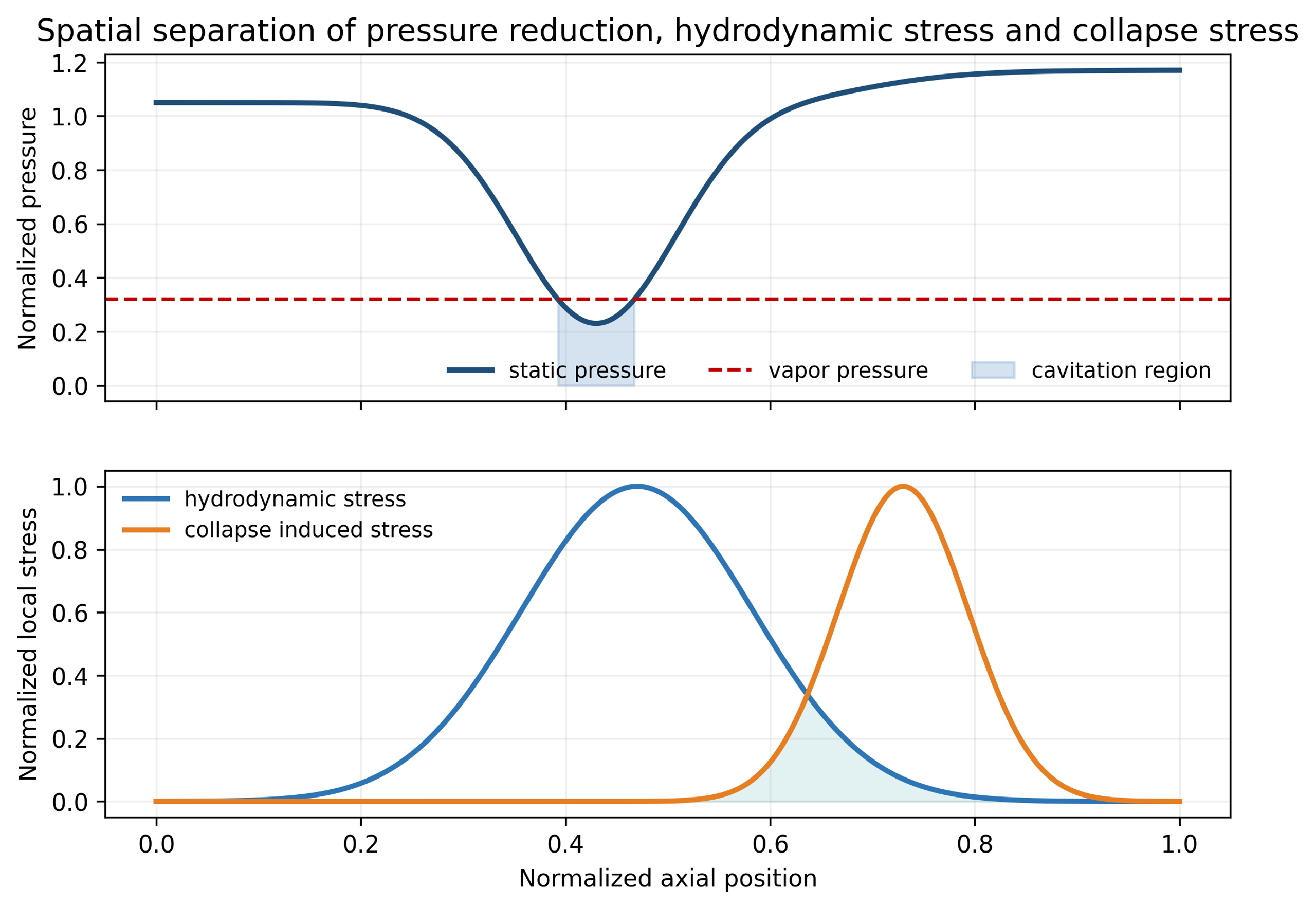
Figure 4.3. Conceptual axial pressure and stress distributions through a cavitating restriction [58].
The separation shown in Figure 4.3 explains why pressure drop or average power density alone cannot uniquely predict particle-size reduction. Two devices with the same pressure drop may create different cavity lengths, recovery gradients, jet spreading rates, and collapse locations.