
Technical publication
Back to publications
Reactors & equipment
Cavitation-Assisted Particle Dispersion
okozyuk.com
Published
Read complete publication for whole-document Find and printing. Browser Find and native printing on this reader include only loaded content.
3 Colloidal forces, agglomerate strength, and suspension stability
3.1 Interparticle attraction and stabilization
Deagglomeration increases the solid-liquid interfacial area. The mechanical process is therefore inseparable from formulation chemistry. A cluster separated in the collapse zone may reattach within milliseconds unless the liquid provides sufficient electrostatic, steric, or electrosteric stabilization.
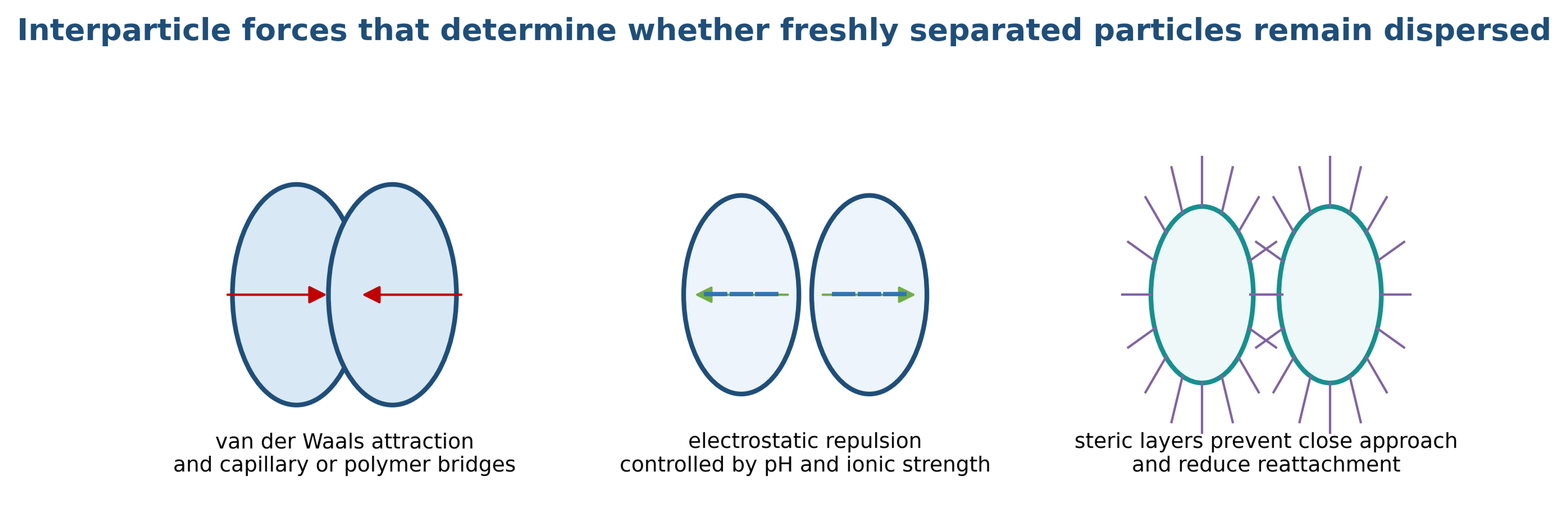
Figure 3.1. Principal interparticle forces that determine whether freshly separated particles remain dispersed [58].
For two particles, the total interaction potential is commonly represented as the sum of van der Waals attraction, electrostatic repulsion, steric interaction, and any additional nonideal contribution:
For two equal spheres of radius at a small surface separation , a useful approximation for van der Waals attraction is:
where is the Hamaker constant. The corresponding attractive force scale is:
Electrostatic repulsive interaction depends on surface potential, ion valence, and ionic strength. For a symmetric electrolyte and moderate surface potential, a simplified constant potential expression for two spheres is:
The Debye screening length is:
where is ionic strength. Increasing ionic strength reduces the screening length and can cause rapid aggregation even when immediate particle size after cavitation is small. Zeta potential is useful for comparing related electrostatic systems, but it is not a universal stability criterion. Sterically stabilized systems may remain stable at low zeta potential because adsorbed polymer layers prevent close approach.
Capillary bridges can dominate dry powder agglomeration and partially wetted feed systems. A simple capillary force scale is:
where is liquid surface tension and is the contact angle. Complete wetting and removal of trapped gas can reduce capillary cohesion, although rapid cavitation may also introduce additional gas-liquid interfaces.
For approximately spherical nonporous particles, the external area per unit mass is:
The increase in surface area after deagglomeration can sharply increase dispersant demand. The first estimate of dispersant mass is:
where is the adsorbed mass per unit area and is the mass of solid. Equation (3.8) is a formulation estimate, not a substitute for an adsorption isotherm. Excess polymer may increase viscosity or cause bridging flocculation, while insufficient polymer permits reattachment.
3.2 Agglomerate strength
Agglomerate failure occurs when external stress exceeds a local strength that depends on bond force, coordination number, porosity, primary particle size, and defect structure. A generalized contact network strength relation is:
where is agglomerate tensile strength, is a structural coefficient, is agglomerate porosity, is a characteristic bond force, and is the size of the load bearing building block [14–16]. Real agglomerates have a distribution of bond strengths. Weak outer branches may erode gradually while a compact core remains intact. Strong impulses may split a cluster into several daughter fragments. Repeated subcritical impulses can also produce fatigue-like erosion.
A useful local breakage number is:
where is an applied hydrodynamic or collapse-induced stress. Values below unity indicate that instantaneous rupture is unlikely, although repeated loading may still erode the structure. Values substantially above unity favor rapid rupture or shattering. The fragment distribution cannot be predicted from alone.
3.3 Sedimentation, Brownian motion, and rheology
Dispersion can meet an immediate particle-size target and still fail during storage. For an isolated spherical particle in the Stokes regime, the terminal settling velocity is:
The Brownian diffusion coefficient is:
A sedimentation Peclet number over a characteristic height is:
Large indicates that gravity dominates Brownian redistribution. Equations (3.11) to (3.13) are screening relations. Concentrated suspensions exhibit hindered settling, network formation, yield stress, and non-Newtonian flow. Deagglomeration often increases wetted surface area and may increase viscosity if dispersant is insufficient. In other systems, breakup of a space-spanning floc network reduces yield stress and viscosity. Rheology is therefore an independent response, not a predictable consequence of a smaller median diameter [20].