
Technical publication
Back to publications
Reactors & equipment
Cavitation-Assisted Particle Dispersion
okozyuk.com
Published
Read complete publication for whole-document Find and printing. Browser Find and native printing on this reader include only loaded content.
9 Process variables and optimization
9.1 Pressure drop and cavitation number
Increasing pressure drop generally increases jet velocity, lowers cavitation number, and increases the probability of severe collapse. The response usually exhibits diminishing returns. Weak clusters are removed first, while the remaining structures are stronger or the product reaches an endpoint limited by stability. Excess pressure can increase wear and temperature without improving aged particle size.
The correct objective is the minimum pressure and cumulative exposure that satisfy the particle size, stability, morphology, purity, and throughput requirements. A process should not be optimized by the smallest immediate value alone.
9.2 Geometry and collapse location
Passage diameter, the ratio of length to diameter, contraction profile, recovery angle, downstream chamber, and wall proximity determine where cavities form and collapse. For dispersion, the preferred collapse region is one where particles are present, and wall erosion is manageable. A short microchannel can move collapse downstream, while a long channel may sustain a vapor cavity or erode internally [23–25].
A small passage increases local velocity and stress but also increases plugging and contamination risk. For feeds with a broad coarse tail, a staged system is often more robust than a single fine restriction.
9.3 Number of passes and residence time distribution
The first pass often produces the largest improvement, as shown by ZnO and soy slurry. Later passes target stronger structures and deliver smaller incremental reductions. The optimum pass count is the minimum that meets both immediate and aged specifications.
In a recirculating tank, the actual exposure distribution must be considered. A well-mixed tank provides statistical redistribution, while poor mixing leaves untreated material and repeatedly processes fluid near the return. A once-through or series arrangement provides tighter exposure but may require more devices or higher pressure.
9.4 Solids loading and viscosity
Higher solids loading increases throughput per unit liquid and collision frequency. It also raises viscosity, pressure loss, plugging tendency, and the probability of reaggregation. Viscous damping can suppress bubble growth and change cavity structure. A formulation that disperses successfully at 0.1 wt% may not behave similarly at 40 wt%.
Possible strategies include predilution, staged solids addition, controlled heating, a larger first stage, or processing in a carrier followed by letdown. Final validation must be performed at the intended production solids and temperature.
9.5 Surface chemistry and dispersant level
Fresh surface must be stabilized rapidly. Important variables include pH, ionic strength, counterion identity, solvent polarity, surfactant concentration, polymer molecular mass, adsorption kinetics, and competitive adsorption. A useful experimental matrix combines cavitation intensity with dispersant concentration. Higher pressure may improve immediate size but worsen aged size when dispersant is insufficient.
9.6 Temperature, dissolved gas, and nuclei
Higher temperature raises vapor pressure and usually lowers viscosity. Cavitation may begin more readily, but increased vapor content can cushion collapse. Temperature also affects adsorption, solubility, polymer conformation, and chemical stability. Inlet and outlet temperatures should be recorded at the reactor, not only in the tank.
Dissolved and entrained gas influence both bubble number and collapse severity. Noncondensable gas cushions collapse but can increase the number of cavities. Degassing may produce fewer but more severe vapor collapses. Gas addition can create a dense, milder bubble population and increase foam. The optimum depends on whether shock intensity, mixing, or gas-liquid interfacial area controls the process.
9.7 Erosion, contamination, and morphology preservation
Cavitation erosion can release metal, ceramic, or polymer debris from nozzles, valves, and downstream surfaces. Risk is highest where bubbles repeatedly collapse near a wall. Replaceable inserts, hard materials, smoother recovery, and relocation of the collapse zone can reduce contamination. Wear should be assessed by mass loss, dimensional inspection, and elemental analysis of product and blanks.
Morphology preservation must be verified for flakes, fibers, hollow particles, coated particles, and soft crystals. A process that produces a low value may be unacceptable if it shortens carbon fibers, destroys silver flake aspect ratio, removes a functional coating, or changes a pharmaceutical polymorph.
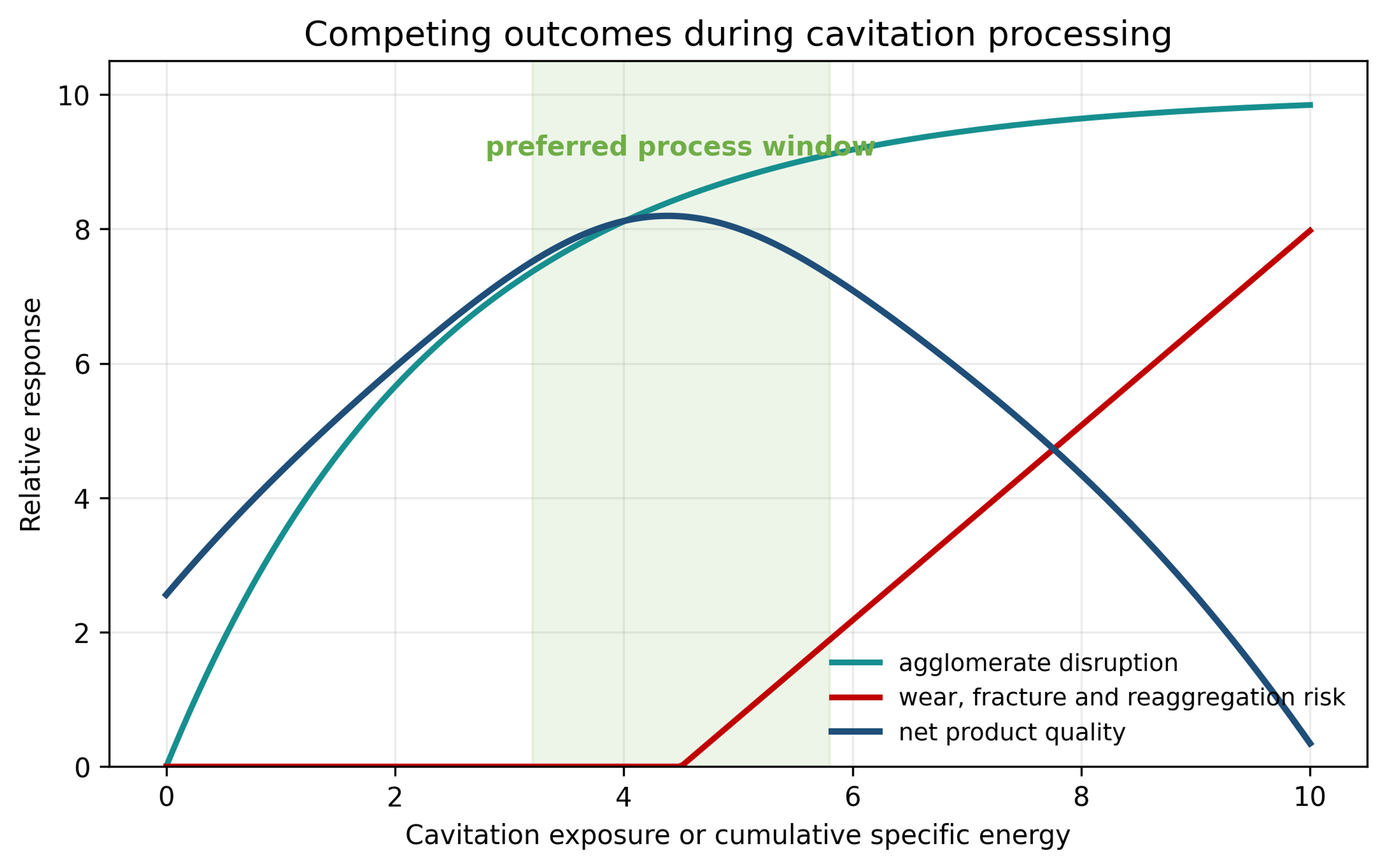
Figure 9.1. Conceptual balance among agglomerate disruption, product quality, and damage risk [58].
Table 9.1. Directional effects of major process variables.
| Variable increased | Likely beneficial effect | Potential adverse effect |
|---|---|---|
| Pressure drop | Higher velocity and stronger cavitation | Wear, heating, fracture, reaggregation |
| Number of passes | Greater probability of disrupting strong clusters | Diminishing returns, contamination, thermal exposure |
| Solids loading | Higher production rate and more collisions | Viscosity, plugging, poor exposure uniformity |
| Temperature | Lower viscosity and easier inception | Degradation, desorption, vapor cushioning |
| Dissolved gas | More nuclei and bubbles | Collapse cushioning, foam, oxidation |
| Dispersant concentration | Faster stabilization of fresh surface | Bridging, viscosity increase, altered product properties |
| Smaller passage | Higher local velocity and stress | Plugging and accelerated erosion |
| Faster pressure recovery | More severe collapse | Wall damage and morphology loss |
9.8 Experimental design
A useful development design includes pressure, geometry, pass count, solids concentration, temperature, dispersant level, and gas condition. Responses should include , , span, coarse particle count, viscosity, aged size, morphology, and at least one purity or functional measure. Factor interactions should be expected. Statistical replication is particularly important when nuclei condition and sampling vary.