
Technical publication
Back to publications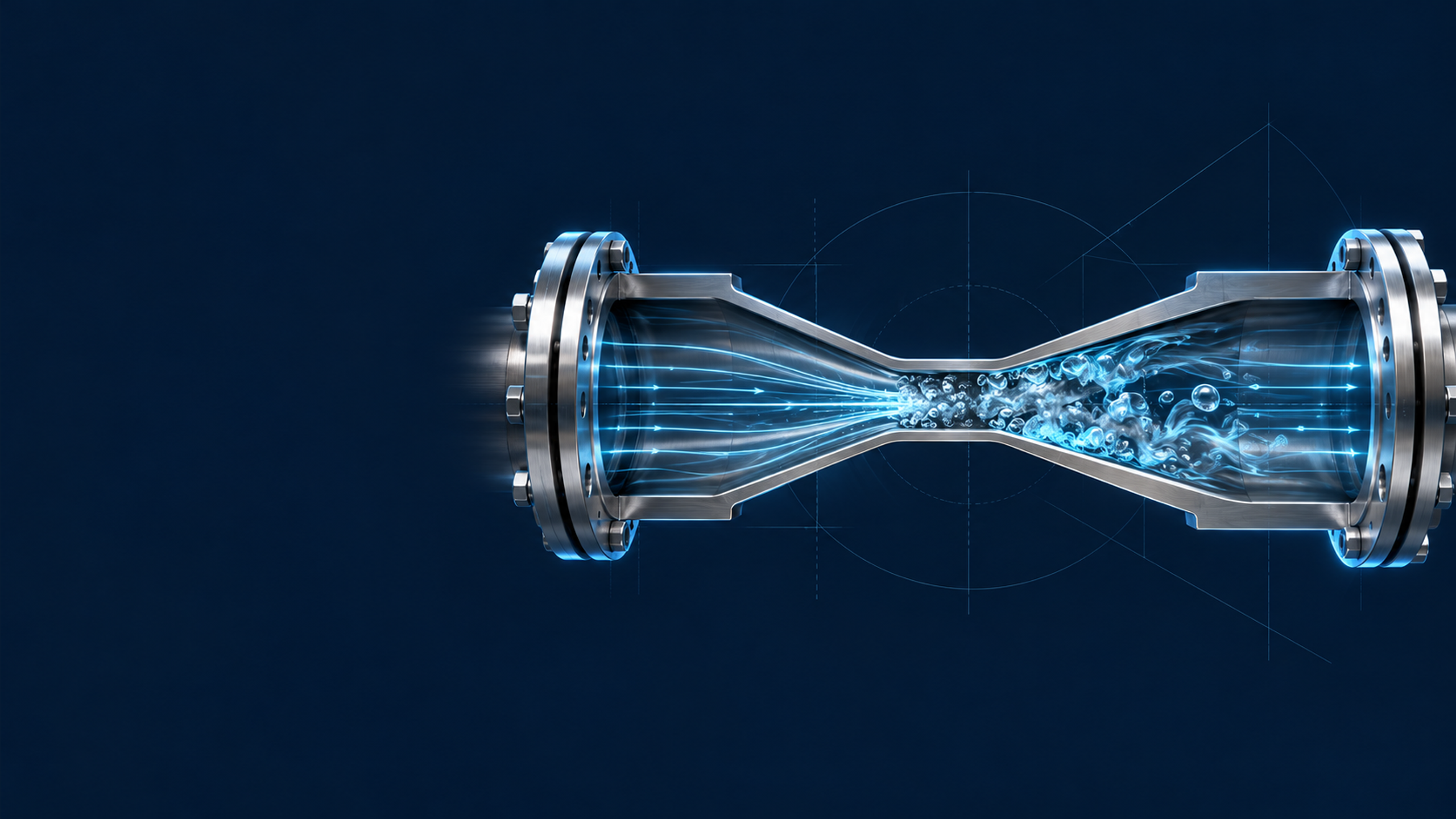
Reactors & equipment
Calculations of Hydrodynamic Cavitation Devices
okozyuk.com
Published
Read complete publication for whole-document Find and printing. Browser Find and native printing on this reader include only loaded content.
Calculations of Hydrodynamic Cavitation Devices
Abstract
Hydrodynamic cavitation devices generate controlled vapor and gas vapor cavities by imposing a local pressure depression followed by pressure recovery. Reliable design therefore requires more than a single cavitation threshold or dimensionless index. This article presents a calculation framework for static, vortex, and dynamic hydrodynamic cavitation devices and integrates hydraulic sizing, pressure reference selection, dimensionless analysis, energy input, residence time, cavity collapse, uncertainty, mechanical integrity, materials selection, scale translation, and commissioning. Static device calculations address orifices, nozzles, slits, Venturi passages, bluff bodies, and multistage arrangements. Vortex device calculations combine tangential inlet sizing with radial equilibrium screening and finite core limitations. Dynamic device calculations include rotor tip speed, rotational Reynolds number, cavitation number, power number, torque, rotor stator clearance, feature passage frequency, stress, vibration, and thermal growth. Worked examples demonstrate preliminary sizing for an eight hole orifice plate, an ideal Venturi throat, a finite core vortex chamber, and a rotor stator operating point. The analysis emphasizes that local pressure history, cavity structure, process response, and erosion cannot be inferred reliably from global pressure drop alone. Calibrated coefficients, validated computational fluid dynamics, representative pilot testing, and measured operating maps are required to establish a defensible design envelope and service life.