
Technical publication
Back to publications
Industrial applications
Vegetable Oil Refining, Biodiesel, and Oleochemical Conversion
okozyuk.com
Published
Updated
Read complete publication for whole-document Find and printing. Browser Find and native printing on this reader include only loaded content.
9 Product Quality, Sampling, and Analytical Verification
9.1 Material balance before optimization
Small yield improvements can have large economic value, but they are also easily obscured by tank inventory, moisture, and sampling error. A plant should establish a closed material balance before attributing a 0.1 to 0.4 percent change to cavitation. For a refining stage, phosphorus removal is:
Oil yield can be expressed as:
Both values can mislead. Low phosphorus can be achieved by transferring more oil into gums, while apparent yield can increase because of water, residual heavy phase, or inventory movement. Neutral oil in gums, soapstock, wash water, spent earth, filter cake, and off specification product must be tracked.
9.2 Sampling locations and timing
Cavitated dispersions evolve quickly. The sample point, valve geometry, sample line, delay before analysis, temperature, and agitation must be standardized. A narrow sampling valve can create more shear than the process under study. Recommended locations are feed before reagent, immediately after the device, after the chemical or enzymatic hold, both separator phases, and final product after drying or purification.
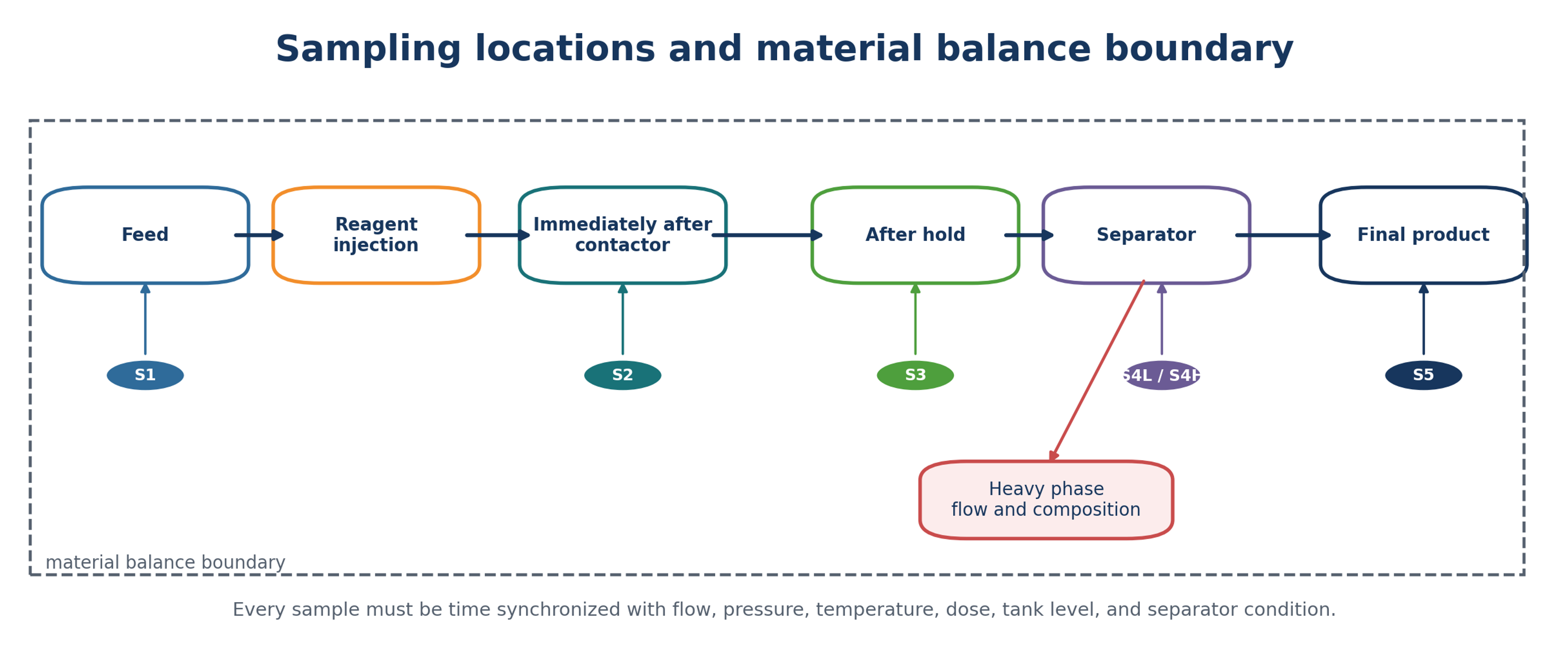
A crossover trial is stronger than a simple before and after comparison. The plant alternates baseline and cavitation conditions after reaching steady state, for example A B B A, while unrelated changes are prohibited. Tank turnover time and downstream residence must be allowed before samples are assigned to a condition. Composite samples describe average product quality; synchronized grab samples are needed to study short time dynamics.
9.3 Analytical endpoints
Refining analysis should include phosphorus by a validated elemental method, calcium, magnesium, iron, soap, free fatty acids, moisture, insoluble impurities, color, chlorophyll where relevant, trace metals, oxidation markers, and oxidative stability. Heavy phase flow and composition are essential. Droplet and floc measurements support the mechanism but do not replace product and loss measurements.
For biodiesel, gravimetric yield is:
This value does not equal conversion because recovered mass can contain unreacted oil, methanol, water, and soap. Gas chromatography is required to distinguish FAME, monoacylglycerol, diacylglycerol, and triacylglycerol. Free and total glycerin distinguish reaction and separation. Residual methanol, metals, water, acid number, oxidation stability, flash point, and cold flow properties establish final fuel behavior [4,31-33].
Table 9.1. Recommended verification program.
| Objective | Primary measurement | Supporting measurements | Acceptance logic |
|---|---|---|---|
| Water or acid degumming | Residual phosphorus | Calcium, magnesium, moisture, oil in gums, heavy phase flow | Meet phosphorus target without increased oil loss or oxidation |
| Enzymatic degumming | Phosphorus and oil yield | Enzyme activity, FFA, reaction products, hold time | Lower dose or shorter time at equal quality and yield |
| Neutralization | FFA and soap in light phase | Caustic dose, neutral oil in soapstock, wash water, moisture | Reduce excess caustic and soap without greater saponification loss |
| Bleaching dispersion | Color and metals | Phosphorus, peroxide value, filter rate, spent earth oil | Equal quality at lower adsorbent dose without filtration penalty |
| Biodiesel reaction | FAME and glyceride profile | Free and total glycerin, catalyst, methanol, acid number | Meet complete fuel specification, not only mass yield |
| Equipment condition | Pressure drop and vibration trend | Motor power, temperature, metal particles, inspection | Stable hydraulic fingerprint without accelerating wear |