
Technical publication
Back to publications
Industrial applications
Vegetable Oil Refining, Biodiesel, and Oleochemical Conversion
okozyuk.com
Published
Updated
Read complete publication for whole-document Find and printing. Browser Find and native printing on this reader include only loaded content.
7 Oleochemical Conversion Pathways
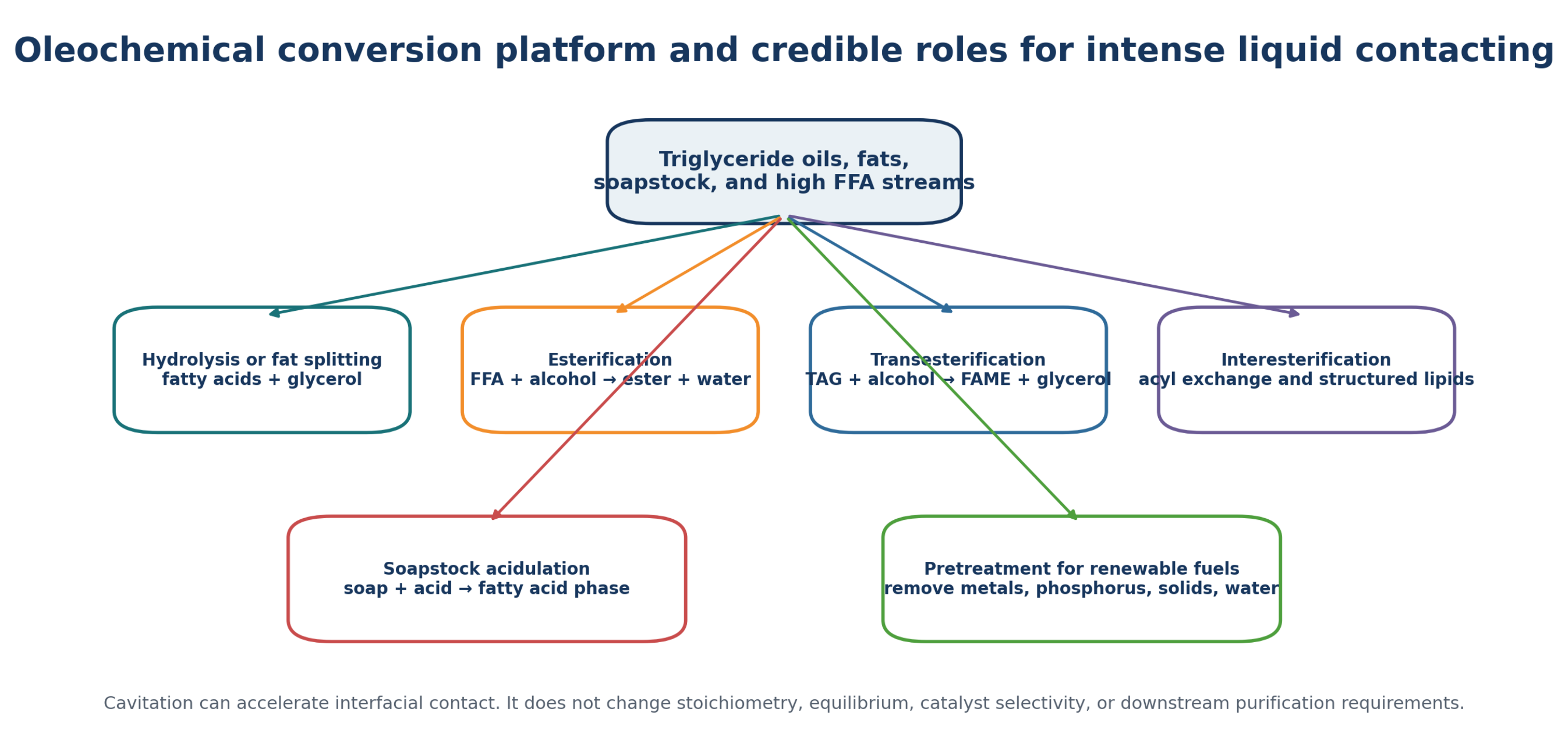
Hydrodynamic cavitation is applicable to oleochemical reactions in which immiscible phases or heterogeneous catalysts limit contact. Technology does not alter equilibrium or stoichiometry. It can shorten the time needed to approach equilibrium, reduce bulk heating demand, improve catalyst wetting, and change product distribution when mass transfer competes with reaction. More aggressive chemistry also increases the importance of corrosion, pressure containment, seal compatibility, and temperature control.
7.1 Fatty oil hydrolysis
Hydrolysis converts triacylglycerol to fatty acids and glycerol:
The reacting phases are initially poorly contacting. Cavitation can disperse water into oil, renew interfaces, and reduce external transport resistance. The product fatty acids and partial glycerides change interfacial behavior as conversion proceeds. The process must still provide the temperature, catalyst, pressure, and water ratio required by the selected hydrolysis route. Product selectivity, acid value, glycerol purity, corrosion, and energy are more informative than conversion time alone.
7.2 Esterification of high free fatty acid streams
Acid esterification is used for high free fatty acid feedstocks, fatty acid distillates, sludge oils, and soapstock derived fatty acids. The equilibrium reaction is shown in Equation 6.2. Cavitation can improve alcohol and acid catalyst contact, but water removal remains necessary. The Juera Ong, et al. sludge palm oil study illustrates the magnitude of pretreatment needed for extremely acidic material: heterogeneous and homogeneous acid routes reduced very high free fatty acid levels to about 1 percent under their respective optimized conditions [34].
7.3 Interesterification and structured lipids
Interesterification rearranges acyl groups without producing free glycerol in the same manner as conventional transesterification. Methyl acetate interesterification can be represented as:
Cavitation can improve contact among oil, acyl donor, and catalyst. In food fat processing, enzymatic interesterification changes triacylglycerol distribution, melting behavior, and solid fat content. The 2026 acoustic cavitation study reported accelerated enzymatic interesterification of fat blends and lower reaction time compared with its conventional reference, while also showing that oxidation control and enzyme protection are necessary [14]. Hydrodynamic systems should be evaluated with the same product distribution and quality measurements rather than only a viscosity or conversion endpoint.
7.4 Soapstock acidulation and fatty acid recovery
Soapstock contains soap, water, phospholipids, salts, and entrained neutral oil. Acidulation converts sodium carboxylate back to free fatty acid (Equation 7.3):
Intense contacting can distribute acid rapidly and reduce local overacidification, while the downstream process must allow fatty acid, aqueous salt, and neutral oil phases to separate. A complete balance should quantify recovered fatty acid, neutral oil, aqueous chemical oxygen demand, salt load, acid use, and emulsion stability. [19].
Table 7.1. Oleochemical pathways and cavitation design questions.
| Pathway | Primary contact limitation | Potential cavitation role | Critical acceptance measurements |
|---|---|---|---|
| Hydrolysis | Water oil interface and catalyst distribution | Fine water dispersion and boundary renewal | Acid value, glycerol purity, selectivity, energy, corrosion |
| Acid esterification | Alcohol and acid contact with free fatty acids | Rapid dispersion and shorter approach to equilibrium | Residual FFA, water, methanol recovery, catalyst removal |
| Base transesterification | Methoxide transfer into oil rich phase | Rapid reaction initiation | FAME and complete glyceride profile |
| Methyl acetate interesterification | Acyl donor contact and catalyst distribution | High interfacial area without glycerol phase | FAME, triacetin, catalyst, residual donor |
| Enzymatic interesterification | Enzyme accessibility at interface | Improved contact at controlled stress | Triacylglycerol distribution, enzyme activity, oxidation, solid fat content |
| Soapstock acidulation | Acid distribution in surfactant rich mixture | Micromixing followed by low shear separation | Fatty acid recovery, neutral oil, salt water, emulsion loss |