
Technical publication
Back to publications
Industrial applications
Vegetable Oil Refining, Biodiesel, and Oleochemical Conversion
okozyuk.com
Published
Updated
Read complete publication for whole-document Find and printing. Browser Find and native printing on this reader include only loaded content.
6 Biodiesel Production by Intensified Contacting
6.1 Reaction chemistry and phase limitation
Biodiesel is commonly produced by transesterification of triacylglycerols with methanol in the presence of a catalyst:
The overall reaction proceeds through diacylglycerol and monoacylglycerol intermediates. At the beginning, the oil rich and methanol rich phases are poorly miscible, so observed rate is strongly influenced by interfacial area. As methyl esters and partial glycerides form, phase behavior changes and intrinsic kinetics become more important. Cavitation is particularly effective during the early mass transfer controlled period [4,22-29].
High free fatty acid feed reacts with base catalyst to form soap. It is commonly dried and subjected to acid esterification before base transesterification:
Acid value is determined by titration and can be calculated as:
Water formed during esterification must be controlled because it shifts equilibrium and promotes soap formation in the later base stage. The high free fatty acid patent US 7,935,157 B2 discloses series cavitation and holding stages for reducing free fatty acid content before transesterification [23]. The broader lesson is that cavitation accelerates contacting but does not change stoichiometry or equilibrium.
Table 6.1. Feed decision logic for biodiesel pretreatment.
| Feed condition | Primary problem | Preferred preparation | Acceptance before base stage |
|---|---|---|---|
| Low FFA, dry refined oil | Initial methanol oil mass transfer | Direct base transesterification with accurate catalyst preparation | Water and FFA within validated plant limit |
| Moderate FFA | Catalyst consumption and soap | Drying plus acid esterification or controlled two stage process | Acid value reduced to validated threshold |
| High FFA waste oil or sludge oil | Severe soap formation, solids, water, oxidation | Filtration, drying, acid esterification, settling, and possible repeat stage | Low water, low solids, and FFA suitable for base conversion |
| Animal fats or high melting feed | Viscosity and crystallization | Heating, filtration, and temperature controlled contact | Stable liquid feed at reactor inlet |
| Mixed or variable waste feed | Uncertain composition and catalyst demand | Feed equalization, frequent analysis, and adaptive dosing | Stable feed envelope and traceable batch history |
6.2 Reactor arrangements
Orifice and venturi loops are common in laboratory systems. A pump circulates oil, alcohol, and catalyst through one or more active geometries for a specified number of passes. Rotor stator and shockwave power reactors create repeated low pressure events in rotating gaps and can operate continuously. Patent disclosures include single pass, parallel, series, and recirculation arrangements, as well as staged processes that remove glycerol between reaction stages [22,24,25].
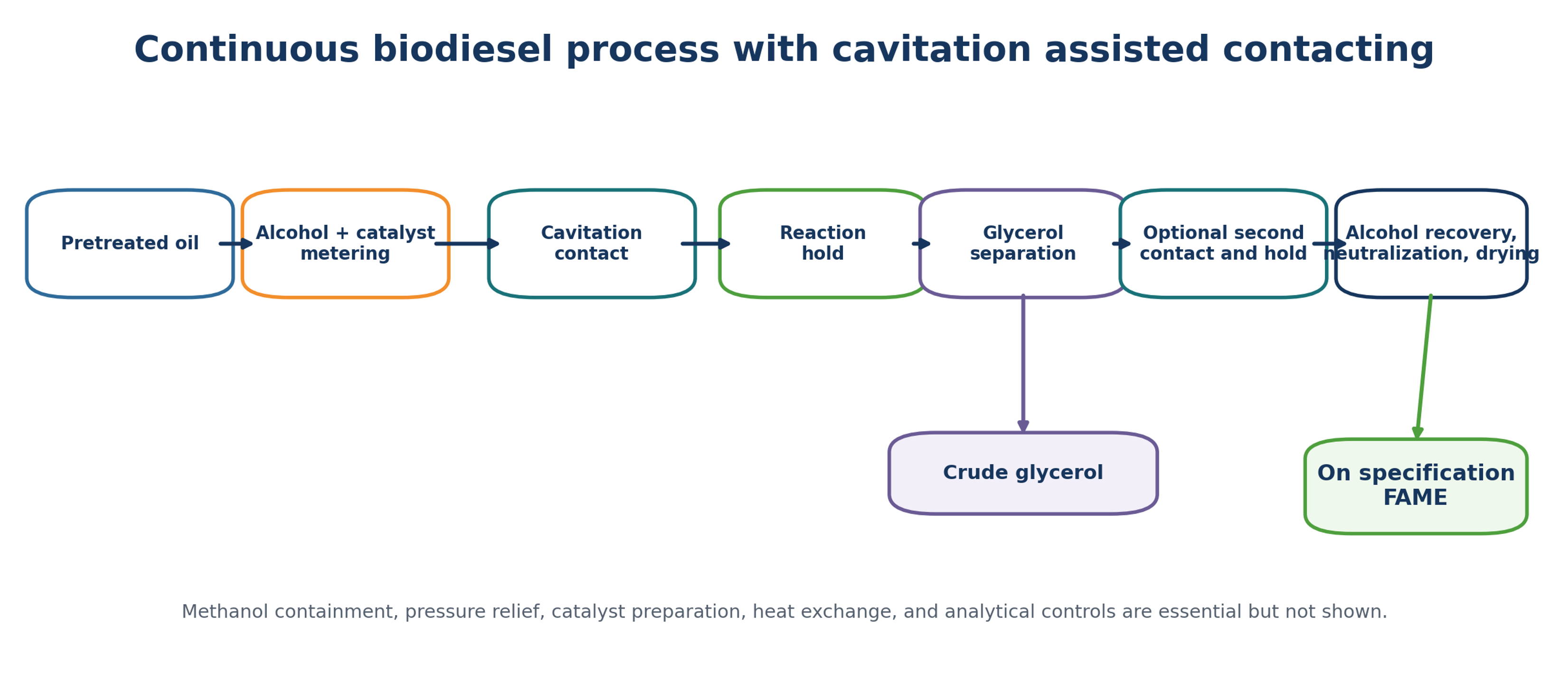
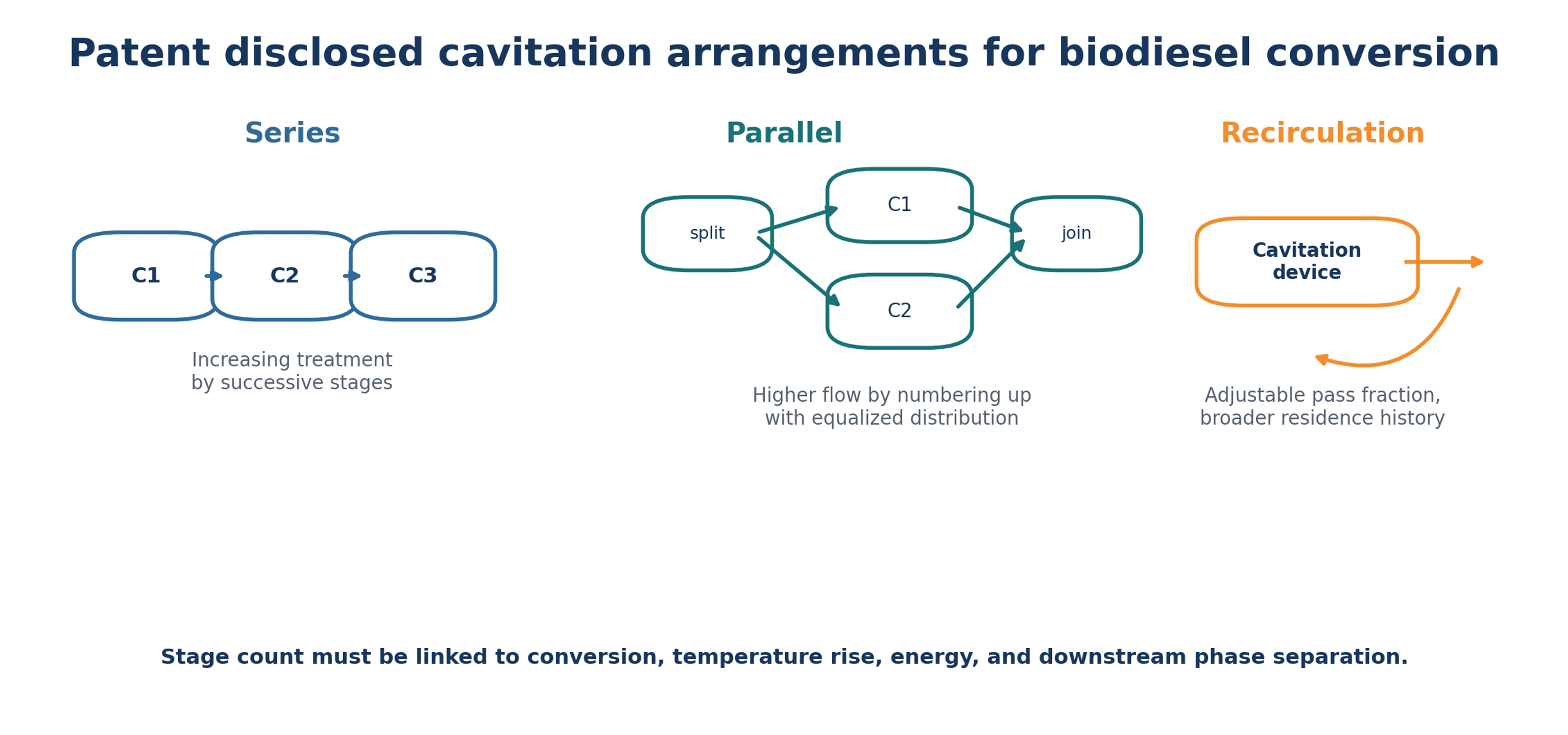
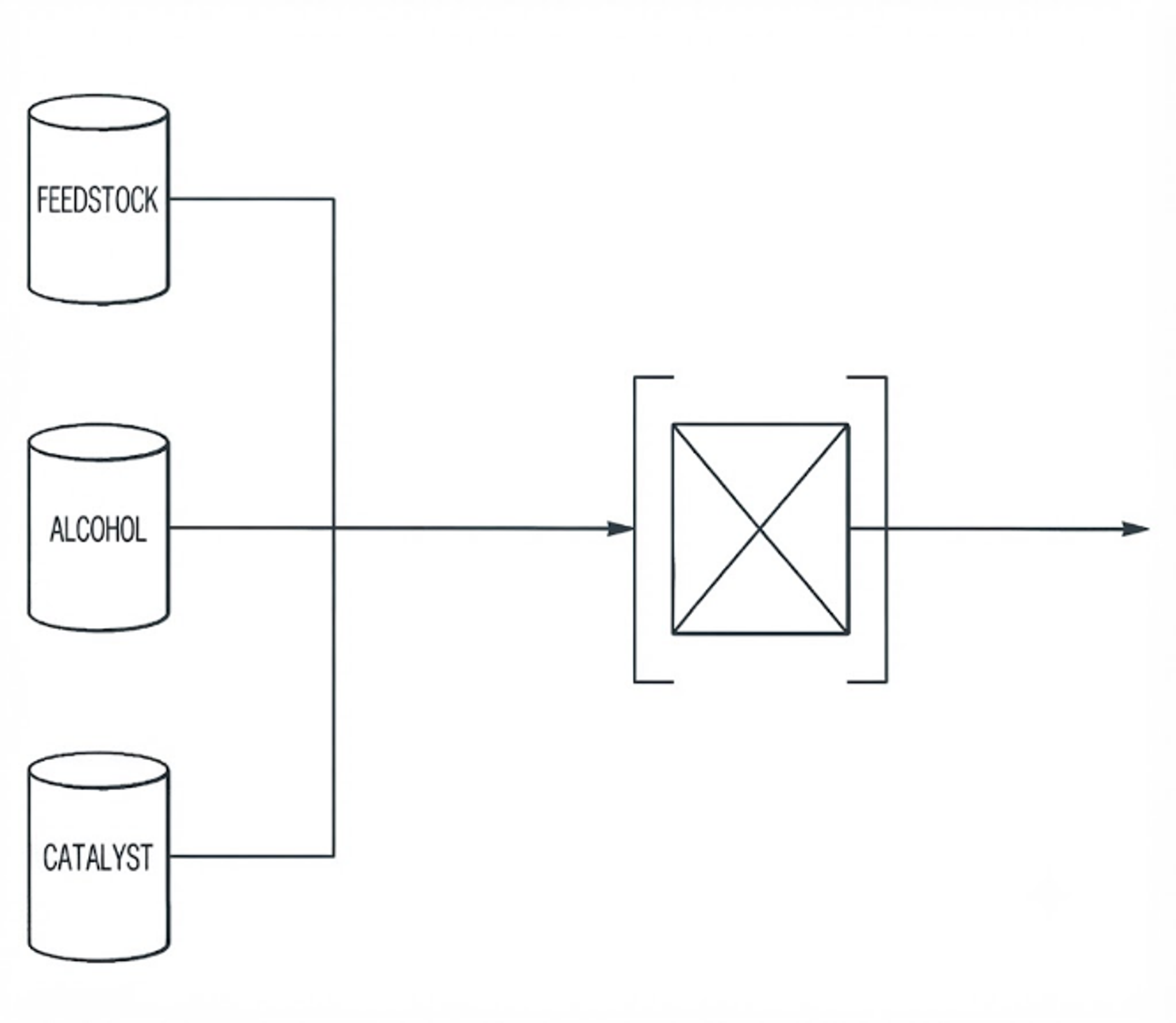
US 8,709,109 B2 discloses a pre reaction cavitation step, intermediate glycerol separation, and finishing in a pressurized reactor, with the objective of improving filterability and removing impurities with the glycerol rich stream [24]. US 9,000,244 B2 discloses a three stage system consisting of a high shear first reactor and lower shear finishing stages with separation and recycle [25]. These architectures reinforce a general principle: the high intensity contact should be brief, and slower conversion and separation should occur in equipment suited to those duties.
6.3 Published performance and proper comparison
Published outcomes must be compared carefully because yield, conversion, ester content, and product recovery are not equivalent. A reported 96 percent value can mean gas chromatographic FAME content, conversion of triacylglycerol, or gravimetric mass recovery. Feedstock, catalyst, alcohol ratio, temperature, reactor volume, pass count, and analytical method must accompany every result.
The orifice plate study by Vera Rozo and coworkers reported that a FAME criterion above 96.5 percent was reached in 17 minutes, compared with 120 minutes for the reported conventional reference [26]. The 2025 continuous shockwave power reactor study reported FAME above 96.5 percent for soybean and waste cooking oil over a matrix of rotor speed, flow, alcohol ratio, and catalyst type, with specific energy analysis included [27].
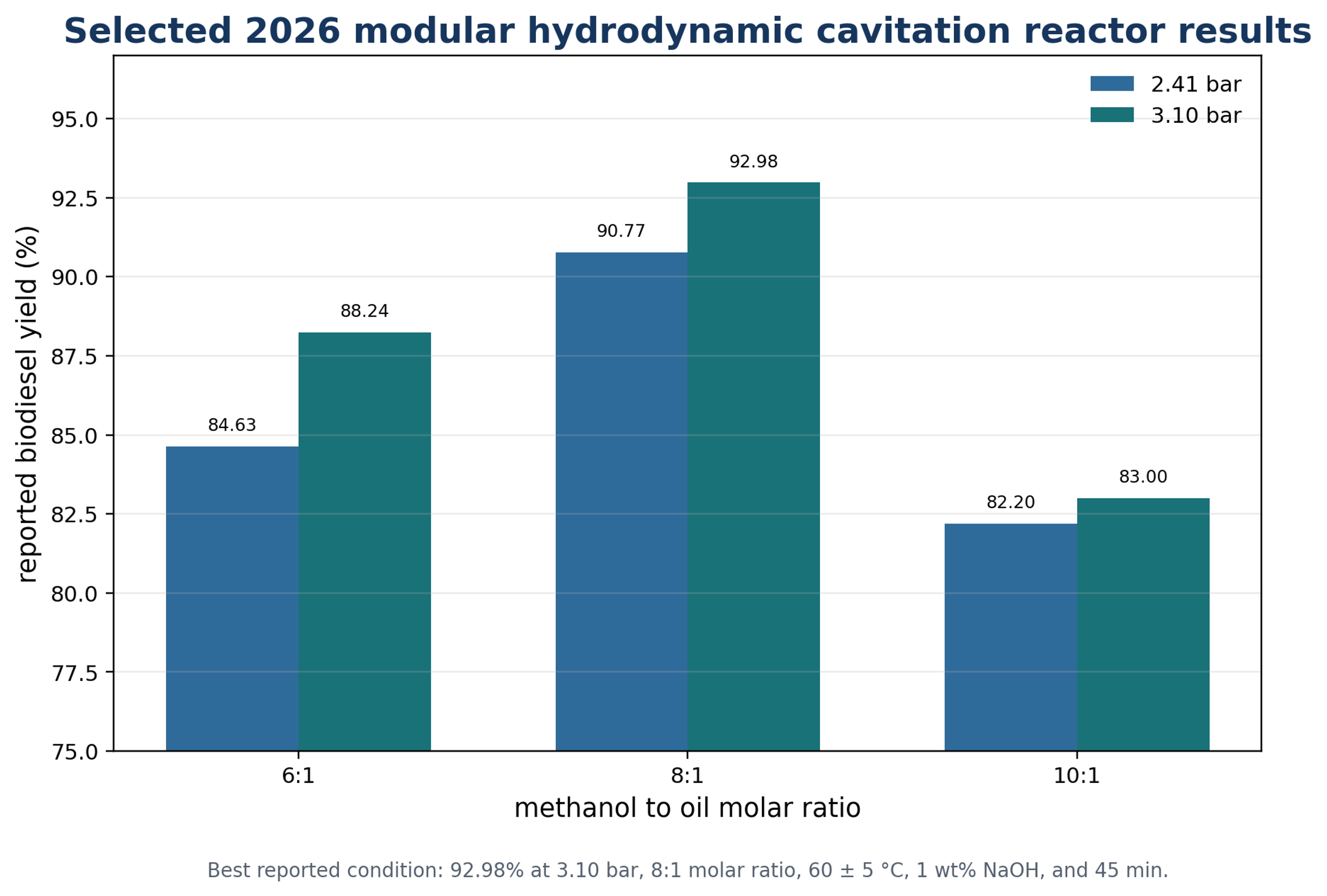
The modular reactor study by Andia Marron and coworkers reported the best biodiesel yield of 92.98 percent at 3.10 bar, an 8 to 1 methanol to oil molar ratio, 45 minutes, about 60 degrees Celsius, and 1 percent sodium hydroxide. The same study shows that increasing methanol ratio beyond the optimum did not improve yield [28].
A useful noncavitating comparator is the continuous tubular reactor with a static mixer. It reported an experimental yield of 84.97 percent at a 6 to 1 molar ratio, 0.9 percent sodium hydroxide, and 6 minutes residence time [29]. This comparison is important because process intensification can result from any geometry that creates sufficient interfacial renewal. A cavitation claim should therefore demonstrate an advantage over an optimized static or dynamic mixer, not only over a poorly mixed batch.
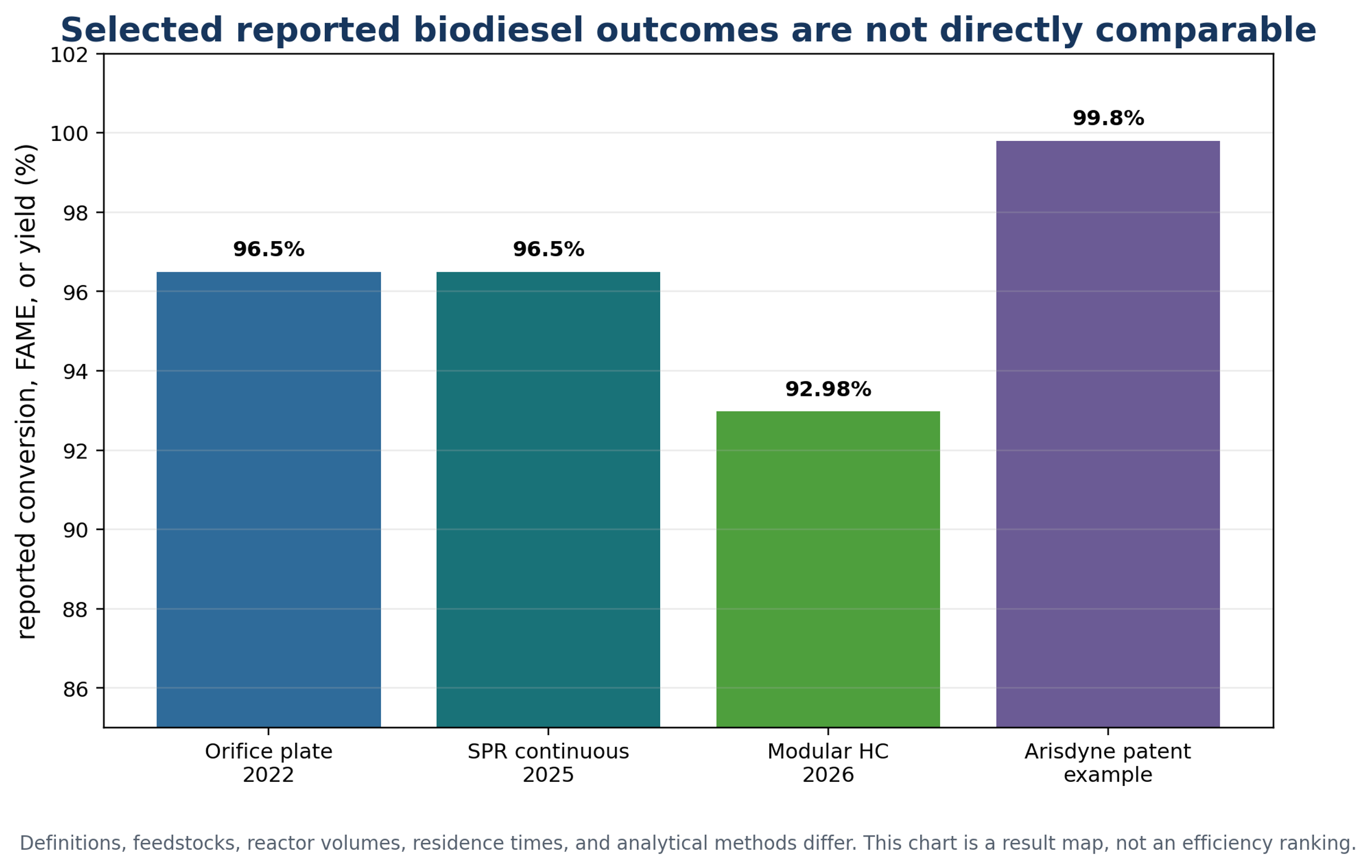
Table 6.2. Selected biodiesel studies and design implications.
| Source | Feed and reactor | Reported outcome | Design implication |
|---|---|---|---|
| US 7,754,905 B2 [22] | Oil, methanol, base, one to four controlled cavitation devices | Examples above 98 percent conversion and up to 99.8 percent in series | Pressure history and number of devices can be staged |
| Vera Rozo et al. 2022 [26] | Soybean oil, orifice plate | FAME criterion above 96.5 percent after 17 min | Compare at equal analytical method and full specification |
| Vera Rozo et al. 2025 [27] | Soybean and waste cooking oil, continuous SPR | FAME above 96.5 percent in continuous operation | Steady metering and energy normalization improve industrial relevance |
| Andia Marron et al. 2026 [28] | Soybean oil, modular cavitation reactor | Best reported yield 92.98 percent at 3.10 bar and 8 to 1 | Pressure and alcohol ratio interact and require optimization |
| Acevedo Quiroz et al. 2024 [29] | Soybean oil, continuous tubular static mixer | 84.97 percent experimental yield in 6 min | Use an optimized noncavitating comparator |
6.4 Reaction kinetics and scale interpretation
A simplified first-order representation of observed conversion is expressed as:
Temperature dependence is commonly represented by the Arrhenius equation:
For first-order approximation, the Damkohler number is:
In a mass transfer limited regime, kobs includes hydrodynamic effects and should not be interpreted as an intrinsic chemical rate constant. Increasing hydraulic intensity can increase kobs by increasing interfacial area, while the molecular kinetic constant remains unchanged. Once mass transfer is no longer limiting, further intensity increases power, heat, and wear without proportional conversion benefit.
6.5 Industrial results
The supplied biodiesel materials report an industrial comparison in which feed rate increased from about 700 to 800 lb per min, catalyst concentration decreased from 2.6 to 2.1 percent, and monoglycerides decreased from 0.59 to 0.28 percent in one comparison. A separate long term presentation reports capacity increase above 10 percent, catalyst reduction above 25 percent, and annual catalyst savings of approximately USD 0.45 to 1.35 million for a producer. These are vendor and customer reported values [19-21,30].
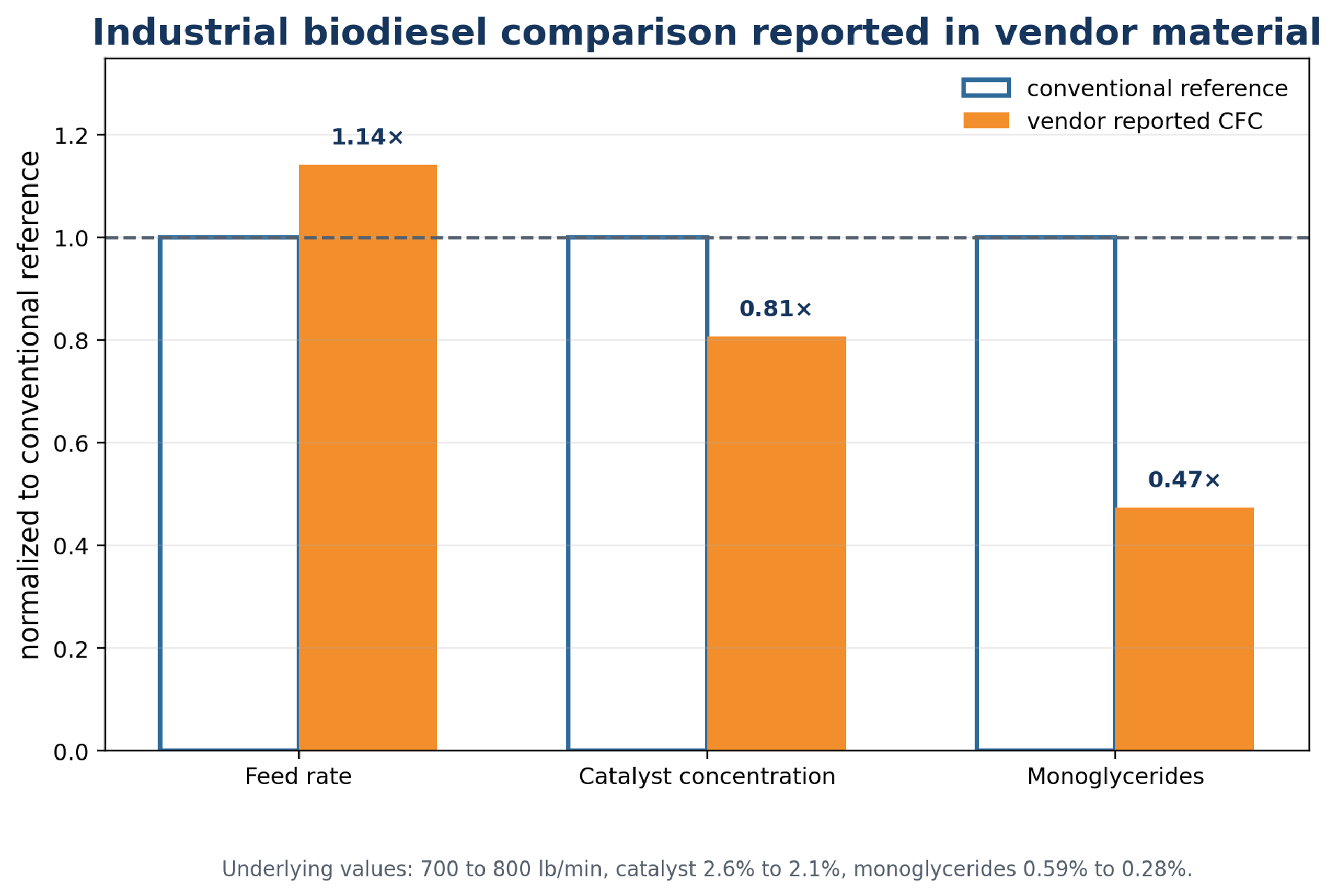
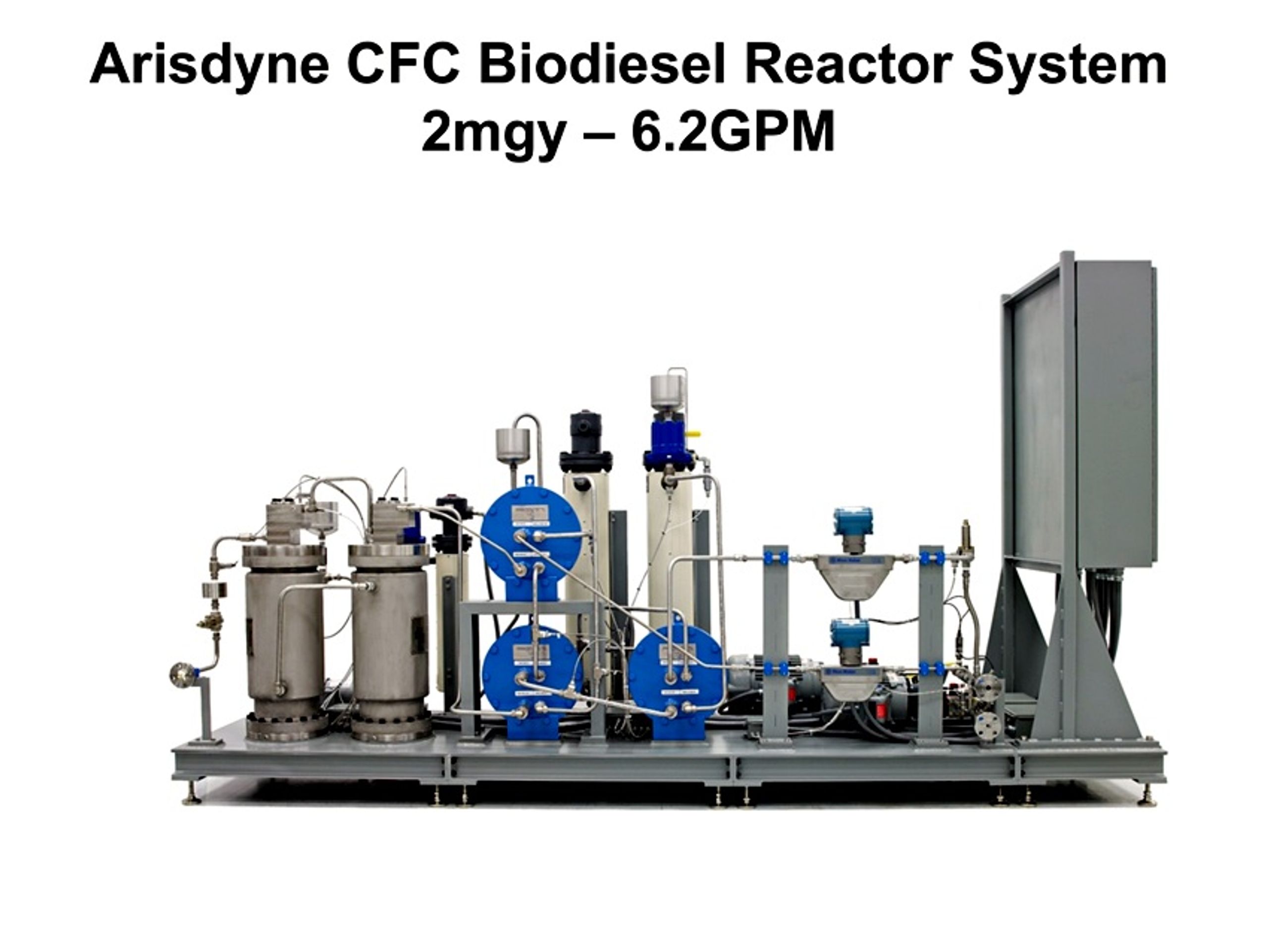
Table 6.3. Reported industrial biodiesel comparison [19,21].
| Metric | Conventional reference | CFC reported | Verification requirement |
|---|---|---|---|
| Feed rate | 700 lb/min | 800 lb/min | Mass flow calibration and steady state production |
| Catalyst concentration | 2.6 percent | 2.1 percent | Catalyst active concentration and total addition |
| Monoglycerides | 0.59 percent | 0.28 percent in one condition | Common sampling point and validated gas chromatography |
| Capacity increase | Baseline | More than 10 percent in customer feedback | Confirm that downstream recovery and purification remain within capacity |
| Annual catalyst savings | Not reported | USD 0.45 to 1.35 million | Recalculate using site catalyst price and actual production |
6.6 Product quality and standards
High apparent yield does not establish biodiesel quality. ASTM D6751 24 covers B100 blendstock grades and specifies properties including flash point, residual methanol, water and sediment, viscosity, oxidation stability, sulfur, acid number, free glycerin, total glycerin, phosphorus, and metal limits [31]. European FAME production is governed by the contractual edition of EN 14214. A 2026 edition has entered standards catalogs, while some national catalogs and existing contracts continue to reference EN 14214:2012+A2:2019. Contracts should identify the exact edition and test methods rather than state only that product meets ASTM or EN [32,33].
Sampling should begin only after the complete process reaches steady state. Hydraulic conditions can stabilize quickly, while methanol recovery, glycerol separation, wash systems, dryers, and tanks can require much longer. Every product claim should report FAME content, monoacylglycerol, diacylglycerol, triacylglycerol, free and total glycerin, residual methanol, acid number, water and sediment, viscosity, density, oxidation stability, phosphorus, sodium, potassium, calcium, magnesium, flash point, cloud point, and cold filter plugging or cold soak behavior as required by the contract [4,31-33]
Table 6.4. Biodiesel analytical program.
| Quality group | Measurements | Reason |
|---|---|---|
| Conversion | FAME, monoacylglycerol, diacylglycerol, triacylglycerol | Separates chemical conversion from mass recovery |
| Glycerol control | Free glycerin and total glycerin | Indicates both reaction and glycerol separation |
| Volatiles and water | Residual methanol, water, sediment, flash point | Safety, storage, and specification compliance |
| Catalyst and metals | Sodium, potassium, calcium, magnesium, phosphorus, soap | Engine aftertreatment, ash, and purification |
| Fuel behavior | Viscosity, density, cloud point, cold filter plugging, cold soak filtration | Operability and handling |
| Stability | Acid number, peroxide markers where used, oxidation induction period | Storage and product life |