
Technical publication
Back to publications
Industrial applications
Vegetable Oil Refining, Biodiesel, and Oleochemical Conversion
okozyuk.com
Published
Updated
Read complete publication for whole-document Find and printing. Browser Find and native printing on this reader include only loaded content.
2 Vegetable Oil Feedstocks and Conventional Refining
2.1 Composition and refining objectives
Crude oil is normally more than 90 percent triacylglycerol by mass, yet a small impurity fraction controls color, flavor, stability, processing loss, catalyst demand, wastewater load, and deodorizer performance. Hydratable phospholipids become associated with an aqueous phase after controlled water addition. Nonhydratable phospholipids often occur as calcium or magnesium salts of phosphatidic acid and related compounds and require acid, chelation, electrolyte treatment, or enzymatic conversion before they can be removed effectively [2,3,11,12].
Free fatty acids are removed by alkali neutralization or by steam stripping during physical refining. Alkali neutralization produces soap, which acts as both the desired heavy phase carrier and an emulsifier that can entrain neutral oil. Metals such as iron, copper, calcium, and magnesium influence oxidation, gum chemistry, bleaching, and downstream catalyst behavior. Waxes and high melting components determine haze and cold stability. Water, suspended solids, and entrained gas influence viscosity, nucleation, pressure loss, and separation. A cavitation design basis must therefore use measured feed properties at operating temperature rather than a nominal oil name.
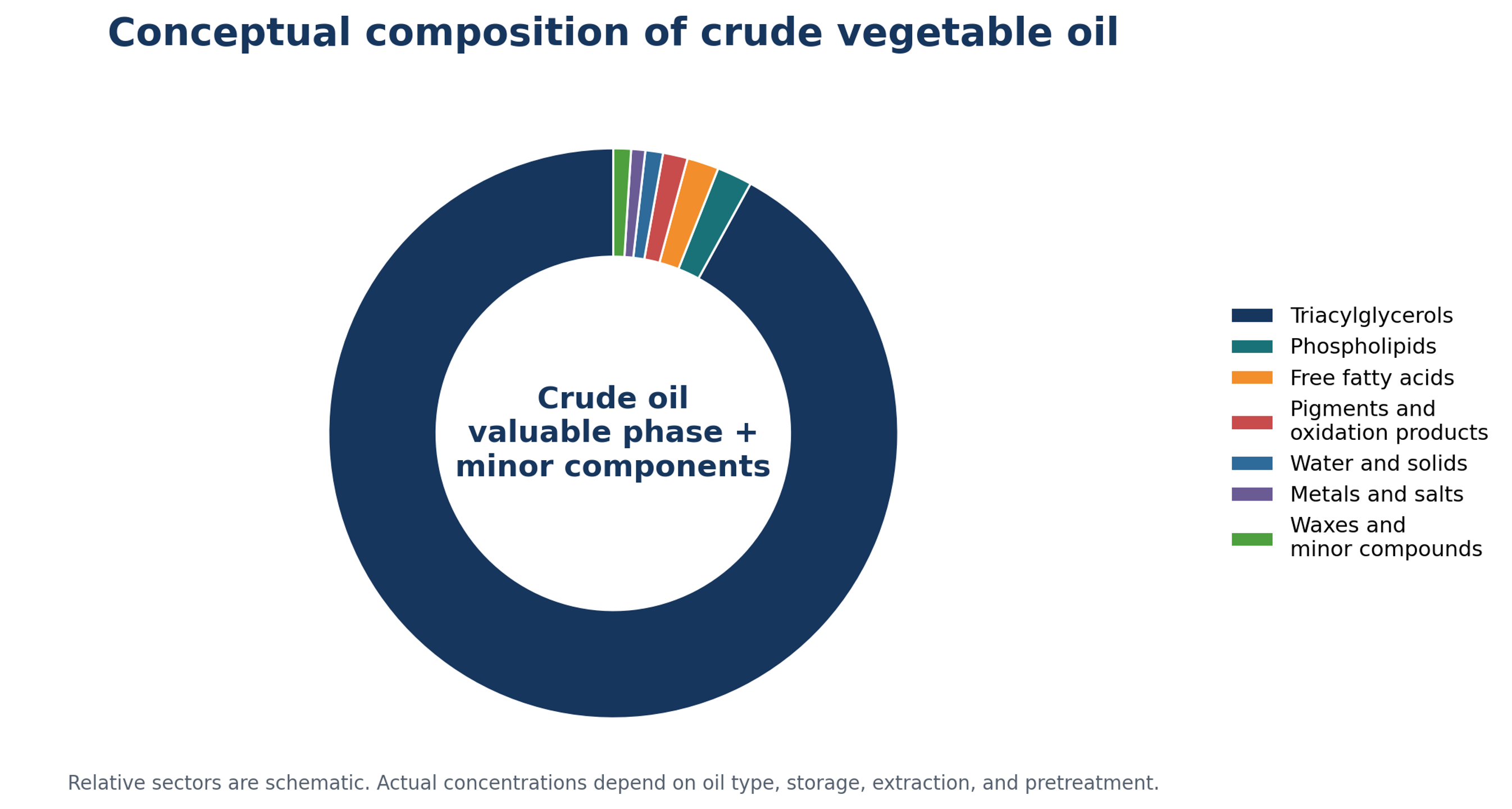
Table 2.1. Major crude oil constituents, refining consequences, and relevance to cavitation assisted contacting.
| Constituent | Process consequence | Refining objective | Cavitation relevance |
|---|---|---|---|
| Triacylglycerols | Primary valuable product | Maximize recovery and avoid hydrolysis or saponification | Excessive shear, heat, oxygen, or caustic contact can reduce yield or stability |
| Hydratable phospholipids | Form gums after water contact | Hydrate and create a separable heavy phase | Fine water dispersion accelerates contact, followed by coalescence and floc growth |
| Nonhydratable phospholipids | Associated with calcium, magnesium, and acidic phospholipids | Convert to hydratable or extractable forms | Small acid dose requires rapid and uniform distribution |
| Free fatty acids | Increase refining loss and acid value | Neutralize selectively or remove by physical refining | Micromixing can reduce caustic excess, while overcontact can saponify neutral oil |
| Soaps and partial glycerides | Strong interfacial stabilizers | Remove without entraining oil | Create the emulsion paradox and constrain useful dose |
| Trace metals | Promote oxidation and poison catalysts | Transfer to water, gums, or adsorbent | Acid contact and adsorbent dispersion can improve removal |
| Pigments and oxidation products | Color, flavor, and stability defects | Adsorb during bleaching or strip during deodorization | Adsorbent wetting may improve, but oxidation must be monitored |
| Water, gas, and solids | Hydrolysis, fouling, unstable flow, and nucleation changes | Control before each stage | Strongly influence pressure field, plugging, and cavitation onset |
| Waxes and high melting compounds | Haze and poor cold behavior | Crystallize and filter | Excessive shear can fragment crystals and reduce filterability |
2.2 Feedstock variability
Soybean oil is a common degumming feed because it can contain substantial phospholipid concentrations. Rapeseed and canola oils have different phospholipid and sulfur containing minor components. Sunflower and corn oils may require careful wax and color control. Rice bran oil can develop high free fatty acid content rapidly after milling if lipase is not inactivated. Palm oil normally contains less phospholipid than soybean oil but may contain high free fatty acids, moisture, metals, and thermal history effects. Castor oil has much higher viscosity because of hydroxylated fatty acids. Used cooking oil contains water, food particles, oxidation products, polymers, free fatty acids, and highly variable contaminant loads [2-4].
The same device setting can therefore produce different pressure drop, cavitation intensity, droplet size, and heat rise in different oils. A design that operates stably in warm soybean oil can plug or fail to cavitate in a colder, more viscous feed. Alcohol addition changes vapor pressure and compressibility. Water and suspended particles change the nuclei population. Scale up should preserve a product response rather than assume that a fixed pressure drop is universally transferable.
Table 2.2. Minimum feed characterization for design and acceptance testing.
| Property | Reason for measurement | Recommended reporting basis |
|---|---|---|
| Density and viscosity | Determine velocity, Reynolds number, pressure loss, pumping, and separation | Measured at each operating temperature |
| Vapor pressure or boiling tendency | Affects cavitation onset and alcohol flashing | Estimated or measured for actual mixture |
| Water and entrained gas | Influence nuclei, hydrolysis, pressure stability, and phase volume | Mass fraction plus sampling method |
| Free fatty acids or acid value | Determines caustic or esterification demand | Mass fraction and mg KOH per g |
| Phosphorus, calcium, magnesium, and iron | Define gum chemistry and pretreatment demand | mg per kg with analytical uncertainty |
| Soap and partial glycerides | Control emulsion stability and separator loading | mg per kg or mass fraction at defined sample point |
| Suspended solids and waxes | Affect plugging, erosion, and filtration | Particle loading and size distribution |
| Oxidation state | Provides baseline for quality protection | Peroxide value, p anisidine value, induction period, and conjugated dienes |
2.3 Conventional process train and realistic boundaries
A conventional chemical refining train includes heating and conditioning, water or acid degumming, centrifugal separation, caustic neutralization, one or more water washes, vacuum drying, bleaching, filtration, and deodorization. Physical refining removes free fatty acids in the deodorizer but requires very low phosphorus, metals, soap, and moisture upstream. Hydrodynamic cavitation is most credible in liquid liquid contacting, reaction initiation, and selected solid dispersion duties. It does not replace centrifugation, vacuum drying, filtration, deodorization, alcohol recovery, or final product testing.
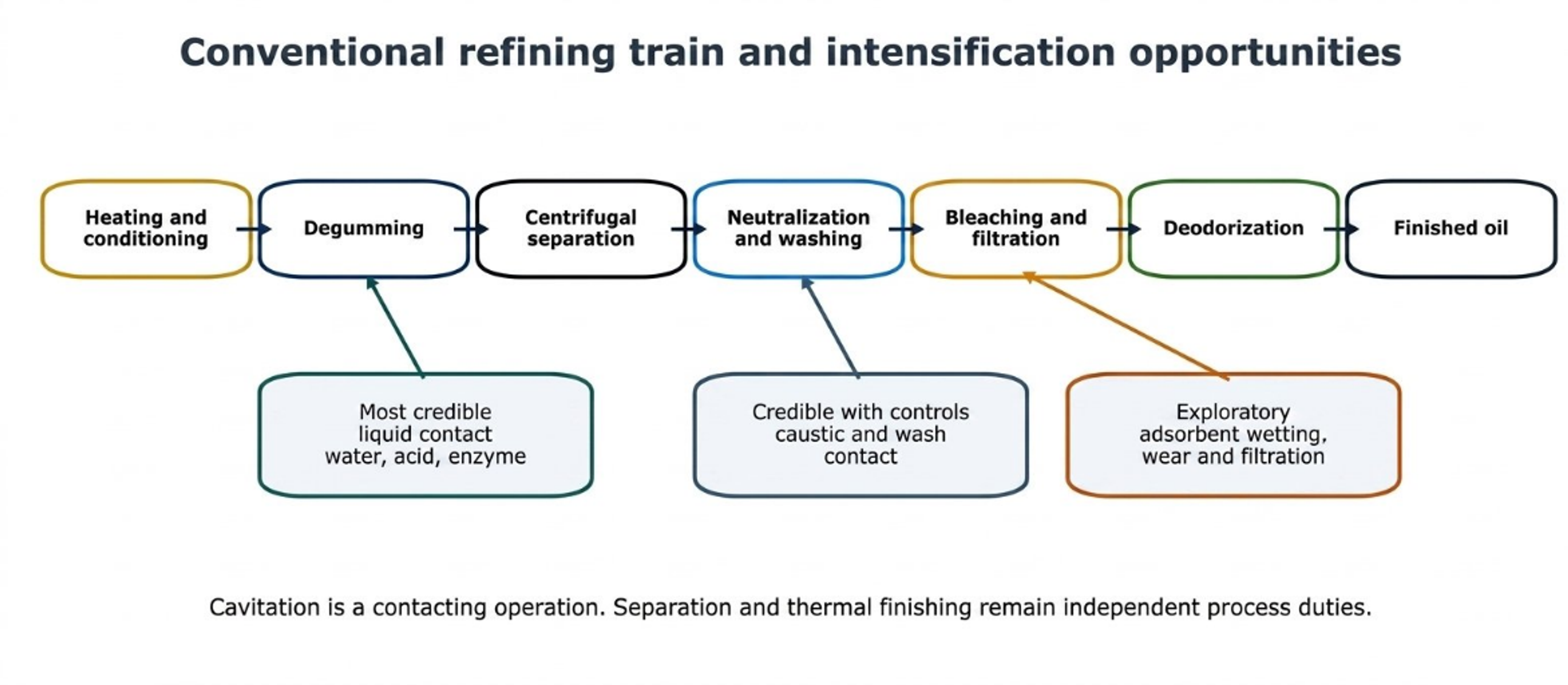
The integration point must be chosen from the downstream requirement. A device placed immediately before a centrifuge can create droplets too small to separate within the available residence time. A device placed before an acid hold can improve conversion while allowing later aggregation. A separate mild water contacting stage can provide hydration without reapplying the full acid contact dose. The plant should therefore be designed backward from the required separator inlet condition.