
Technical publication
Back to publications
Industrial applications
Vegetable Oil Refining, Biodiesel, and Oleochemical Conversion
okozyuk.com
Published
Updated
Read complete publication for whole-document Find and printing. Browser Find and native printing on this reader include only loaded content.
1 Introduction
This article applies standard hydraulic definitions, energy boundaries, residence time expressions, uncertainty requirements, and scale translation principles to vegetable oil refining, biodiesel production, and oleochemical conversion. The analysis develops the transport mechanisms, hydraulic models, process integration criteria, analytical requirements, and acceptance limits needed to evaluate hydrodynamic cavitation as an intensification technology for these applications.
Vegetable oils and fats are valuable mixtures whose dominant components are triacylglycerols, but whose processing behavior is governed by much smaller concentrations of phospholipids, free fatty acids, soaps, water, metals, pigments, oxidation products, waxes, partial glycerides, and suspended solids. Refining must remove selected impurities while retaining neutral oil, tocopherols, sterols, and other desirable minor components. Biodiesel production has a related objective: convert acyl groups to fatty acid alkyl esters while controlling glycerol, alcohol, catalyst, soap, metals, water, oxidation stability, and cold flow behavior. Oleochemical conversion expands the same chemistry to hydrolysis, esterification, interesterification, structured lipids, fatty acids, soaps, and glycerol based coproducts [1-4].
The recurring engineering difficulty is phase contact. Water must reach hydratable phospholipids. Acid must reach calcium and magnesium associated phospholipids. Caustic must contact free fatty acids without remaining in concentrated droplets long enough to saponify neutral oil. Enzymes must reach an oil water interface without being thermally or mechanically deactivated. Methanol and catalyst must contact triacylglycerols even though the initial oil rich and alcohol rich phases are poorly miscible. In each case, intrinsic chemistry can be faster than the transport of material to the interface [1-3,5].
Hydrodynamic cavitation is produced when liquid velocity and local pressure are manipulated so that vapor and gas cavities form, grow, and subsequently collapse as pressure recovers. The useful process effects include droplet breakup, boundary layer renewal, pressure pulses, localized liquid jets, intense velocity gradients, deagglomeration, and bulk hydraulic energy dissipation. These effects can reduce contact time and reagent overdosage, but they can also create persistent emulsions, heat, oxidation, erosion, plugging, vibration, and unwanted cavitation in the pump. Process benefit therefore exists only inside a defined operating window [1,5-9].
Technology should be evaluated as one operation within a sequence of metering, contact, hold, phase transformation, and separation. An inline cavitation device cannot compensate for inaccurate reagent concentration, unstable feed flow, insufficient chemical residence time, an overloaded centrifuge, or poor sampling. Conversely, a well-integrated contactor can remove a mixing bottleneck that otherwise forces a plant to use excessive acid, caustic, water, enzyme, catalyst, alcohol, adsorbent, or residence volume.
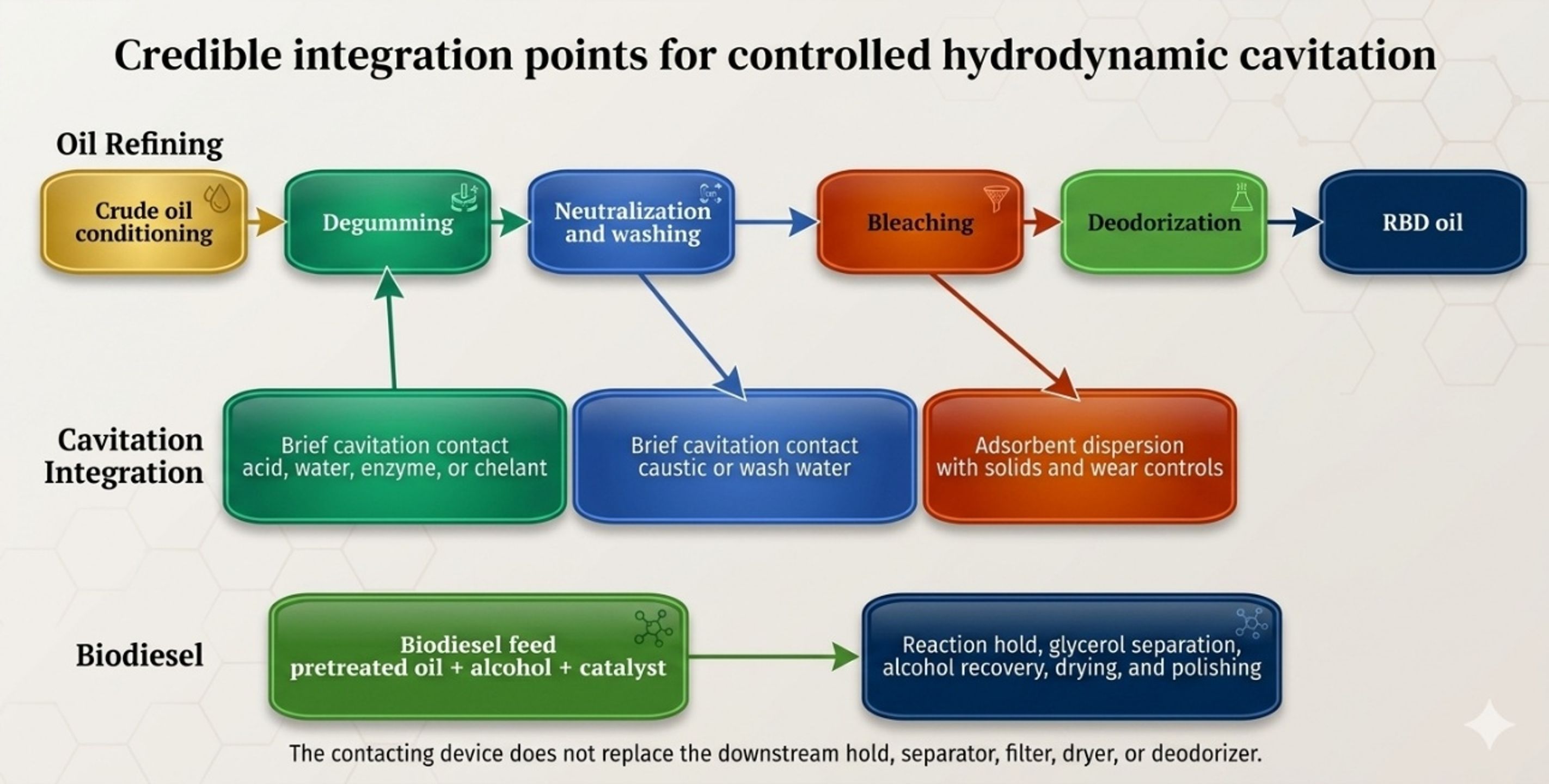
This article addresses five engineering questions. First, which transport or reaction limitation is the device intended to remove? Second, which hydraulic variables create and control the low pressure region? Third, how does the dispersion evolve during the downstream hold? Fourth, which measurements demonstrate a net improvement in product quality and yield? Fifth, do recoverable savings in product, chemicals, water, residence time, and capacity exceed the associated energy, maintenance, and capital costs?