
Technical publication
Back to publications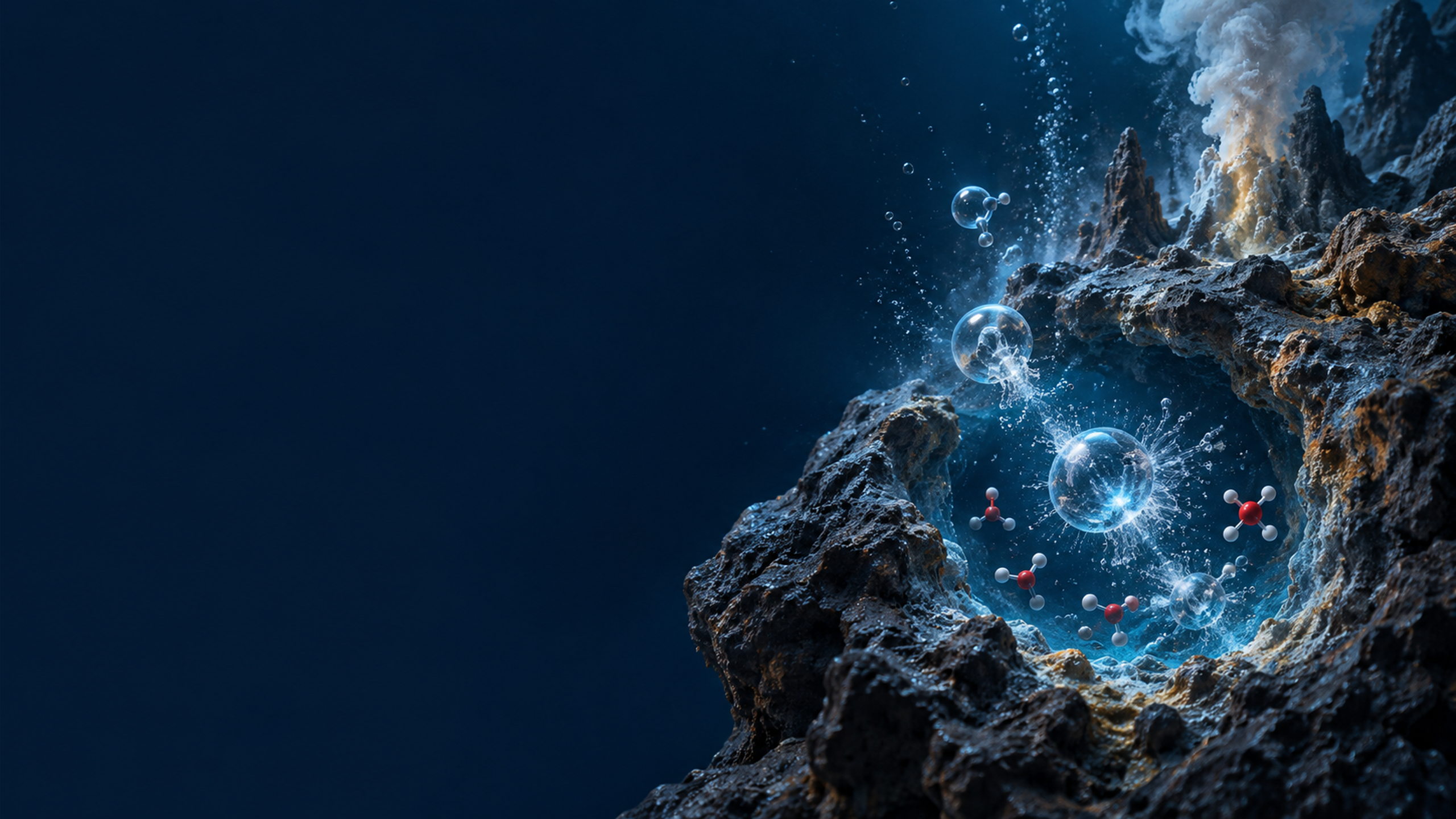
Reactors & equipment
The Rise of Life on Earth: Cavitation in Nature
okozyuk.com
Published
Read complete publication for whole-document Find and printing. Browser Find and native printing on this reader include only loaded content.
Abstract
The phenomenon of cavitation has been known in science and technology for more than a hundred years. It was first recognized as an important hydrodynamic phenomenon in connection with high speed marine propulsion, including early observations associated with British destroyers in the late nineteenth century. Osborne Reynolds and later researchers helped establish cavitation as a serious problem in ship propellers, pumps, and turbines [1,2].
Connection with the Miller–Urey Experiment
The Miller–Urey experiment is one of the classic studies in origin of life research. In 1952, Stanley Miller performed an experiment in which water, methane, ammonia, and hydrogen were exposed to electrical discharges intended to simulate lightning in a possible early Earth atmosphere. The experiment produced amino acids and other organic compounds from simple inorganic precursors [3].
The importance of the Miller–Urey experiment was not that it recreated the exact origin of life. Rather, it showed that biologically relevant organic molecules could form naturally when simple gases were supplied with energy [3].
Cavitation offers a natural parallel. In the Miller–Urey experiment, the energy source was an electrical discharge. In cavitation, the energy source is the violent collapse of a bubble. Both processes involve simple molecules, water, and intense localized energy.
During cavitation collapse, microscale electrical and thermal effects may occur, along with radical formation and molecular fragmentation. These conditions could promote reactions among water vapor, methane, carbon oxides, nitrogen compounds, hydrogen, and other gases. In this sense, a cavitation bubble can be imagined as a miniature, naturally occurring Miller–Urey type reactor [7,8].