
Technical publication
Back to publications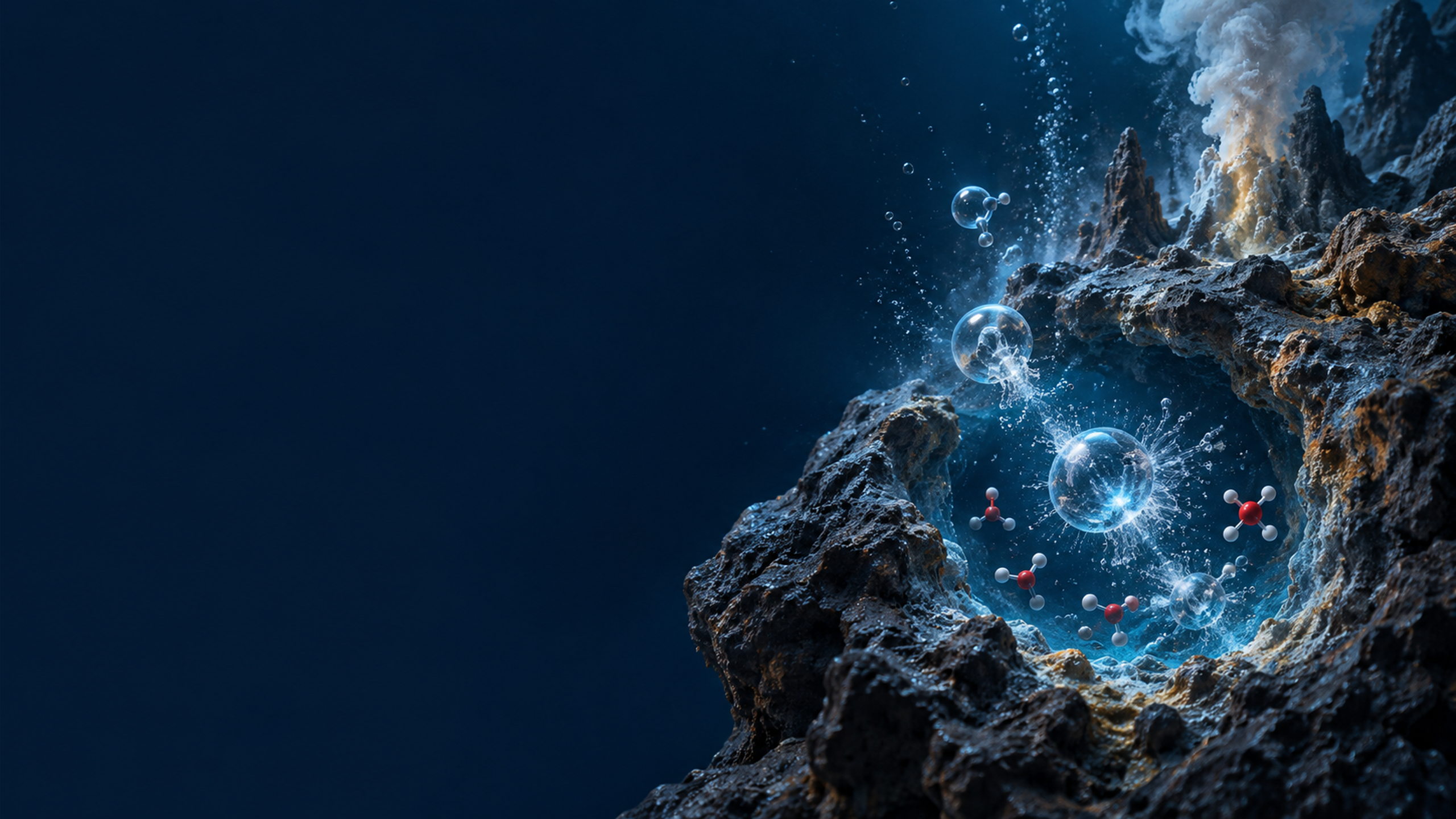
Reactors & equipment
The Rise of Life on Earth: Cavitation in Nature
okozyuk.com
Published
Read complete publication for whole-document Find and printing. Browser Find and native printing on this reader include only loaded content.
Abstract
The phenomenon of cavitation has been known in science and technology for more than a hundred years. It was first recognized as an important hydrodynamic phenomenon in connection with high speed marine propulsion, including early observations associated with British destroyers in the late nineteenth century. Osborne Reynolds and later researchers helped establish cavitation as a serious problem in ship propellers, pumps, and turbines [1,2].
Cavitation as a Prebiotic Microreactor
The origin of life required a transition from simple inorganic molecules to more complex organic compounds. These compounds include amino acids, nucleobases, sugars, lipids, and other molecular building blocks of living systems. Such transformations require energy.
Several possible energy sources have been proposed for prebiotic chemistry: lightning, ultraviolet radiation, geothermal heat, hydrothermal vents, meteorite impacts, mineral catalysis, and redox gradients. Cavitation may be added to this list as another natural energy source [7,8].
Each collapsing cavitation bubble could act as a microscopic chemical reactor. The bubble forms, captures vapor and dissolved gases, collapses, and creates a short lived zone of high temperature, high pressure, shock waves, radical chemistry, and possibly micro electrical discharge. Most bubbles would produce nothing significant. But over geological time, the number of such events would be enormous.
The question is therefore not whether one special bubble created life. A better question is whether repeated cavitation events could have contributed to the chemical inventory from which life eventually emerged.